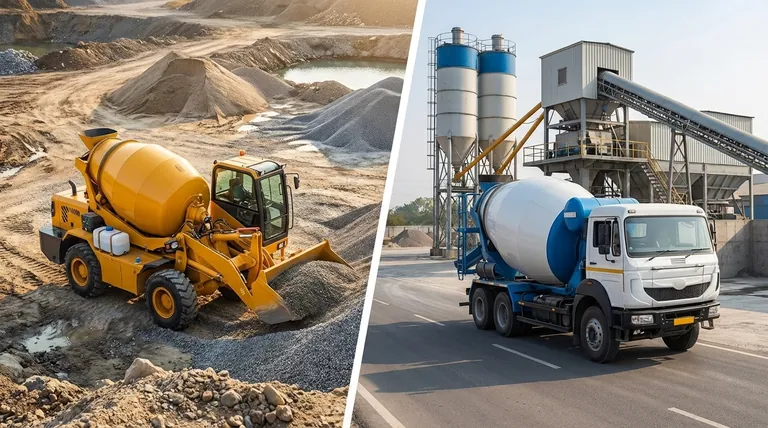
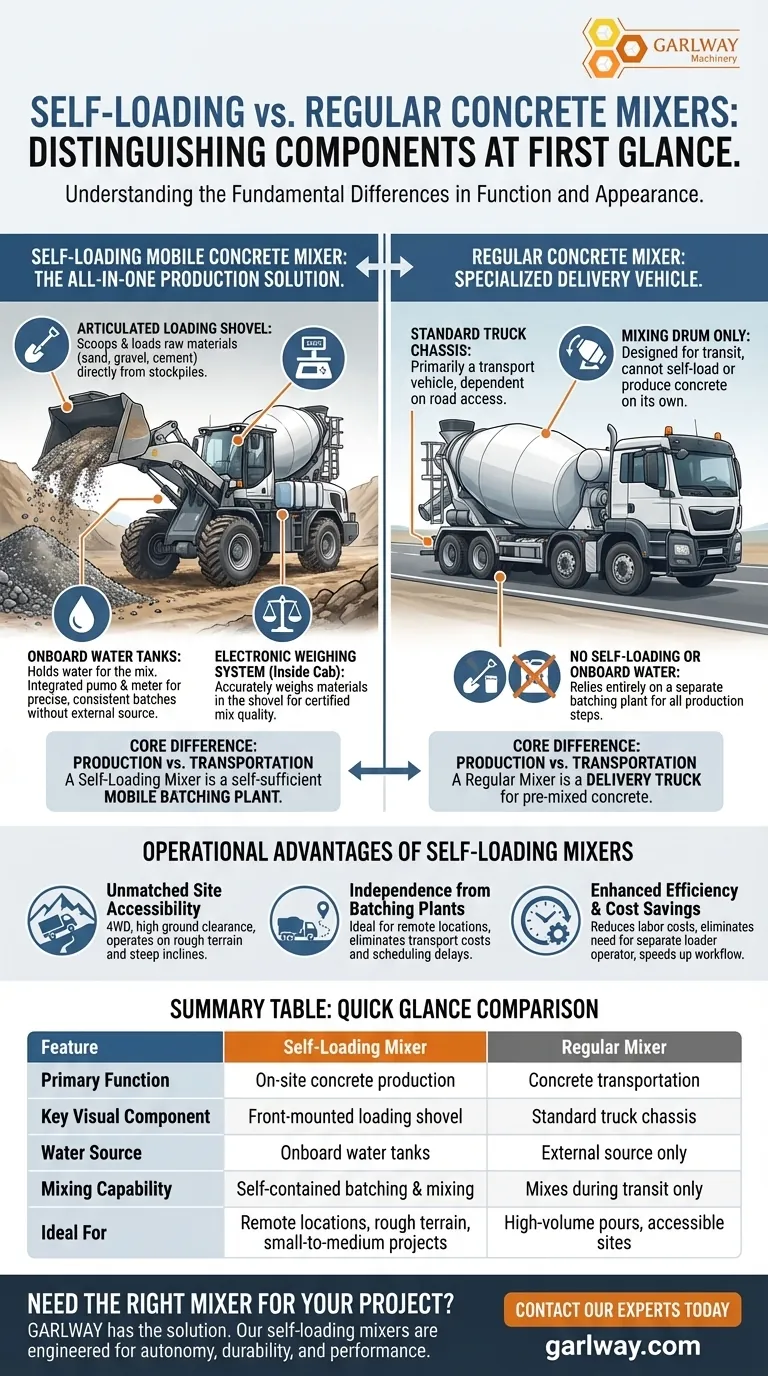
At first glance, a self-loading mobile concrete mixer is distinguished from a regular mixer by three key components: a prominent front-mounted loading shovel for aggregates, visible onboard water tanks, and a sophisticated operator's cab housing an electronic weighing system. These features are entirely absent on a standard mixer truck, which is essentially just a transport vehicle with a rotating drum.
The fundamental difference is not just in appearance, but in function. A self-loading mixer is a self-sufficient, mobile batching plant, while a regular mixer is simply a delivery truck for pre-mixed concrete.
The Core Difference: Production vs. Transportation
Understanding the role of each machine is key to recognizing why they are built so differently. Their components are a direct reflection of their intended purpose on a job site.
The Self-Loading Mixer: An All-in-One Solution
A self-loading mixer is designed for total autonomy. It performs the entire concrete production cycle on its own.
This machine can drive to a stockpile of sand and gravel, use its shovel to load the raw materials, weigh them for accuracy, introduce water from its own tanks, and mix the concrete in its drum—all on-site.
The Regular Mixer: A Specialized Delivery Vehicle
A regular mixer truck has only one primary function: to transport ready-mixed concrete from a central batching plant to a job site.
It arrives pre-loaded and cannot produce concrete on its own. Its existence depends entirely on a separate, stationary plant to do the weighing, loading, and mixing.
A Closer Look at the Distinguishing Components
The functional differences manifest as distinct, visible hardware that makes the self-loading mixer easy to identify.
The Articulated Loading Shovel
This is the most obvious visual identifier. The front of the machine is equipped with a hydraulic, articulated shovel, much like a front-end loader.
Its sole purpose is to scoop aggregates (sand, gravel) and cement directly from stockpiles and load them into the mixing drum.
Onboard Water Tanks
Typically mounted on the sides of the machine, these tanks hold the water required for the concrete mix.
An integrated water pump and meter allow the operator to add a precise, pre-calculated amount of water, ensuring consistent batch quality without needing an external water source.
The Electronic Weighing System
While the hardware is inside the cab, this system is central to the machine's function. It allows the operator to accurately weigh all raw materials as they are loaded into the shovel before being deposited into the drum.
This precision is critical for producing concrete that meets specific strength and quality standards.
Understanding the Operational Advantages
These unique components give the self-loading mixer significant advantages in specific scenarios, particularly where traditional methods fall short.
Unmatched Site Accessibility
Self-loading mixers are typically built with four-wheel drive, high ground clearance, and an optimized center of gravity.
This allows them to operate effectively on rough terrain, uneven surfaces, and even steep inclines up to 30 degrees, reaching parts of a site that a standard road-based mixer cannot.
Independence from Batching Plants
Their self-sufficiency makes them invaluable for projects in remote locations where ready-mix concrete is unavailable or prohibitively expensive to transport.
By bringing the production capability to the site, they eliminate the logistical challenge of sourcing concrete from a distant plant.
Enhanced Efficiency and Cost Savings
For projects with tight schedules or intermittent concrete needs, this machine eliminates travel time to and from a plant.
It also reduces labor costs by removing the need for a separate loader operator, leading to a more streamlined and cost-effective workflow on site.
Common Pitfalls to Avoid
While versatile, the self-loading mixer is not a universal replacement for traditional methods. Understanding its limitations is crucial for proper application.
Assuming Unlimited Volume
A self-loading mixer's batch size and production rate are significantly lower than that of a large, dedicated batching plant. It is not suited for high-volume, continuous pours like large foundations.
Overlooking Quality Control
With on-site mixing, the responsibility for mix consistency falls entirely on the machine's operator. This requires a skilled operator and diligent oversight, unlike centralized plant batching where quality control is more standardized.
Ignoring Maintenance Complexity
The self-loading mixer is a more complex machine, integrating hydraulics, weighing electronics, and water systems. It requires a more rigorous and specialized maintenance schedule than a simple transit mixer.
Making the Right Choice for Your Project
Choosing between these machines depends entirely on the logistics, location, and scale of your work.
- If your primary focus is large-scale, high-volume pours in an accessible area: A fleet of regular mixers supplied by a central batching plant remains the most efficient option.
- If your primary focus is projects in remote or difficult-to-access locations: The self-loading mixer's autonomy and all-terrain capability are indispensable.
- If your primary focus is cost control and flexibility on small-to-medium jobs: A self-loading mixer's ability to produce concrete on-demand minimizes waste and transport costs.
Ultimately, identifying these machines is about recognizing the right tool for the specific demands of the job.
Summary Table:
| Feature | Self-Loading Mixer | Regular Mixer |
|---|---|---|
| Primary Function | On-site concrete production | Concrete transportation |
| Key Visual Component | Front-mounted loading shovel | Standard truck chassis |
| Water Source | Onboard water tanks | External source only |
| Mixing Capability | Self-contained batching & mixing | Mixes during transit only |
| Ideal For | Remote locations, rough terrain, small-to-medium projects | High-volume pours, accessible sites |
Need the Right Mixer for Your Project's Demands?
Whether you're tackling a remote site or need flexible, on-demand concrete production, GARLWAY has the solution. Our self-loading mobile concrete mixers are engineered for autonomy, durability, and performance in challenging conditions.
GARLWAY specializes in providing construction machinery—including winches, concrete mixers, and batching plants—to construction companies and contractors worldwide. Let us help you determine if a self-loading mixer is the right tool to increase your efficiency and reduce costs.
Contact our experts today for a personalized consultation and discover the GARLWAY advantage.
Visual Guide
Related Products
- Skid Steer Self Loading Concrete Mixers for Construction
- Belle Mixer Drum Self Loading Mortar Mixers JS3000
- Portable Cement Mixer with Lift Concrete Machine
- Portable Concrete Mixer Machine Equipment for Mixing Concrete
- JW1000 Mobile Cement Mixer Concrete Mixer Truck and Batching Plant
People Also Ask
- How does the control system improve production efficiency in a self loading concrete mixer? Automate Mixing for Speed & Quality
- What is the purpose of keeping the drum rotating during transportation in a self loading concrete mixer? Ensure Quality & Consistency
- How does the weighing process work in a self loading concrete mixer? Achieve Precise, On-Site Concrete Batching
- What components are involved in the loading process of a self loading concrete mixer? A Guide to the Key Systems
- How should materials be loaded into a self-loading concrete mixer? Master the Step-by-Step Process