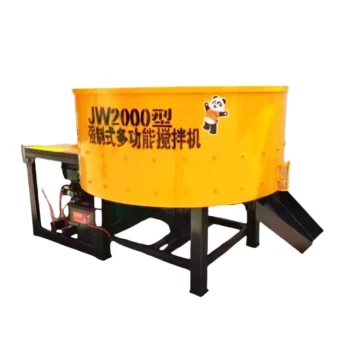
Beyond just mixing materials, a cement mixer fundamentally improves project outcomes by boosting efficiency, ensuring quality control, reducing costs, and enhancing worker safety. It transforms a labor-intensive, variable task into a consistent and predictable process directly on your construction site.
The core value of a cement mixer is control. It shifts concrete production from a logistical dependency on external suppliers to a flexible, on-demand capability, directly impacting your project's timeline, budget, and quality.
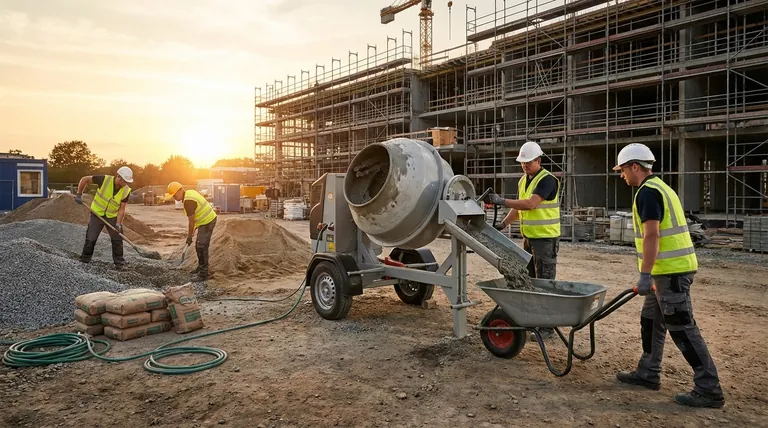
The Strategic Impact on Project Efficiency
A mixer’s primary benefit is its ability to accelerate the entire construction process. This goes beyond simply mixing faster; it creates systemic efficiencies.
Accelerating Timelines
With an on-site mixer, concrete is ready precisely when you need it. This eliminates the downtime spent waiting for ready-mix deliveries or the slow pace of manual mixing, ensuring tasks are completed within their scheduled time.
Reducing Labor Intensity
Manually mixing concrete is physically demanding and slow. A mixer automates this strenuous task, freeing up your team to focus on more skilled work like forming, pouring, and finishing.
Gaining Logistical Independence
Owning a mixer removes your dependency on ready-mix companies. You are no longer constrained by their delivery schedules, minimum order requirements, or service areas, giving you complete flexibility to work whenever and wherever you need.
Enhancing Quality and Consistency
The structural integrity of a project depends on the quality of its concrete. A mixer is the best way to guarantee a high-quality, homogenous mix every time.
The Foundation of a Superior Mix
Hand mixing often results in an inconsistent blend with dry spots or overly wet sections, compromising strength. A mixer's tumbling action ensures that cement, aggregates, and water are thoroughly combined into a uniform, high-quality mixture.
Precise Control Over Ratios
A mixer allows for the precise measurement and combination of materials. This control is critical for creating concrete that meets specific strength and performance requirements for different applications.
Minimizing Material Waste
The ability to mix only what you need, when you need it, significantly reduces material waste. This is not only cost-effective but also promotes more environmentally friendly practices on the job site.
Understanding the Financial and Safety Trade-offs
While a mixer requires an initial investment, its return is measured in direct cost savings and a dramatic reduction in physical risk for your crew.
Direct Impact on Labor Costs
By mechanizing the mixing process, you reduce the number of worker hours required for concrete production. This translates directly into lower human capital costs and a more profitable project.
Improved Worker Safety
Manual mixing is a leading cause of back strain and other musculoskeletal injuries on construction sites. Using a mixer mitigates these health and safety risks, protecting your most valuable asset: your people.
A Cleaner, More Professional Site
A mixer centralizes the mixing operation, containing the mess of scattered material piles and slurry. This leads to an organized, safer work environment, simplifies cleanup, and presents a more professional image to clients.
Making the Right Choice for Your Goal
Selecting the right mixer depends entirely on the scale and nature of your work.
- If your primary focus is small-scale DIY or renovation: A portable electric mixer offers excellent maneuverability and is perfect for tasks like paving, building walls, or small additions.
- If your primary focus is professional contracting with varied job sizes: A gas-powered mixer provides greater power and independence from electrical sources, offering maximum flexibility across different sites.
- If your primary focus is maximizing control over smaller batches: A mixer allows you to produce as little or as much concrete as needed, avoiding the minimum charges and potential waste associated with ready-mix deliveries.
Ultimately, a cement mixer is an investment in operational control, turning a critical construction variable into a reliable constant.
Summary Table:
| Key Benefit | Core Impact |
|---|---|
| Project Efficiency | Accelerates timelines, reduces labor, and provides logistical independence. |
| Quality & Consistency | Ensures a homogenous, high-strength mix with precise material control. |
| Cost & Safety | Lowers labor costs, minimizes waste, and significantly improves worker safety. |
Ready to take control of your concrete production and project outcomes?
GARLWAY specializes in providing robust and reliable construction machinery, including cement mixers, winches, and concrete batching plants, designed for the demanding needs of construction companies and contractors globally. Investing in the right equipment is an investment in your project's success.
Contact GARLWAY today to discuss how our cement mixers can boost efficiency, ensure quality, and enhance safety on your next job site.
Visual Guide

Related Products
- HZS25 Best Cement Mixer for Quick Mix Concrete at Bunnings
- JDC350 Small Cement Concrete Mortar Mixer
- JW1000 Mobile Cement Mixer Concrete Mixer Truck and Batching Plant
- JZC400 Mobile Small Concrete Mixer Cement Mixer Machine
- Concrete Cement Mixer Machine Drum Mixer for Construction
People Also Ask
- How do cement mixers enhance safety on construction sites? Reduce Strain, Hazards, and Accidents
- What are the main components of a cement mixer? A Guide to Core Parts & Functions
- What are some tips for using a cement mixer effectively? Maximize Your Mixer's Performance & Concrete Quality
- How does cleaning a cement mixer after use benefit its performance? Maximize Lifespan and Mix Quality
- Why is it important to clean the cement mixer after use? Prevent Costly Damage and Ensure Quality Concrete