
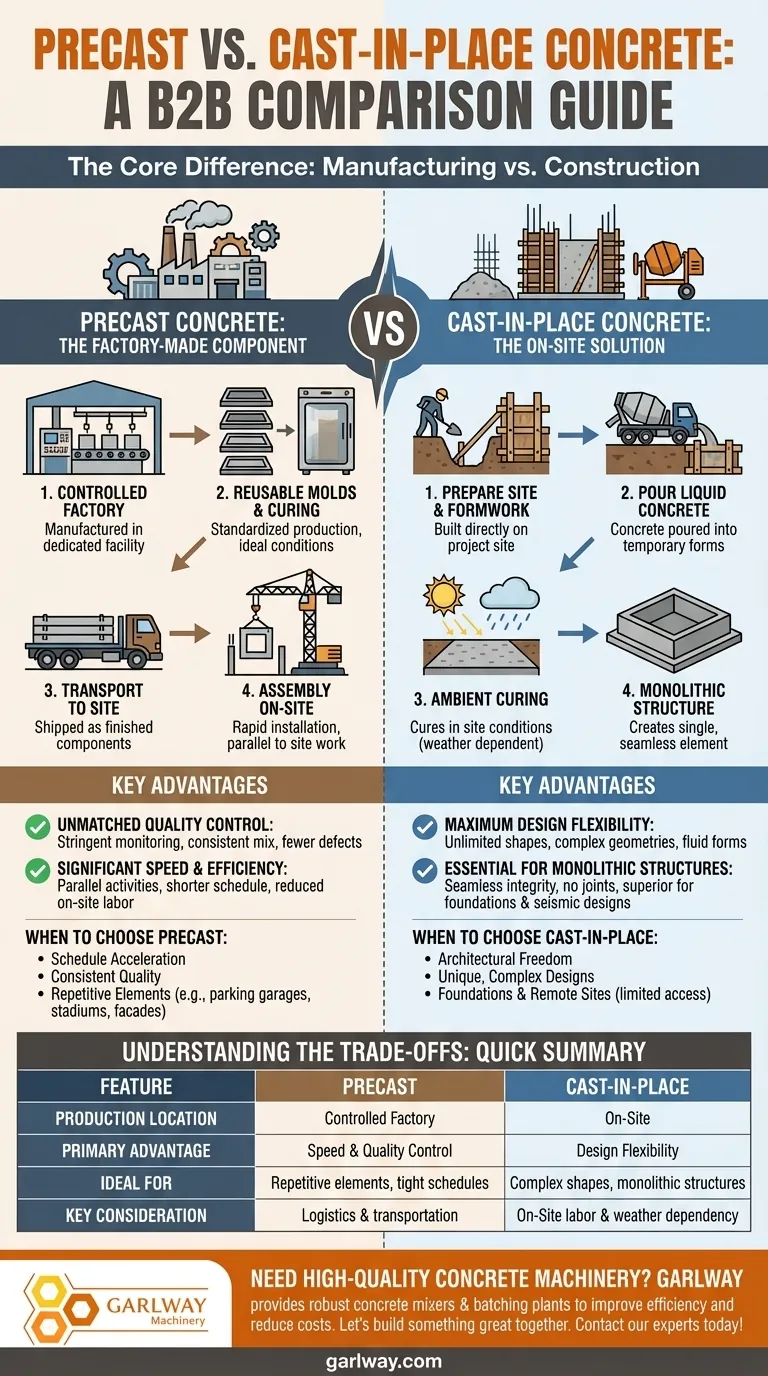
At its core, precast concrete is a construction component manufactured in a controlled factory setting. Unlike traditional cast-in-place concrete, which is poured and cured on the final job site, precast elements are produced in reusable molds, cured under ideal conditions, and then transported to the site for assembly.
The fundamental difference is not the material itself, but the method and location of its creation. Precast is a manufactured product optimized for quality and speed, while cast-in-place is a site-based construction process optimized for flexibility.
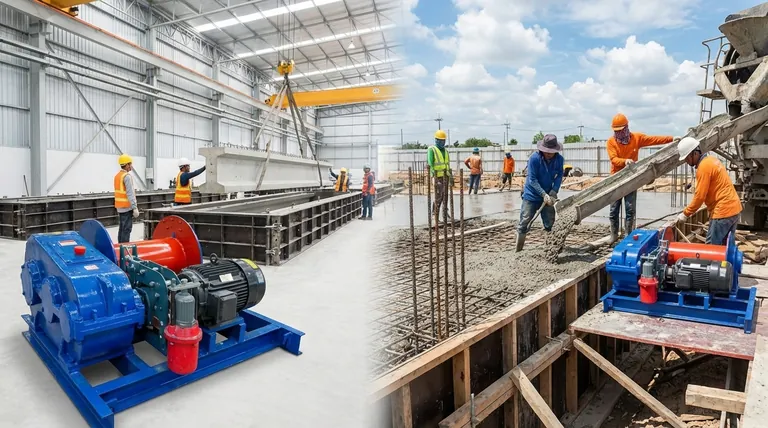
The Core Difference: Manufacturing vs. Construction
Understanding the distinction between these two methods requires thinking of one as a manufacturing process and the other as a traditional construction process. Each has a distinct workflow and set of inherent advantages.
Precast Concrete: The Factory-Made Component
Precast concrete is created in a dedicated facility. This factory environment allows for a highly controlled and standardized production line.
Elements are cast in high-quality, reusable molds, ensuring dimensional accuracy and consistent finishes. The curing process is carefully managed, optimizing temperature and humidity to achieve maximum strength and durability far more reliably than on an open construction site.
Cast-in-Place Concrete: The On-Site Solution
Cast-in-place, or in-situ, concrete is the conventional method where liquid concrete is poured into temporary forms (formwork) built directly on the project site.
The concrete is then left to cure in ambient site conditions, which can be affected by weather, temperature fluctuations, and humidity. This method creates a single, monolithic structure directly in its final position.
Key Advantages of Precast Concrete
Choosing precast is often a strategic decision driven by the need for quality, speed, and predictability on a project.
Unmatched Quality Control
Because it's made in a factory, precast concrete benefits from stringent quality control. The concrete mix, placement of reinforcement, and curing process are all monitored to meet exact specifications.
This results in a final product that is exceptionally strong, dense, and consistent, with fewer defects like honeycombing or surface blemishes.
Significant Speed and Efficiency
The precast manufacturing process can occur at the same time as site preparation and foundation work. This parallel activity dramatically shortens the overall project schedule.
Once on-site, precast elements are simply lifted and assembled, often allowing for rapid enclosure of a structure. This reduces on-site labor needs and minimizes delays caused by weather.
When to Choose Cast-in-Place Concrete
Despite the advantages of precast, cast-in-place concrete remains the ideal choice for many specific applications.
Maximum Design Flexibility
Cast-in-place concrete offers nearly unlimited freedom for unique architectural shapes and complex geometries. It is perfect for creating fluid, curved, or non-standard forms that would be difficult or impossible to produce and transport as precast elements.
Essential for Monolithic Structures
For foundations, slabs-on-grade, or structures requiring seamless structural integrity, cast-in-place is superior. It creates a single, continuous element without the joints inherent in a precast assembly, which can be a critical advantage in certain seismic or load-bearing designs.
Understanding the Trade-offs
The decision between precast and cast-in-place is not about which is universally better, but which presents the right set of benefits and drawbacks for a specific project's goals.
Cost and Schedule
Precast often involves a higher initial material cost due to manufacturing, transportation, and crane rental. However, it can significantly reduce the overall project cost through shorter schedules and lower on-site labor expenses.
Cast-in-place may have a lower upfront material cost but is more vulnerable to schedule delays and can be more labor-intensive, potentially increasing total project costs.
Structural Connections vs. Continuity
Precast structures are an assembly of individual components connected on-site. The design and execution of these connections are critical to the structure's integrity and can be complex.
Cast-in-place concrete avoids this by creating a monolithic structure, but the on-site formwork required can be complex and time-consuming to build.
Logistics and Site Access
Precast requires careful logistical planning for transporting large, heavy elements and requires significant on-site space for cranes and staging. This can be a major constraint on tight urban or remote sites.
Cast-in-place is often better suited for sites with difficult access, as raw materials (cement, sand, aggregate) are easier to transport than massive concrete panels.
Making the Right Choice for Your Project
Selecting the appropriate method depends entirely on your project's primary constraints and objectives.
- If your primary focus is schedule acceleration and consistent quality: Precast is the superior choice, especially for projects with repetitive elements like parking garages, stadiums, or building facades.
- If your primary focus is architectural freedom for a unique, monolithic structure: Cast-in-place provides the flexibility needed to realize complex and seamless designs.
- If your primary focus is a foundation or a project on a remote site with limited access: The logistical simplicity of bringing in raw materials makes cast-in-place the more practical option.
Ultimately, understanding this distinction empowers you to move from a simple choice of material to a strategic choice of construction methodology.
Summary Table:
| Feature | Precast Concrete | Cast-in-Place Concrete |
|---|---|---|
| Production Location | Controlled factory | On-site |
| Primary Advantage | Speed & Quality Control | Design Flexibility |
| Ideal For | Repetitive elements, tight schedules | Complex shapes, monolithic structures |
| Key Consideration | Logistics & transportation | On-site labor & weather dependency |
Need High-Quality Concrete Machinery for Your Project?
Whether you're planning a precast or cast-in-place project, having the right equipment is crucial for success. GARLWAY specializes in providing robust and reliable construction machinery, including concrete mixers and batching plants, to construction companies and contractors worldwide.
We can help you:
- Improve Efficiency: Our machinery ensures consistent mix quality and faster production times.
- Reduce Costs: Reliable equipment minimizes downtime and maximizes your return on investment.
- Scale Your Operations: From small batches to large-scale production, we have solutions to meet your needs.
Let's build something great together. Contact our experts today to discuss the best machinery for your specific project requirements!
Visual Guide
Related Products
- HZS120 Ready Mix Concrete Batching Plant Commercial Mud Cement Mixer
- HZS180 Ready Mix Concrete Plant for Foundations with Sand and Cement
- HZS35 Small Cement Concrete Mixing Batch Plant
- Portable Concrete Mixer Machine Equipment for Mixing Concrete
- HZS25 Best Cement Mixer for Quick Mix Concrete at Bunnings
People Also Ask
- What is a ready mix concrete batching plant? The Engine of Modern Construction
- What is the name of the machine used in ready mix? Unpacking the Complete Concrete System
- What is the core component of a concrete batching plant? The Mixer Unit Defines Your Concrete Quality
- What are the types of concrete mixers used in batching plants? Choose the Right Mixer for Your Project
- What are the advantages and disadvantages of concrete batching plants? Maximize Quality & Efficiency


