
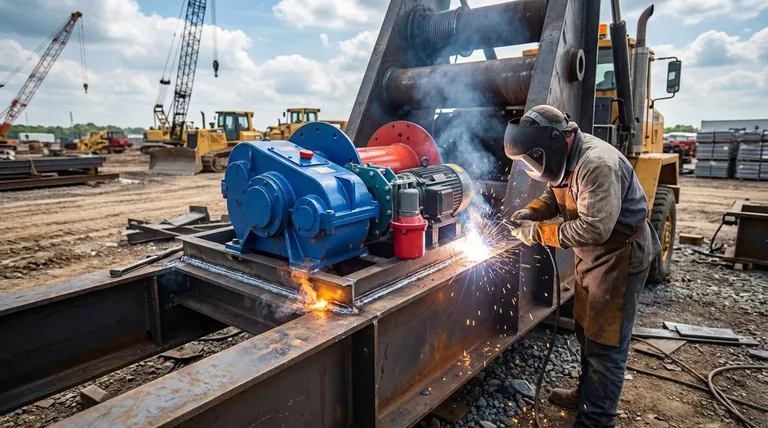
The defining characteristic of a weld-on winch is its permanent attachment method. By welding the winch directly to a trailer frame or piece of machinery, it becomes an integral part of the structure, providing a level of strength and stability that bolt-on or portable models cannot achieve. This fusion is what makes it uniquely suited for the most demanding heavy-duty applications where reliability is non-negotiable.
The core advantage of a weld-on winch isn't just its lifting power, but its complete structural integration. You are not just attaching a tool; you are making the winch a permanent, unified part of the equipment, eliminating the weakest links found in temporary mounting systems.
The Principle of Structural Integration
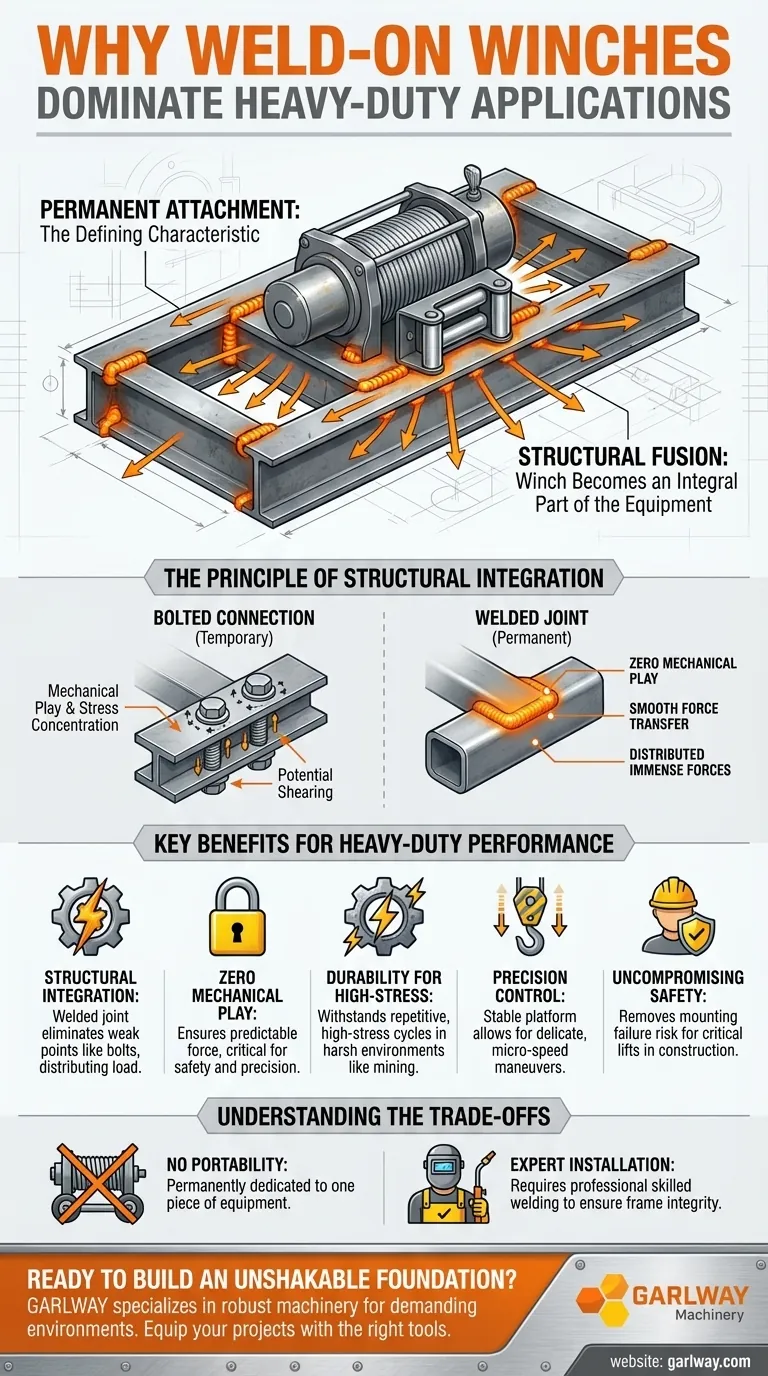
The suitability of a weld-on winch for heavy-duty work comes down to a simple engineering principle: a welded joint effectively turns two separate pieces of metal into one. This has profound implications for strength and reliability.
Why a Weld Creates Superior Strength
A weld fuses the winch directly to the equipment's frame. This distributes the immense pulling and lifting forces across the entire structure, rather than concentrating them on a few bolts. This unified construction eliminates common points of failure, like bolts that can shear under extreme load or loosen over time due to vibration.
Eliminating Mechanical Play
Bolted connections, no matter how tight, have a microscopic amount of "play" or movement. Under the extreme stress of heavy loads, this tiny movement can lead to shock loading and metal fatigue. A weld has zero play, ensuring that all force is transferred smoothly and predictably, which is critical for both safety and precision.
Durability for High-Stress Environments
Weld-on winches are designed for environments where they are used constantly, such as in mining, heavy construction, or industrial lifting. The permanent installation ensures the winch can withstand repetitive, high-stress cycles without degradation, providing long-term operational reliability.
Operational Demands in Heavy-Duty Winching
Heavy-duty work is about more than just raw power; it's about control and safety under immense pressure. The stable platform provided by a welded winch is the foundation for meeting these demands.
The Foundation for Precise Control
For many heavy-duty tasks, such as positioning sensitive materials or assembling large components, precise control is essential. Operators may need to lower a load at a "micro-speed." A winch that is immovably fixed to its base provides the stability required to perform these delicate maneuvers safely and effectively.
Ensuring Uncompromising Safety
In applications like mine hoisting or road construction, winch failure can be catastrophic. By creating a permanent, unified structure, a weld-on winch removes the risk of the mounting itself becoming a point of failure. This makes it the standard choice where safety and reliability are the absolute top priorities.
Understanding the Trade-offs
Choosing a weld-on winch means committing to a permanent solution. This approach has clear limitations that must be considered.
The Obvious Limitation: No Portability
The primary trade-off is the complete loss of portability. Unlike models used for off-roading or forestry, a weld-on winch cannot be moved between vehicles or job sites. It permanently dedicates that piece of equipment to a specific winching task.
Installation Requires Expertise
Properly welding a winch to a frame is a skilled task. It requires a professional to ensure the weld is strong and that the heat from the welding process does not compromise the structural integrity of the equipment's frame. This is a more complex and often more costly installation than a simple bolt-on procedure.
Making the Right Choice for Your Application
The decision to use a weld-on winch should be based entirely on the nature of the work it will perform.
- If your primary focus is maximum structural strength and permanent integration: A weld-on winch is the definitive choice, as it makes the winch an inseparable part of the machinery.
- If your primary focus is versatility across different equipment or locations: A bolt-on or portable winch is the necessary alternative, as a weld-on solution cannot be relocated.
- If your primary focus is industrial-grade safety for repetitive, critical lifts: The unmatched stability and reliability of a welded connection make it the superior and often mandatory option.
Ultimately, choosing a weld-on winch is about building a system on a foundation of absolute stability for the most critical tasks.
Summary Table:
| Key Feature | Benefit for Heavy-Duty Applications |
|---|---|
| Structural Integration | Welded joint fuses winch to frame, distributing force and eliminating weak points like bolts. |
| Zero Mechanical Play | Ensures smooth, predictable force transfer, critical for safety and precision control. |
| Permanent Installation | Provides long-term durability and reliability for repetitive, high-stress cycles. |
| Foundation for Precision | Stable platform allows for micro-speed control in delicate lifting operations. |
| Uncompromising Safety | Removes risk of mounting failure, making it standard for critical lifts in mining and construction. |
Ready to build an unshakable foundation for your heavy-duty lifting needs?
At GARLWAY, we specialize in engineering robust construction machinery for the most demanding environments. Our weld-on winches are designed to become a permanent, reliable part of your equipment, ensuring safety and performance where it matters most.
Let us help you equip your projects with the right tools for ultimate strength and reliability.
Contact GARLWAY today to discuss your specific requirements for winches, concrete mixers, and batching plants.
Visual Guide
Related Products
- Heavy Duty Electric Boat Winch Windlass Anchor
- Electric and Hydraulic Winch for Heavy Duty Applications
- Quick Windlass Portable Winch for Truck and Boat Best Boat Winch
- 12000 lb Electric Boat Trailer Winch with Windlass Anchor Warn
- Warn Winch Windlass Boat Trailer Winch
People Also Ask
- How do electric boat winches work? Unlock Effortless Launching & Retrieval
- How much current does an electric boat winch draw? Plan Your Electrical System for Peak Performance
- Can an electric winch be used as a hoist? Understand the Critical Safety Differences
- What is the major advantage of an electric-powered winch? Unmatched Self-Recovery When Your Engine Fails
- What makes electric winches suitable for off-road use? Key Features for Reliable Vehicle Recovery





