In the maritime industry, hydraulic winches are the cornerstone for the most demanding tasks. Their primary applications are centered on anchoring and mooring, cargo and equipment handling, and critical search, rescue, and towing operations where failure is not an option.
The core reason hydraulic winches dominate at sea is not simply their raw power, but their unique combination of immense force, precise control, and exceptional durability, making them uniquely suited to the unforgiving marine environment.
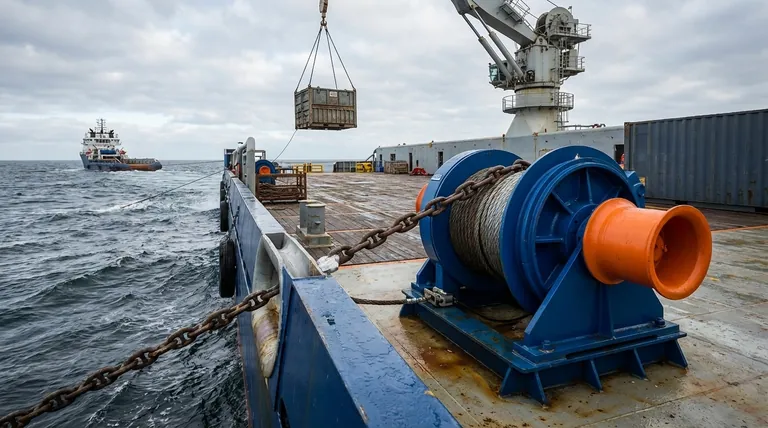
Why Hydraulics Are the System of Choice at Sea
While various winches exist, hydraulic systems possess a set of characteristics that make them the default choice for mission-critical marine functions. This comes down to power, control, and resilience.
Unmatched Power Density
A hydraulic winch delivers enormous pulling force from a relatively compact and lightweight motor. On a vessel where space and weight are always at a premium, this high power-to-weight ratio is a significant operational advantage.
Absolute Precision and Control
The nature of hydraulic fluid allows for incredibly smooth and variable control over both speed and tension. This precision is essential for gently easing a multi-ton anchor into place, maneuvering sensitive cargo without shock, or carefully tensioning a mooring line against a pier.
Built for the Harshest Environments
Marine operations expose equipment to constant saltwater spray, humidity, and extreme temperatures. Hydraulic systems are inherently sealed and robust, making them highly resistant to the corrosion and water intrusion that can cripple electrical components.
Continuous, Unfaltering Operation
Hydraulic winches are engineered for long, demanding duty cycles. They can operate under heavy load for extended periods, such as deep-sea anchoring or long-distance towing, without the risk of overheating that can affect other winch types.
Core Maritime Applications in Detail
The inherent advantages of hydraulic systems directly translate into their primary applications on vessels of all sizes.
Anchoring and Mooring
This is the most fundamental application. Hydraulic winches provide the controlled power needed to deploy and retrieve heavy anchor chains and cables. During mooring, they allow for the precise tensioning of lines to secure the vessel safely against docks, especially in challenging tides or currents.
Cargo and Equipment Handling
From deck cranes to loading ramps, hydraulic winches are central to moving heavy materials. Their ability to lift and lower loads smoothly prevents jarring movements that could damage sensitive cargo or compromise the stability of the vessel.
Search, Rescue, and Towing
In these high-stakes scenarios, reliability is paramount. Hydraulic winches provide the unwavering pulling power needed for towing disabled vessels. They are also equipped with fail-safe mechanisms, such as automatic brakes, that engage if hydraulic pressure is lost, preventing catastrophic load release.
Understanding the Trade-offs
Despite their dominance, hydraulic systems are not without their complexities. A clear-eyed assessment requires acknowledging their operational requirements.
System Complexity
A hydraulic winch is part of a larger system. It requires a Hydraulic Power Unit (HPU), pumps, fluid reservoirs, and a network of high-pressure hoses. This adds a layer of complexity compared to a self-contained electric winch.
Maintenance and Leaks
The integrity of the hydraulic system is critical. These systems demand regular maintenance to check for hose wear and connection integrity. Any hydraulic fluid leak is not only a slip hazard but also an environmental concern that must be managed.
Initial Installation Cost
The infrastructure required for a hydraulic system—the HPU and associated plumbing—can lead to a higher upfront installation cost and a more involved setup process compared to simpler alternatives.
Making the Right Choice for Your Goal
The decision to use a hydraulic winch is an investment in capability and safety. Your specific operational priority should guide your focus.
- If your primary focus is vessel security (anchoring and mooring): Prioritize winches with superior tension control and robust, automatic braking systems.
- If your primary focus is material handling (cargo and equipment): Focus on systems offering the smoothest possible variable speed control to ensure load stability and safety.
- If your primary focus is mission-critical response (towing and rescue): Demand systems with proven durability, fail-safe mechanisms, and the ability to handle sustained, heavy loads without faltering.
Ultimately, choosing a hydraulic winch is an investment in operational control, safety, and unwavering reliability in the most demanding marine environments.
Summary Table:
| Application | Key Advantage |
|---|---|
| Anchoring & Mooring | Precise tension control and automatic braking for vessel security |
| Cargo & Equipment Handling | Smooth, variable speed control to prevent load damage |
| Search, Rescue & Towing | Fail-safe mechanisms and sustained heavy-load capability |
Ready to enhance your maritime operations with reliable hydraulic winches? As GARLWAY, a specialist in construction and marine machinery, we provide robust winches, concrete mixers, and batching plants tailored for construction companies and contractors globally. Our solutions deliver the power, precision, and durability your projects demand. Contact us today to discuss your specific needs and discover how we can support your success!
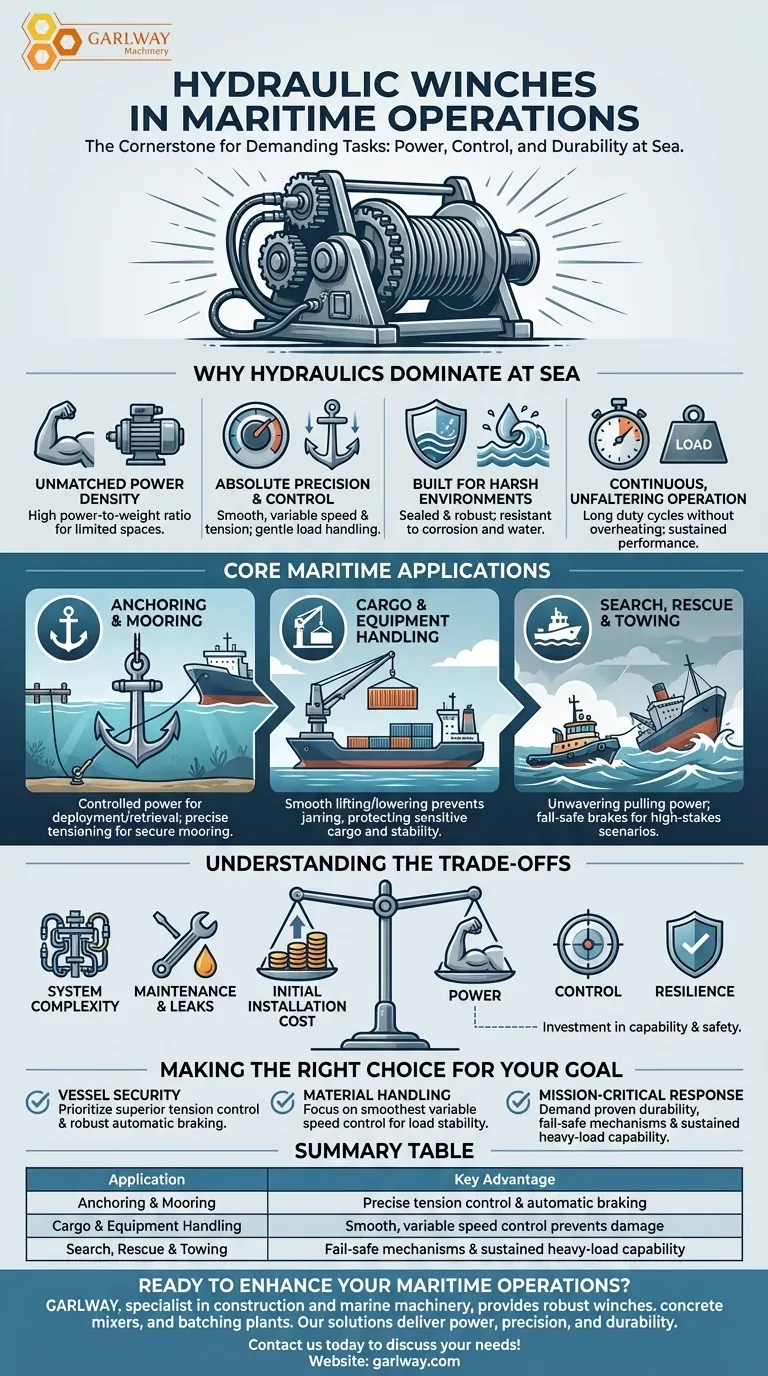
Visual Guide
Related Products
- Hydraulic Winding Engine Harbor Freight Winch
- Electric and Hydraulic Winch for Heavy Duty Applications
- Small Electric Winch 120V and 240V for Compact Applications
- Electric 120V Boat Winch by Badlands
- 12000 lb Electric Boat Trailer Winch with Windlass Anchor Warn
People Also Ask
- What role does hydraulic fluid play in hydraulic winches? It's the Lifeblood of Your Heavy-Duty Pulling Power
- What vehicles commonly use hydraulic winches? For Industrial Trucks Needing Unmatched Power
- What are the features of hydraulic winches? Unmatched Power and Continuous Duty for Heavy Loads
- What preventive measures can be taken to avoid oil leakage in hydraulic winches? Ensure Long-Term Reliability
- What does 'power out' mean in a hydraulic winch? Achieve Absolute Control When Lowering Heavy Loads