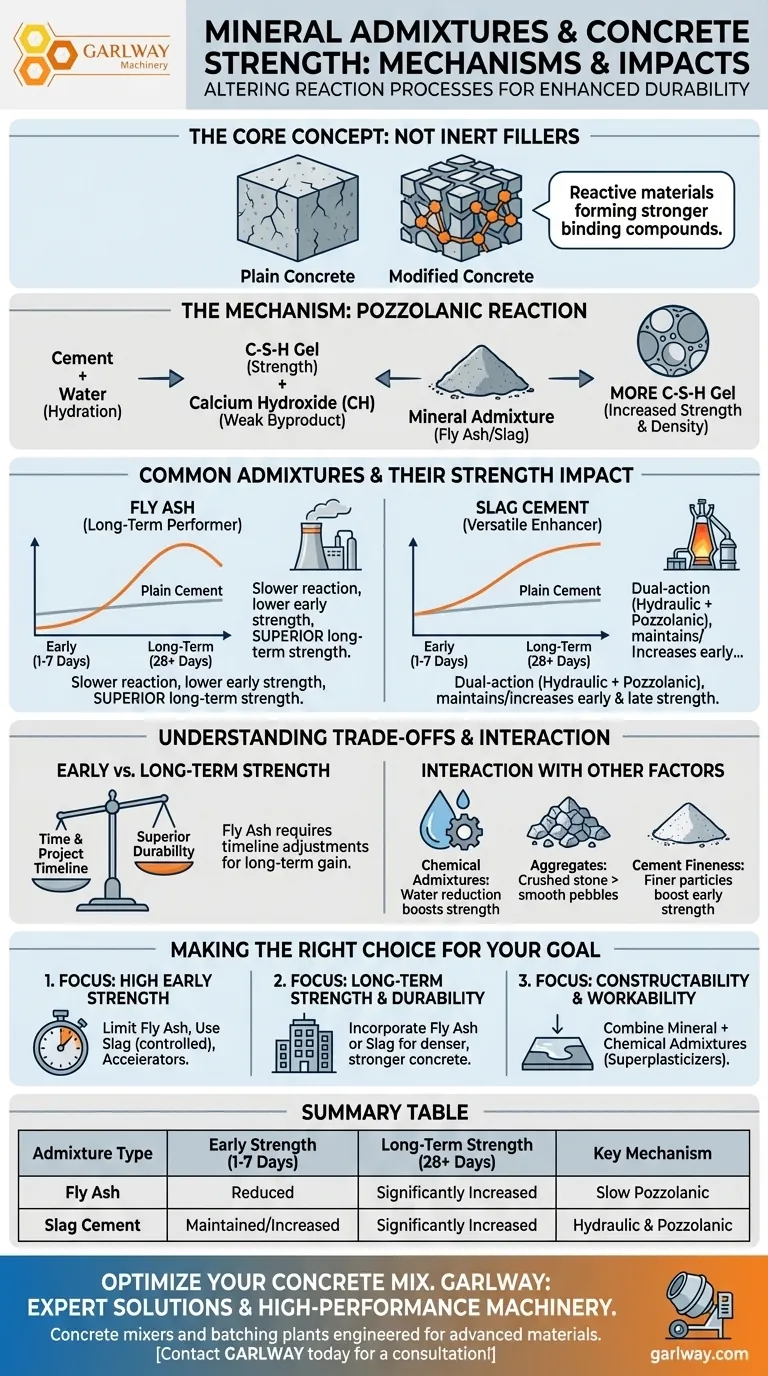
At their core, mineral admixtures fundamentally alter the strength development of concrete by changing its chemical reaction process and internal structure. Their effect depends entirely on the type of admixture used, the amount of cement it replaces, and the age at which strength is measured. Some, like slag, can contribute to both early and late strength, while others, like fly ash, typically reduce early strength in exchange for superior long-term performance.
The central principle to grasp is that mineral admixtures are not inert fillers. They are reactive materials that consume weak byproducts of cement hydration to form additional, stronger binding compounds, ultimately creating a denser and more durable concrete matrix over time.
The Mechanism: How Admixtures Build Strength
What Are Mineral Admixtures?
Mineral admixtures are finely ground materials, often byproducts of industrial processes, that are added to concrete to enhance its properties. They are sometimes referred to as Supplementary Cementitious Materials (SCMs).
The most common types include fly ash (from coal-fired power plants) and ground granulated blast-furnace slag (slag cement) (from steel production).
The Pozzolanic Reaction
Standard Portland cement reacts with water (hydration) to form a binding gel called Calcium Silicate Hydrate (C-S-H), which is the primary source of concrete's strength. This reaction also produces a weaker byproduct, Calcium Hydroxide (CH).
Mineral admixtures work through a pozzolanic reaction, reacting with this less desirable Calcium Hydroxide to produce more of the strength-giving C-S-H gel. This process refines the pore structure and increases the density of the concrete.
Common Admixtures and Their Strength Impact
Fly Ash: The Long-Term Performer
Fly ash reacts more slowly than Portland cement. Consequently, when it replaces a portion of cement, the early strength of the concrete (measured at 1-7 days) is typically lower.
However, as the pozzolanic reaction continues over weeks and months, fly ash contributes significantly to long-term strength. The concrete will often surpass the 28-day and 90-day strength of an equivalent plain cement mix.
Slag Cement: The Versatile Enhancer
Slag has both hydraulic and pozzolanic properties. This means it can react with water on its own (like cement) in addition to reacting with the Calcium Hydroxide byproduct.
This dual-action nature allows slag to replace a portion of cement while contributing more effectively to both early and late-stage strength compared to fly ash. Within certain replacement ranges, it can maintain or even increase strength at all ages.
Understanding the Trade-offs
Early Strength vs. Long-Term Strength
The most critical trade-off is time. Using an admixture like fly ash requires a shift in project timelines. While you gain superior long-term strength and durability, you must accommodate slower initial strength gain, which can affect when structures can bear loads or when formwork can be removed.
Interaction with Other Factors
The final strength of concrete is a result of the entire system. Mineral admixtures work in conjunction with other components.
- Chemical Admixtures: Water-reducing admixtures are often used to decrease the water content, which independently increases strength and complements the effect of mineral admixtures.
- Aggregates: The type of aggregate remains critical. The superior bonding surface of crushed stone will result in higher strength than smooth pebbles, regardless of the admixture used.
- Cement Fineness: Finer cement particles hydrate faster, boosting early strength. This can be used to help offset the initial lag caused by some mineral admixtures.
Dosage is Critical
The performance of a mineral admixture is highly dependent on the replacement level. Replacing too much cement can severely compromise early strength and workability. Mix designs must be carefully calibrated and tested to achieve the desired outcome.
Making the Right Choice for Your Goal
Selecting the correct admixture is about aligning the material's properties with the project's primary objective.
- If your primary focus is high early strength: Limit the use of fly ash. Utilize slag cement at a controlled replacement level or use a standard Portland cement mix, possibly with a chemical accelerating admixture.
- If your primary focus is long-term strength and durability: Incorporate fly ash or slag cement into the mix design to create a denser, less permeable, and ultimately stronger concrete for the structure's service life.
- If your primary focus is constructability and workability: Combine mineral admixtures with chemical admixtures like superplasticizers to achieve properties like self-leveling concrete while still gaining long-term strength benefits.
By understanding these materials as active components, you can engineer concrete that is not just strong, but precisely optimized for its intended purpose.
Summary Table:
| Admixture Type | Early Strength (1-7 Days) | Long-Term Strength (28+ Days) | Key Mechanism |
|---|---|---|---|
| Fly Ash | Typically Reduced | Significantly Increased | Slow Pozzolanic Reaction |
| Slag Cement | Maintained or Increased | Significantly Increased | Hydraulic & Pozzolanic Reaction |
Need to optimize your concrete mix for strength and durability? At GARLWAY, we specialize in providing high-performance construction machinery and expert solutions for contractors and construction companies worldwide. Our concrete mixers and batching plants are engineered to work seamlessly with advanced materials like mineral admixtures, ensuring your projects achieve optimal strength and longevity. Let our experts help you select the right equipment and mix design for your specific needs. Contact GARLWAY today for a consultation!
Visual Guide