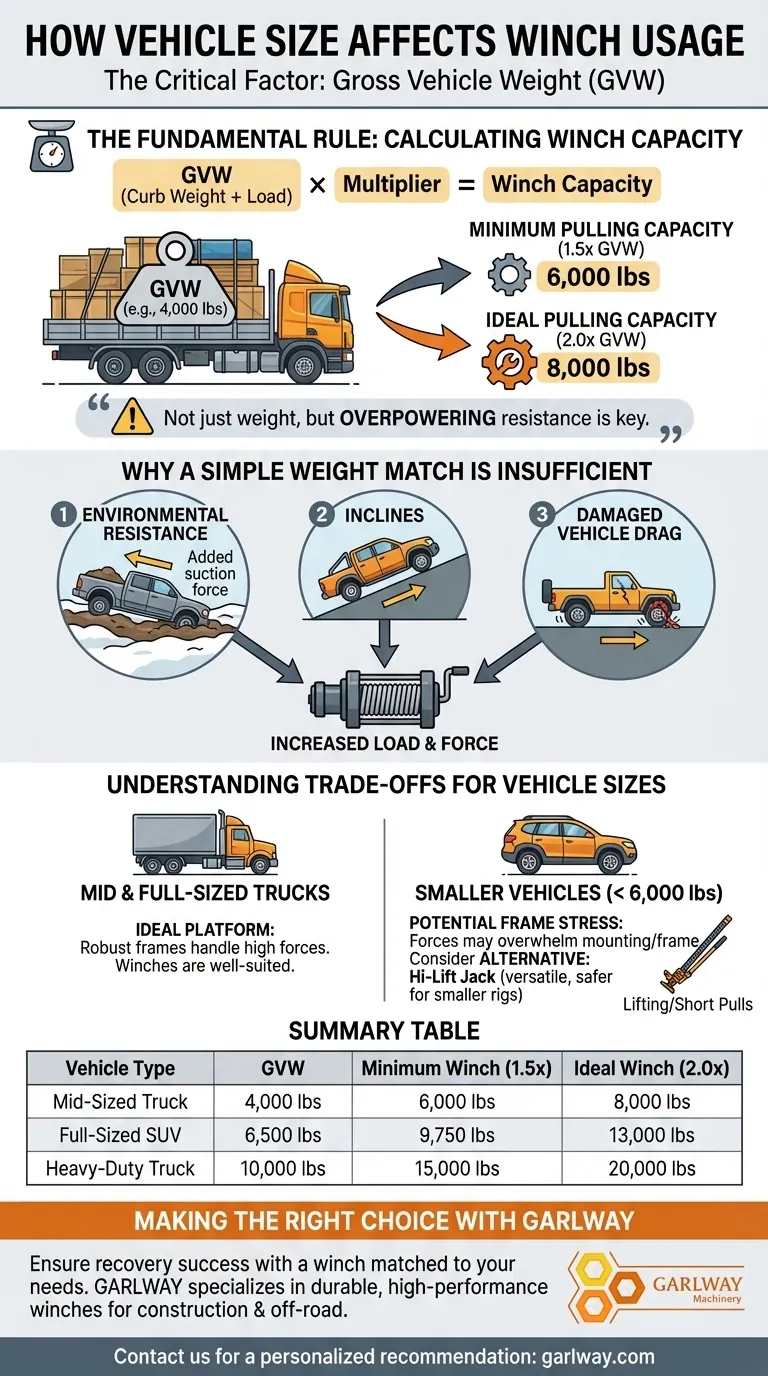
At its core, vehicle size—specifically its Gross Vehicle Weight (GVW)—is the single most critical factor in determining the correct winch for your needs. The standard industry rule is to select a winch with a minimum pulling capacity of 1.5 times your vehicle's fully-loaded weight, with a 2x capacity being the ideal for a safe and effective recovery.
Choosing a winch is not about matching your vehicle's weight; it's about overpowering the combined forces of that weight plus the resistance of the situation you're stuck in. This requires a significant safety margin.
The Fundamental Rule: Calculating Winch Capacity
The process begins with one number: your vehicle's Gross Vehicle Weight (GVW). From there, a simple calculation provides the baseline for your winch selection.
Why Gross Vehicle Weight (GVW) is Your Starting Point
Your vehicle's GVW is its curb weight plus the maximum weight of all passengers, fuel, and gear it can carry. You must use this fully-loaded number, not the empty curb weight, as your baseline.
This ensures you are accounting for the vehicle's weight in a real-world scenario, where you are most likely to need a recovery.
The 1.5x to 2.0x Multiplier
The industry standard is to multiply your GVW by 1.5 to find the minimum winch capacity you should consider.
Multiplying by 2.0 is even better, as this provides an ideal safety and performance margin for more challenging recoveries.
A Practical Example
If your fully-loaded truck has a GVW of 4,000 pounds:
- Minimum Capacity: 4,000 lbs x 1.5 = a 6,000 lb winch.
- Ideal Capacity: 4,000 lbs x 2.0 = an 8,000 lb winch.
Why a Simple Weight Match is Insufficient
A winch isn't just pulling the static weight of your vehicle. It must overcome significant additional forces that can dramatically increase the load.
The Force of Environmental Resistance
Being stuck in deep mud, snow, or sand creates a powerful suction effect. This resistance adds thousands of pounds of force that your winch must overcome in addition to the vehicle's weight.
The Impact of Inclines
Attempting to pull a vehicle up a hill dramatically increases the required pulling force. A steep incline can easily double the load on the winch.
The Drag of a Damaged Vehicle
A vehicle with locked wheels, a damaged axle, or other obstructions that prevent it from rolling freely will present a much higher load than one that can roll.
Understanding the Trade-offs for Different Vehicle Sizes
While the capacity calculation is universal, the suitability of a winch can change based on the vehicle's class and construction.
For Mid-Sized and Full-Sized Trucks
These larger vehicles are the ideal platform for winches. Their robust frames are designed to handle the immense forces generated during a heavy pull, making them well-suited for high-capacity winches.
For Smaller, Lighter Vehicles (< 6,000 lbs)
For smaller SUVs and crossovers, a winch might not always be the most appropriate tool. The forces exerted by a powerful winch can potentially overwhelm the mounting points or even the frame of a lighter unibody vehicle.
The Hi-Lift Jack as an Alternative
On a smaller rig, a hi-lift jack can be a safer and more versatile recovery tool. While slower, it can be used to lift a vehicle out of ruts or perform short-distance "winching" operations without concentrating extreme force on a single point of the frame.
Making the Right Choice for Your Vehicle
Your decision should be based on a clear-eyed assessment of your vehicle and the situations you anticipate encountering.
- If your primary focus is a mid-sized or full-sized truck: Prioritize selecting a winch rated for 1.5x to 2.0x your vehicle's GVW for maximum safety and effectiveness.
- If your primary focus is a smaller SUV or crossover: Critically evaluate your vehicle's structural integrity and consider if a versatile tool like a hi-lift jack is a more suitable primary recovery option.
- If your primary focus is navigating extreme terrain: Always err on the side of caution and select a winch closer to the 2.0x GVW multiplier to ensure you have power in reserve.
Ultimately, selecting the right recovery tool is about preparing for the worst-case scenario, not just the static weight of your vehicle.
Summary Table:
| Vehicle Type | Gross Vehicle Weight (GVW) | Minimum Winch (1.5x GVW) | Ideal Winch (2.0x GVW) |
|---|---|---|---|
| Mid-Sized Truck | 4,000 lbs | 6,000 lbs | 8,000 lbs |
| Full-Sized SUV | 6,500 lbs | 9,750 lbs | 13,000 lbs |
| Heavy-Duty Truck | 10,000 lbs | 15,000 lbs | 20,000 lbs |
Ensure your next recovery is a success with a winch perfectly matched to your vehicle's weight and your toughest terrain challenges.
GARLWAY specializes in durable, high-performance winches for construction companies, contractors, and off-road enthusiasts. Our winches are engineered to deliver the reliable power you need when it matters most.
Contact GARLWAY today for a personalized recommendation on the ideal winch for your truck or equipment.
Visual Guide
Related Products
- Warn Winch Windlass Boat Trailer Winch
- Electric and Hydraulic Winch for Heavy Duty Applications
- Small Electric Winch 120V and 240V for Compact Applications
- 12000 lb Electric Boat Trailer Winch with Windlass Anchor Warn
- Quick Windlass Portable Winch for Truck and Boat Best Boat Winch
People Also Ask
- What are the main components of a boat trailer winch? A Guide to Safe & Efficient Boat Loading
- What factors should be considered when choosing a boat trailer winch? Ensure Safe and Effortless Boat Loading
- What is the purpose of boat trailer winches? Safely and Efficiently Load Your Boat
- What are the two main types of boat trailer winches? Manual vs. Electric Explained
- How often should a boat trailer winch be replaced? Your Guide to Safety and Longevity