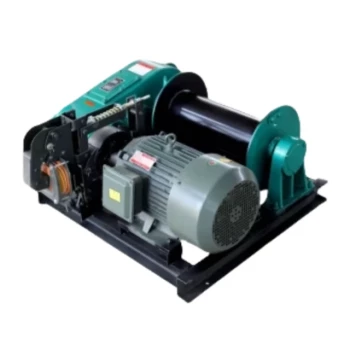
At its core, a trailer winch is a versatile pulling machine whose utility extends far beyond the boat ramp. Its fundamental purpose is to multiply force, enabling a single person to move objects weighing thousands of pounds across various domains, including vehicle recovery, landscaping, construction, and general property maintenance.
A winch transforms from a simple trailer accessory into a powerful, multi-purpose tool when you stop thinking of it as a "boat loader" and start seeing it as a portable, mechanical force multiplier. However, this power demands an unwavering commitment to safety and the correct rigging for every unique task.
Beyond the Boat Ramp: Core Alternative Uses
A winch's power can be applied to a wide range of physically demanding tasks. By understanding its capabilities, you can save significant time and manual effort.
Vehicle and Equipment Management
A primary alternative use is moving heavy, wheeled, or non-running equipment. A winch provides the controlled, immense force needed for these situations.
Tasks include recovering a stuck ATV or tractor, pulling a non-running project car into a garage, or carefully righting an overturned piece of small farm equipment.
Landscaping and Property Clearing
For property owners, a winch is an invaluable tool for landscape modification and clearing. It can handle jobs that are too large for manual labor but too small for heavy machinery.
This includes pulling stubborn tree stumps and shrubs, removing old fence posts, and relocating large rocks or fallen trees from trails and driveways. It can even be used to guide the felling of a tree with precision.
Construction and Workshop Projects
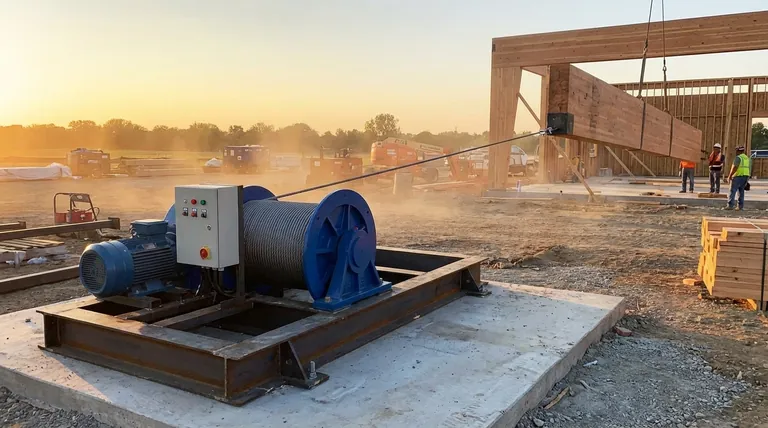
In a construction or fabrication setting, a winch can be used for precise positioning of heavy materials.
When paired with a sturdy A-frame, it can assist in lifting heavy beams. It's also effective for shifting small outbuildings or sheds on their foundations or pulling heavy equipment like scissor lifts into tight spaces.
Understanding the Critical Safety Trade-offs
The immense force generated by a winch can be extremely dangerous if misused. Understanding its limitations is not optional; it is essential for safe operation.
Winches Are for Pulling, Not Lifting
Standard trailer winches are designed for horizontal pulling, not vertical overhead lifting. They typically lack the braking systems and safety ratings of a true hoist.
Using a pulling winch to lift a load overhead creates a significant risk of catastrophic failure, as the braking mechanism is not designed to hold a suspended load securely.
The System is Only as Strong as its Weakest Link
The winch itself is just one component. Your anchor point, shackles, and straps must all be rated for the load you intend to move.
A powerful winch attached to a weak anchor point will simply pull the anchor out, creating a dangerous projectile. Always inspect all rigging components before every use.
Human-Load Applications Require Specialized Gear
While winches can be used for applications like assisting in a cliff descent, this requires human-rated equipment and extensive training.
Never use a standard vehicle or trailer winch to support a person. The equipment is not designed or tested for this purpose, and failure would be life-threatening.
Your Base Must Be Secure
The vehicle or structure the winch is mounted to must be completely stable. When pulling a heavy load, always chock the wheels of the towing vehicle and ensure it is in park with the emergency brake engaged.
An unstable pulling platform can move unexpectedly, leading to a loss of control over the load and a dangerous operating environment.
Applying This to Your Goal
Your primary use case will determine how you can best leverage your winching equipment.
- If your primary focus is property maintenance: A winch is your best tool for removing stumps, rocks, and old fence posts without hiring expensive equipment.
- If your primary focus is vehicle recovery: It provides self-sufficiency for off-roaders and a safe way to move non-running vehicles for mechanics.
- If your primary focus is DIY construction: Use it for the controlled positioning of heavy items and the careful demolition or adjustment of small structures.
By respecting its power and understanding its limitations, you can unlock the full potential of your winch as a true problem-solving tool.
Summary Table:
| Alternative Use Category | Key Applications |
|---|---|
| Vehicle & Equipment | Recovering stuck ATVs/tractors, moving non-running cars, righting overturned equipment. |
| Landscaping & Property | Pulling tree stumps, removing fence posts, relocating large rocks or fallen trees. |
| Construction & Workshop | Positioning heavy beams, shifting small outbuildings, pulling equipment into tight spaces. |
Need a reliable, powerful winch for your construction or contracting projects?
GARLWAY specializes in durable construction machinery, including robust winches, concrete mixers, and batching plants designed for demanding professional use. Our equipment provides the reliable force multiplication you need to handle tough jobs safely and efficiently.
Contact GARLWAY today to find the perfect winching solution for your specific application and unlock new levels of worksite capability.
Visual Guide
Related Products
- 12000 lb Electric Boat Trailer Winch with Windlass Anchor Warn
- Portable Small Trailer Winch
- Best 18000 Pound Drum Anchor Trailer Winch
- Warn Winch Windlass Boat Trailer Winch
- Quick Windlass Portable Winch for Truck and Boat Best Boat Winch
People Also Ask
- How does an electric boat trailer winch differ from a manual one? Effort vs. Control Explained
- What size winch do I need for my boat? Get the Right Capacity for Safe Hauling
- How should a boat trailer winch be properly used? A Step-by-Step Guide for Safe Loading
- What maintenance steps are specific to boat trailer winches? Ensure Safety & Reliability at the Ramp
- How strong of a winch do I need for my boat? Get the Right Pulling Power for Trailering & Anchoring