
At its core, an electric winch is a powerful pulling machine. It is primarily designed to pull, lift, or tow heavy loads using a motor-driven drum that winds a wire rope or synthetic cable. Its applications span from recovering a stuck vehicle on a remote trail to being an integral component in heavy industrial machinery for lifting materials on a construction site.
An electric winch is fundamentally a force multiplier. It uses an electric motor and a gear reduction system to convert modest electrical power into immense pulling force, enabling the safe and controlled movement of objects far too heavy to handle by other means.

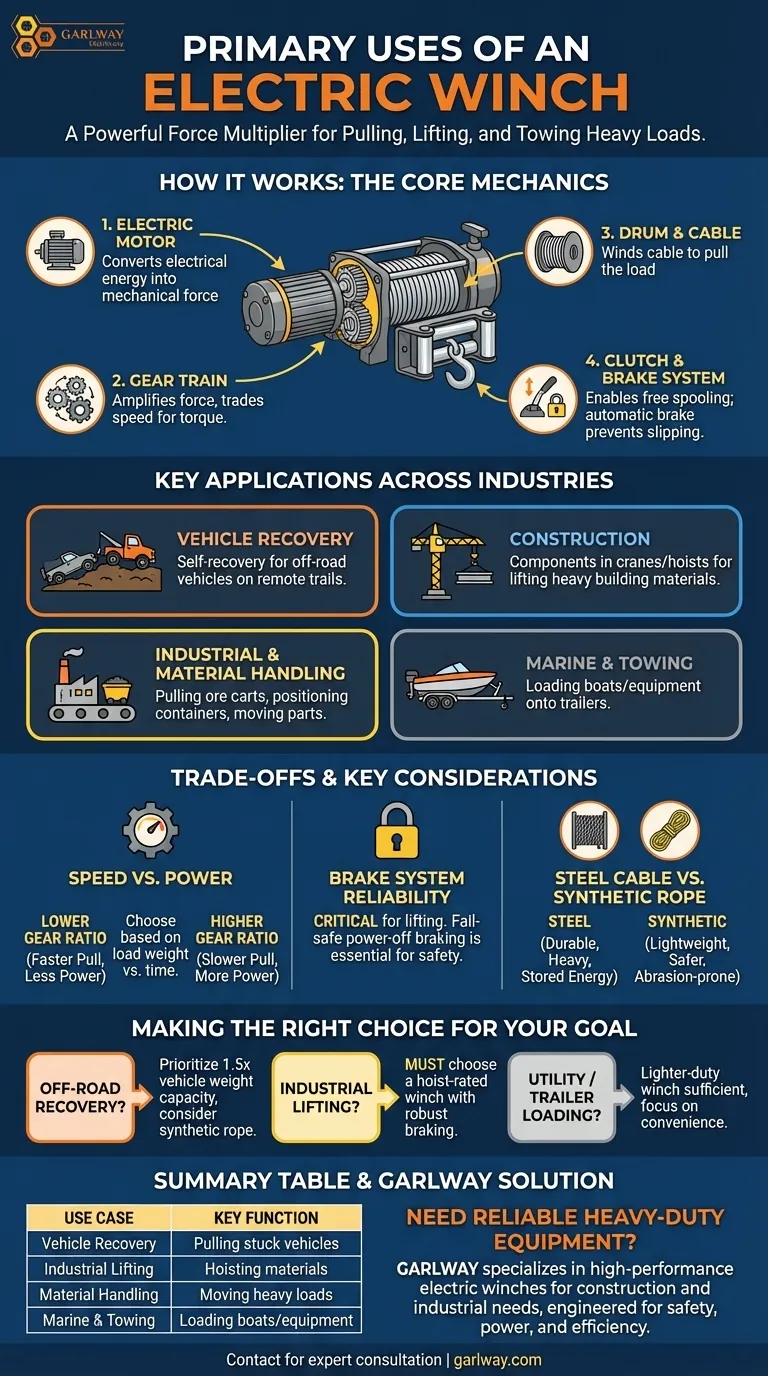
How an Electric Winch Works: The Core Components
To understand its wide range of uses, you must first understand its mechanics. An electric winch is a system of simple machines working in concert to create powerful results.
The Motor and Power Source
The process begins with the electric motor. This component converts electrical energy, typically from a vehicle's battery or another dedicated power source, into mechanical rotational force.
The Gear Train: Amplifying Force
The motor's power is fed into a gear train, often a planetary gear system. This is the critical step where speed is traded for torque. The gear reduction significantly multiplies the motor's force, creating the powerful pull the winch is known for.
The Drum and Cable
This amplified force turns the cylindrical drum. A steel cable or synthetic rope is wound around this drum. As the drum rotates, it spools the cable, pulling the attached load toward the winch.
The Clutch and Brake System
A clutch allows the operator to disengage the drum from the gear train, enabling the cable to be pulled out freely by hand (a process called "free spooling"). Critically, an automatic brake system engages when the motor stops, preventing the load from slipping and ensuring safety.
Key Applications Across Industries
The simple principle of a motorized pull makes the electric winch incredibly versatile. It is found in a vast array of commercial, industrial, and recreational settings.
Vehicle Recovery and Off-Roading
This is perhaps the most common application for consumers. An electric winch mounted to the front of a truck, Jeep, or ATV is an essential tool for self-recovery when a vehicle becomes stuck in mud, sand, or snow.
Construction and Infrastructure
On construction sites, winches are workhorses. They are used as components in larger machinery like cranes and hoists for lifting building materials, steel beams, and other heavy components. They are also used for dragging equipment into place.
Industrial and Material Handling
In settings like mines, docks, and forestry operations, winches are used for pulling ore carts, positioning shipping containers, or dragging logs. They can also be integrated into automated production lines for moving heavy parts.
Marine and Towing Applications
Winches are standard equipment on boat trailers, used to pull boats out of the water and secure them onto the trailer. They are also used for loading heavy equipment or vehicles onto flatbed trailers.
Understanding the Trade-offs and Key Considerations
While the function is straightforward, not all winches are created equal. The design of a winch is a balance of competing factors that you must understand to select the right tool for the job.
Speed vs. Power
A key specification is the gear ratio. A winch with a lower gear ratio will pull faster but have less overall pulling power. A higher gear ratio will be much slower but can handle significantly heavier loads. This is why specialized winches exist, such as high-speed (JK series) and slow-speed (JM series) models for different industrial needs.
The Critical Role of the Brake
The reliability of the braking system is paramount, especially in lifting applications. A failure of the brake under load can be catastrophic. Industrial-grade winches often feature robust power-off braking systems to ensure the load is held securely even if power is lost.
Steel Cable vs. Synthetic Rope
The choice of line is a major trade-off. Steel cable is highly durable and resistant to abrasion but is also heavy and can store dangerous amounts of kinetic energy if it snaps. Synthetic rope is much lighter, safer, and easier to handle, but it is more susceptible to abrasion and UV degradation.
Making the Right Choice for Your Goal
Your intended use case should dictate the type of winch you choose.
- If your primary focus is off-road vehicle recovery: Prioritize a winch with a pulling capacity rated at least 1.5 times your vehicle's gross weight and consider the safety benefits of a synthetic rope.
- If your primary focus is industrial lifting: You must choose a winch specifically rated for hoisting, which has a more robust braking system and a different duty cycle rating than a pulling winch.
- If your primary focus is utility or trailer loading: A smaller, lighter-duty winch is often sufficient, focusing on convenience and ease of use rather than maximum pulling power.
Ultimately, an electric winch provides mechanical advantage, empowering you to move heavy objects with safety and control.
Summary Table:
| Primary Use Case | Key Function | Typical Setting |
|---|---|---|
| Vehicle Recovery | Pulling stuck vehicles | Off-road trails, construction sites |
| Industrial Lifting | Hoisting materials | Construction, mining, docks |
| Material Handling | Moving heavy loads | Factories, warehouses, forestry |
| Marine & Towing | Loading boats/equipment | Marinas, trailers |
Need a reliable electric winch for your heavy-duty projects?
GARLWAY specializes in high-performance construction machinery, offering a range of durable electric winches, concrete mixers, and batching plants. Whether you're a construction company, contractor, or work in industrial material handling, our equipment is engineered for safety, power, and efficiency.
Let us help you find the perfect winch solution for your specific needs.
Contact GARLWAY today for a expert consultation!
Visual Guide
Related Products
- Electric 120V Boat Winch by Badlands
- Electric and Hydraulic Winch for Heavy Duty Applications
- Small Electric Winch 120V and 240V for Compact Applications
- 12000 lb Electric Boat Trailer Winch with Windlass Anchor Warn
- Electric Hoist Winch Boat Anchor Windlass for Marine Applications
People Also Ask
- How do electric boat winches work? Unlock Effortless Launching & Retrieval
- How much current does an electric boat winch draw? Plan Your Electrical System for Peak Performance
- Can I run a winch straight from a battery? Essential Power Setup for Safe Operation
- What are the types of electric winches available? Choose the Right Winch for Your Job
- What are the uses of electric winches in mining and tunneling? Enhance Safety and Efficiency Underground





