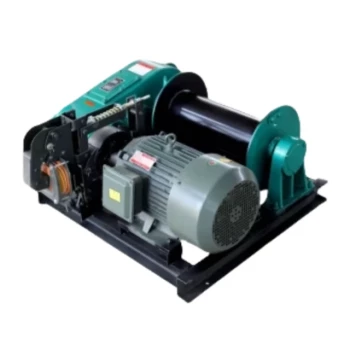
At its core, a winch reduces labor by mechanizing the task of moving heavy materials. It automates the lifting, pulling, and positioning of loads that would otherwise require a team of workers to handle manually. This fundamental shift saves immense physical energy and allows that human effort to be redirected to more skilled and valuable tasks on the construction site.
The true value of a winch is not just in replacing muscle power, but in reallocating your most valuable resource—skilled labor—away from inefficient transport and towards the critical tasks that drive project completion.
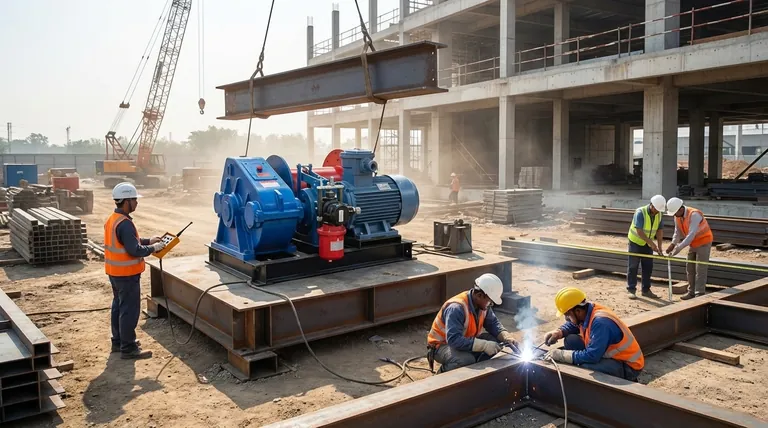
The Core Function: Automating Material Handling
A winch's primary impact comes from its ability to apply immense mechanical force with precision, fundamentally changing how materials are managed on a job site.
Eliminating Manual Transport
A winch completely removes the need for workers to physically carry, push, or drag heavy items. This is its most direct and obvious labor-saving function.
Enabling Continuous Workflow
By providing a steady and reliable flow of materials to an installation point, a winch prevents bottlenecks and allows skilled tradespeople to work uninterrupted, rather than waiting for materials to be manually delivered.
Achieving Precise Placement
Lowering a steel beam or a large pipe into a precise position is a slow and high-risk task for a group of workers. A winch allows a single operator to perform this task with controlled, incremental movements, increasing both speed and safety.
The Ripple Effect on Site Productivity
Automating material transport creates a cascade of benefits that amplify overall site efficiency and directly impact project timelines and budgets.
Redeploying Labor to Skilled Tasks
Instead of assigning three workers to move a heavy component, those same workers can be focused on assembly, fabrication, or finishing work. A winch turns labor from a transportation resource into a value-added one.
Reducing Worker Fatigue
Manual material handling is physically exhausting. By eliminating this strain, workers remain more alert and energetic throughout the day, leading to higher-quality work and fewer errors.
Accelerating Project Timelines
Faster and more efficient material movement translates directly to faster project phases. As noted in the construction of major structures like the Empire State Building, mechanical lifting is crucial for meeting aggressive schedules.
Understanding the Hidden Labor Costs of Injury
A critical, often overlooked, aspect of labor reduction is the prevention of injuries. Workplace accidents represent a significant drain on labor resources and project budgets.
Mitigating Lifting-Related Injuries
Back strains, sprains, and other musculoskeletal injuries are among the most common on construction sites. A winch removes the primary cause of these injuries by taking the load off the worker's body.
Reducing Manpower in Hazardous Zones
A winch can be operated from a safe distance. This reduces the number of personnel required to work in high-risk areas like deep trenches, at heights, or near unstable structures.
Avoiding the Indirect Costs of Accidents
An injured worker means lost time, administrative overhead for incident reporting, and potential work stoppages. By creating a safer environment, a winch protects your available labor pool and avoids these costly disruptions.
Making the Right Choice for Your Goal
To maximize the benefits, consider how a winch aligns with your primary operational objective.
- If your primary focus is accelerating the project schedule: View the winch as a tool to streamline the critical path, ensuring materials are always staged and ready for skilled installers without delay.
- If your primary focus is crew safety and risk reduction: Prioritize its use for eliminating the most hazardous manual handling tasks, thereby reducing your exposure to injuries and their associated costs.
- If your primary focus is budget control: Frame the winch as a direct investment in productivity that reduces billable labor hours and minimizes the financial risks of project delays and accidents.
By mechanizing the most physically demanding work, a winch allows you to apply your workforce with greater skill, safety, and precision.
Summary Table:
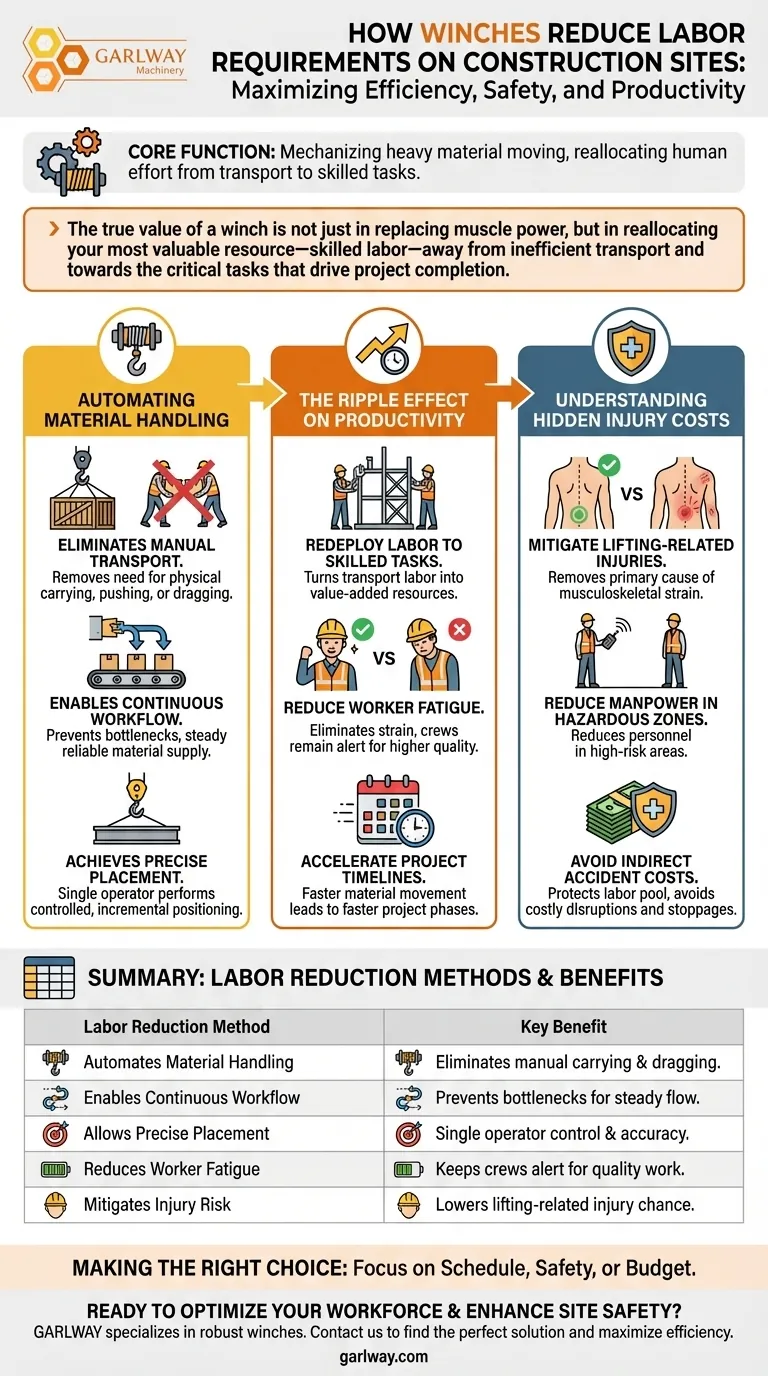
| Labor Reduction Method | Key Benefit |
|---|---|
| Automates Material Handling | Eliminates manual carrying, pushing, and dragging of heavy loads. |
| Enables Continuous Workflow | Prevents bottlenecks by ensuring a steady flow of materials. |
| Allows Precise Placement | A single operator can position heavy items with control and accuracy. |
| Reduces Worker Fatigue | Keeps crews more alert and energetic for higher-quality work. |
| Mitigates Injury Risk | Significantly lowers the chance of common lifting-related musculoskeletal injuries. |
Ready to optimize your workforce and enhance site safety?
GARLWAY specializes in providing robust and reliable construction machinery, including electric and hydraulic winches, designed to handle the toughest jobs. Our winches help construction companies and contractors globally reduce labor costs, prevent injuries, and keep projects on schedule.
Contact GARLWAY today to find the perfect winch solution for your project's needs and start maximizing your team's efficiency.
Visual Guide
Related Products
- Warn Winch Windlass Boat Trailer Winch
- Electric and Hydraulic Winch for Heavy Duty Applications
- Small Electric Winch 120V and 240V for Compact Applications
- Quick Windlass Portable Winch for Truck and Boat Best Boat Winch
- Hydraulic Winding Engine Harbor Freight Winch
People Also Ask
- What are the main components of a boat trailer winch? A Guide to Safe & Efficient Boat Loading
- What factors should be considered when choosing a boat trailer winch? Ensure Safe and Effortless Boat Loading
- What is the purpose of boat trailer winches? Safely and Efficiently Load Your Boat
- What are the two main types of boat trailer winches? Manual vs. Electric Explained
- How often should a boat trailer winch be replaced? Your Guide to Safety and Longevity