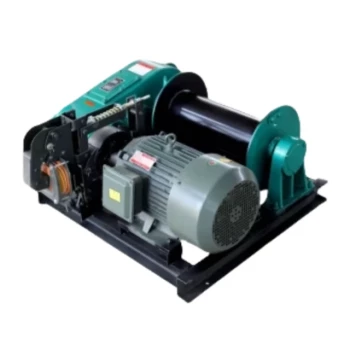
At its core, a trailer-mounted winch reduces the need for additional equipment by integrating the winch onto a mobile platform. This simple but powerful design primarily eliminates the requirement for separate heavy-lifting machinery, such as cranes or forklifts, which would otherwise be needed to transport and position a heavy, stationary winch at a worksite.
The true value of a trailer-mounted winch lies not just in its pulling capability, but in its self-contained mobility. This mobility streamlines job site logistics, reduces operational costs, and minimizes downtime by removing the dependency on separate positioning equipment.
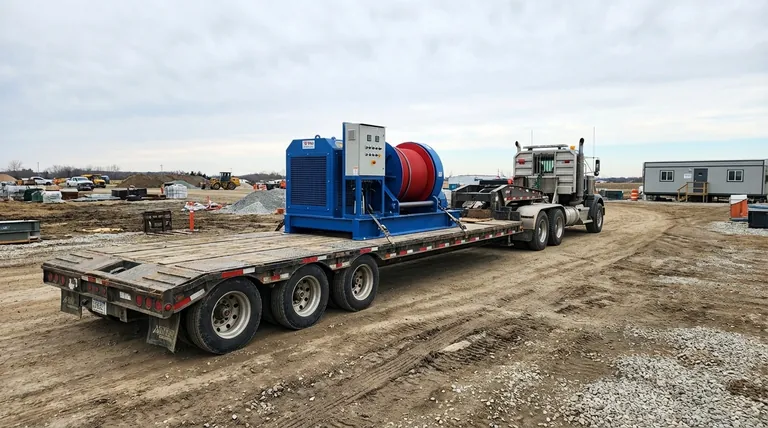
The Core Advantage: Integrated Mobility
A trailer-mounted winch functions as a complete, ready-to-deploy system. This integration is the key to its efficiency, directly impacting which other pieces of equipment are—and are not—required on site.
Eliminating Cranes and Forklifts
A heavy-duty winch is an incredibly dense and heavy piece of machinery. Without a trailer, moving it into the correct operational position requires a crane or a large forklift. The trailer-mounted design completely bypasses this step.
The winch is permanently affixed to its own chassis, making dedicated lifting equipment for the winch itself entirely redundant.
The Role of the Towing Vehicle
The system cleverly leverages a vehicle that is already part of the logistical chain: the main towing vehicle. This truck or tractor becomes the prime mover, responsible for both transporting the winch to the site and precisely maneuvering it into its final working position.
This dual-use of the tow vehicle is a major source of efficiency, consolidating roles and reducing the total number of machines and operators required.
From Transport to Operation
The setup process for a stationary winch can be complex, involving transport, careful unloading, and precise placement. In contrast, a trailer-mounted winch can be positioned, unhitched, and ready for operation in a fraction of the time.
This rapid deployment capability is a direct result of eliminating the intermediate steps that rely on other heavy equipment.
Unpacking the Operational Efficiencies
Removing equipment from the operational chain has significant positive impacts on project timelines, budgets, and overall flexibility.
Drastically Reduced Downtime
Every moment spent waiting for a crane to arrive, set up, and position a winch is a moment of unproductive downtime. A trailer-mounted winch allows work to begin almost immediately upon arrival at the site.
This reduction in setup time translates directly into increased productivity for the entire crew.
Significant Cost Savings
The financial benefits are clear and direct. By not requiring a crane or forklift, you eliminate associated rental fees, fuel costs, and the wages for a specialized heavy equipment operator.
Over the course of multiple jobs, these avoided costs can become one of the most compelling reasons to use a trailer-mounted system.
Increased Site Flexibility
Job site requirements can change. A pulling point may need to be adjusted, or the winch may need to be relocated entirely. With a stationary winch, this is a major undertaking.
With a trailer-mounted winch, the towing vehicle can simply be reconnected and the entire unit repositioned with minimal effort, offering tactical flexibility that is impossible with a fixed system.
Understanding the Trade-offs
While highly efficient, the trailer-mounted system is not without its specific considerations and limitations.
Dependence on the Towing Vehicle
The winch system is entirely dependent on a capable towing vehicle. Without it, the winch is immobile and unusable. The vehicle must have the appropriate towing capacity and hitching equipment.
Site Accessibility Constraints
The effectiveness of this system hinges on the ability of the tow vehicle and trailer to access the desired location. Sites with very soft ground, tight corners, or steep inclines can pose significant challenges to positioning.
Stability for Extreme Loads
While well-designed trailer winches have outriggers and anchoring points for stability, a permanently installed, deep-foundation winch may offer a more rigid platform for the most extreme and specialized pulling tasks.
Making the Right Choice for Your Operation
Choosing the right winch configuration depends entirely on the priorities of your specific application.
- If your primary focus is rapid deployment across multiple sites: A trailer-mounted winch is unmatched, as it eliminates the entire logistical step of positioning equipment.
- If your primary focus is reducing operational costs and complexity: The trailer-mounted winch offers a clear advantage by cutting rental and labor costs for cranes or forklifts.
- If your primary focus is performing work in a fixed, predictable location: A permanently installed winch may be more suitable, provided you have the means to install it.
By integrating mobility directly into the winch system, you fundamentally change the resources required to do the job.
Summary Table:
| Equipment Eliminated | How the Trailer-Mounted Winch Replaces It |
|---|---|
| Cranes & Forklifts | Integrated trailer allows for direct transport and positioning by the towing vehicle. |
| Separate Transport | The winch is a self-contained, mobile unit. |
| Complex Setup Equipment | Rapid deployment from transport to operation. |
Ready to simplify your heavy lifting operations and cut costs? GARLWAY specializes in construction machinery, offering robust trailer-mounted winches, concrete mixers, and batching plants designed for construction companies and contractors globally. Our solutions enhance your site efficiency and reduce dependency on extra equipment. Contact us today to find the perfect winch for your projects and experience the GARLWAY advantage!
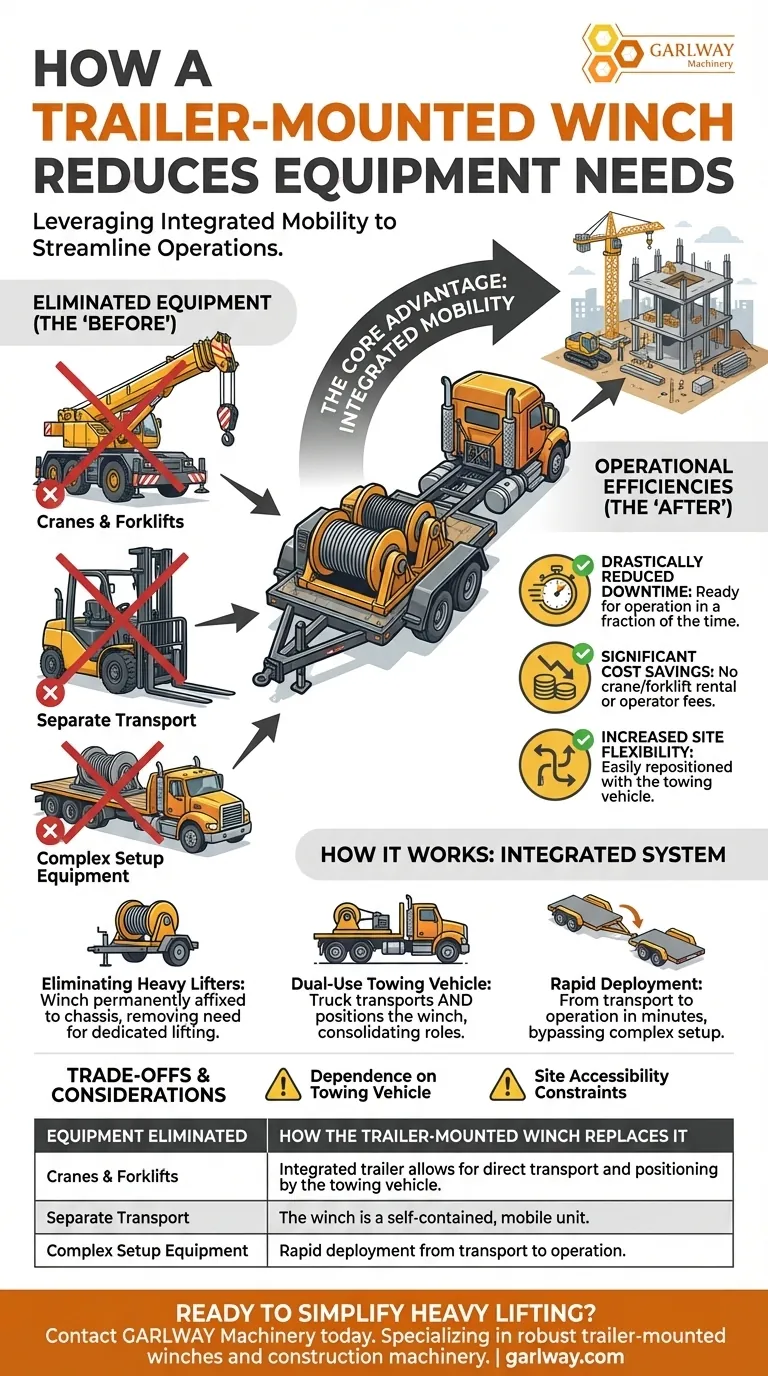
Visual Guide
Related Products
- Best 18000 Pound Drum Anchor Trailer Winch
- 12000 lb Electric Boat Trailer Winch with Windlass Anchor Warn
- Warn Winch Windlass Boat Trailer Winch
- Portable Small Trailer Winch
- Electric and Hydraulic Winch for Heavy Duty Applications
People Also Ask
- In what scenarios is a winch particularly useful for trailers? Load Heavy Items Safely & Efficiently
- How do you install a trailer winch? A Step-by-Step Guide for a Safe & Secure Setup
- What should be considered when mounting a winch on a trailer? Ensure a Safe, Aligned Installation
- What are the considerations for equipping a trailer with a winch for hauling a car? A Guide to Safe and Efficient Vehicle Loading
- What are the main types of trailer winches? Choose the Right Power Source for Your Load