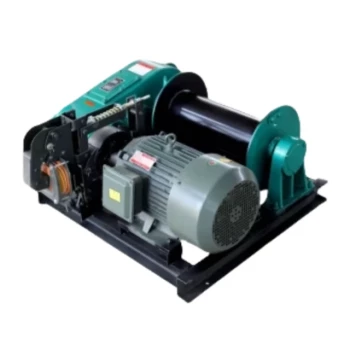
At their core, hydraulic towing winches are equipped with several key safety features designed to manage their immense power and protect the operator. The most common and critical of these are overload protection systems to prevent exceeding the winch's capacity and emergency stop mechanisms for immediate shutdown during a crisis.
The immense power and durability of a hydraulic winch are its greatest assets, but these very characteristics necessitate built-in safety features. These systems are not just add-ons; they are fundamental components designed to prevent equipment failure and ensure operator safety under heavy loads.
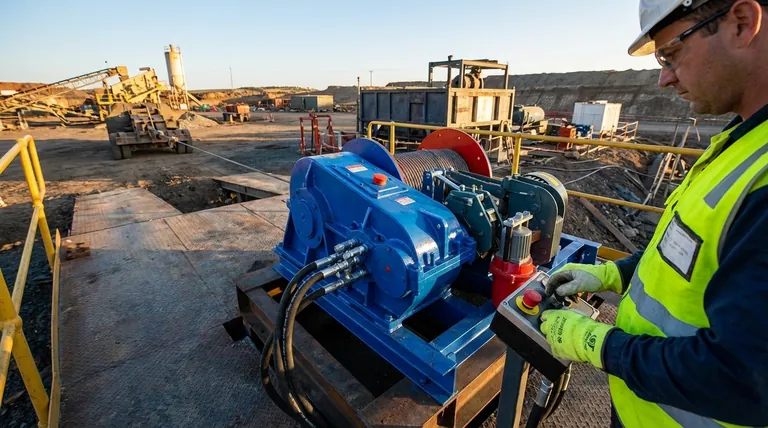
The Core Safety Mechanisms Explained
To appreciate the importance of these features, it's essential to understand what they do. Each system addresses a specific risk inherent in high-force pulling operations.
Overload Protection
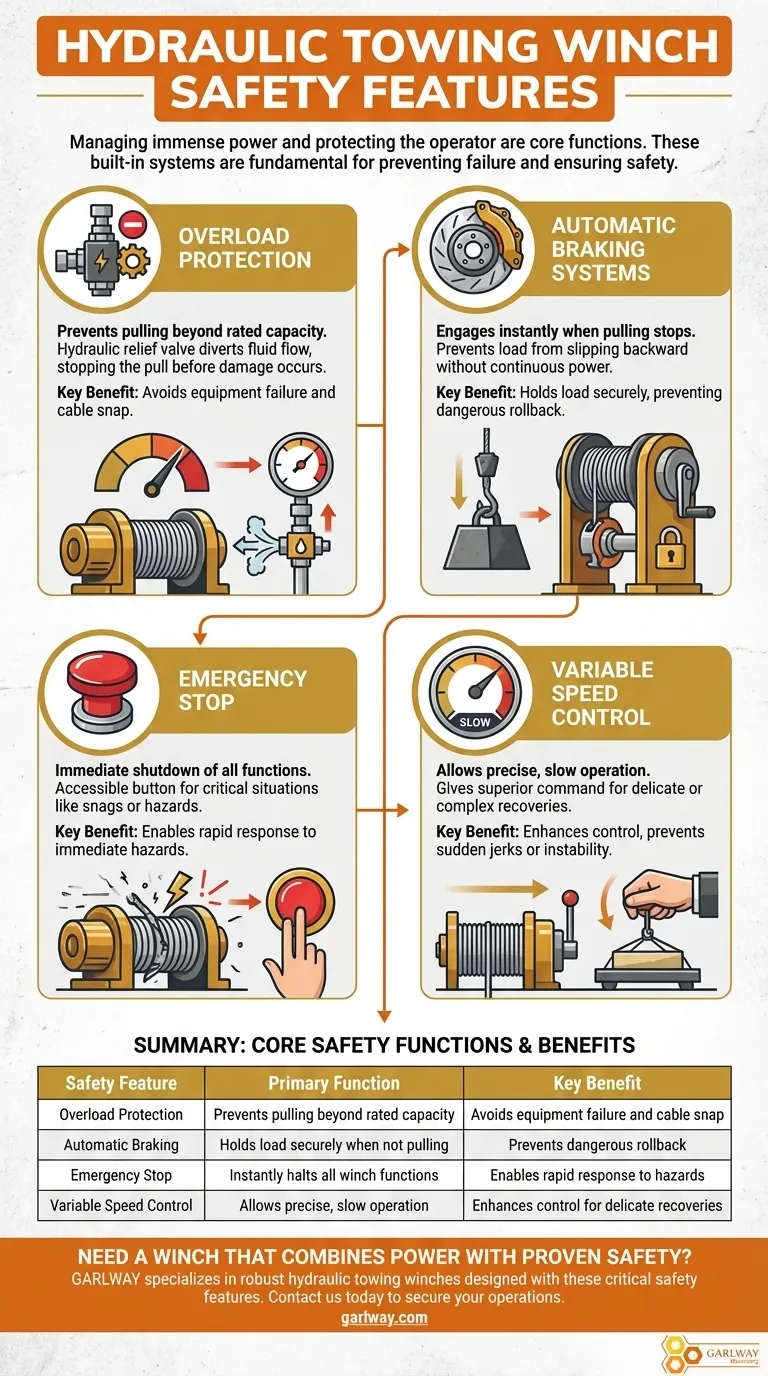
This is arguably the most critical safety feature. It is a system designed to prevent the winch from attempting to pull a load that exceeds its maximum rated capacity.
This is typically achieved through a hydraulic relief valve that diverts fluid flow, stopping the pull before the force can damage the winch motor, gears, cable, or the structure it's mounted on.
Automatic Braking Systems
Hydraulic winches are equipped with powerful, automatic brakes. These brakes engage the instant the operator stops pulling the load.
This prevents the load from slipping backward, which is crucial for safety when repositioning or securing a heavy object. The brake holds the load securely in place without requiring continuous power.
Emergency Stop
An emergency stop system, often a large, easily accessible button, provides an immediate and total shutdown of all winch functions.
In a critical situation—such as a snag, a shifting load, or a personnel hazard—the operator can instantly halt the operation to prevent an accident.
Variable Speed Control
While also a functional benefit, variable speed control is a key safety feature. The ability to pull in a load slowly and precisely gives the operator superior command over the operation.
For delicate or complex recoveries, this fine control prevents sudden jerks or movements that could destabilize the load or create a dangerous situation.
Why These Features are Non-Negotiable
The advantages of hydraulic winches—their high power-to-size ratio, consistent torque, and ability to handle extreme loads—also define their potential risks. Safety systems are the essential counterbalance to this power.
Managing Immense Force
A hydraulic winch does not slow down or strain audibly like an electric motor might when overloaded. It will simply continue pulling with consistent force until something breaks.
Overload protection is the only reliable way to prevent this catastrophic failure, protecting both the equipment and anyone in the vicinity.
Ensuring Operator Control
Winching operations can be unpredictable. Ropes can snag, loads can shift, and ground conditions can change in an instant.
The combination of an emergency stop and variable speed control gives the operator the authority to react to these changes instantly and safely, maintaining control even when things go wrong.
Securing the Load at All Times
The primary goal of any winching task is to move a load from one point to another safely. The automatic brake is fundamental to this goal.
It ensures that once a load is moved, it stays put, removing the risk of rollback that could endanger people or damage property.
Understanding the Operational Realities
While built-in features are critical, safe operation also depends on understanding the winch's operational requirements and limitations.
The Need for a Power Source
A hydraulic winch is useless without a running hydraulic power source, typically the vehicle's engine turning a hydraulic pump.
If the engine stalls, all winch power is lost. Operators must plan for this possibility, ensuring the load is stable and the automatic brake is functioning correctly before starting a pull.
Maintenance as a Safety Prerequisite
The reliability of a hydraulic system is dependent on its integrity. Hoses, fittings, and hydraulic fluid levels must be inspected regularly.
A sudden hydraulic leak can cause a loss of pulling power and braking ability, creating an immediate and severe safety hazard.
The Irreplaceable Role of Training
Safety features are a backstop, not a substitute for a skilled operator.
Proper training on load calculation, safe rigging techniques, and understanding the winch's specific controls are paramount. The best safety feature is an operator who knows how to avoid needing one.
How to Apply This to Your Operation
When selecting or operating a hydraulic winch, your primary goal should dictate which features you scrutinize most closely.
- If your primary focus is heavy industrial recovery: Prioritize a winch with a highly reliable automatic brake and a precisely calibrated overload protection system to handle unpredictable, heavy loads.
- If your primary focus is marine or offshore use: Ensure all controls, especially the emergency stop, are designed for harsh, corrosive environments and are easily accessible.
- If your primary focus is continuous, daily use: Focus on winches with excellent variable speed control and durable components to ensure both precision and safety over long operating cycles.
Ultimately, viewing a hydraulic winch's safety systems as integral to its function transforms it from a simple tool into a dependable asset for your most demanding tasks.
Summary Table:
| Safety Feature | Primary Function | Key Benefit |
|---|---|---|
| Overload Protection | Prevents pulling beyond rated capacity | Avoids equipment failure and cable snap |
| Automatic Braking | Holds load securely when not pulling | Prevents dangerous rollback |
| Emergency Stop | Instantly halts all winch functions | Enables rapid response to hazards |
| Variable Speed Control | Allows precise, slow operation | Enhances control for delicate recoveries |
Need a winch that combines power with proven safety? GARLWAY specializes in robust construction machinery, including hydraulic towing winches designed with the critical safety features outlined above. Our winches are built for construction companies and contractors who demand reliability under extreme loads. Contact us today to discuss how a GARLWAY winch can secure your operations and protect your team.
Visual Guide
Related Products
- Electric and Hydraulic Winch for Heavy Duty Applications
- Hydraulic Winding Engine Harbor Freight Winch
- Warn Winch Windlass Boat Trailer Winch
- 12000 lb Electric Boat Trailer Winch with Windlass Anchor Warn
- Portable Small Trailer Winch
People Also Ask
- What are the differences between electric and hydraulic winches? Choose the Right Winch for Your Job
- What are some common uses for a heavy-duty winch? Power Your Construction & Industrial Projects
- What are electro-hydraulic winches and their applications? The Integrated Power Solution for Heavy-Duty Operations
- How do winches assist in bridge launching? Accelerate Bridge Placement with Controlled Pulling Power
- What are the benefits of using heavy-duty winches for large projects? Boost Efficiency & Safety