As a general principle, the minimum distance between your bow roller and winch drum is calculated to ensure the angle of the anchor rode feeding onto the drum does not exceed 18 degrees from edge to edge. For a winch with a 300mm wide drum, this requires a minimum distance of approximately 948mm to allow the rode to "self-level" correctly.
The core issue is preventing the anchor rode from bunching up on one side of the winch drum. Maintaining a sufficient distance creates a shallow "angle of approach," which allows the rode to spool evenly across the drum automatically, ensuring reliable operation.
The Core Principle: The Angle of Approach
What is "Self-Leveling"?
A self-leveling winch is one that spools the anchor rode (rope or chain) evenly across the drum without requiring manual guidance.
This automated layering is crucial for preventing jams and ensuring the winch can hold its rated capacity. It relies entirely on correct installation geometry.
The 18-Degree Rule
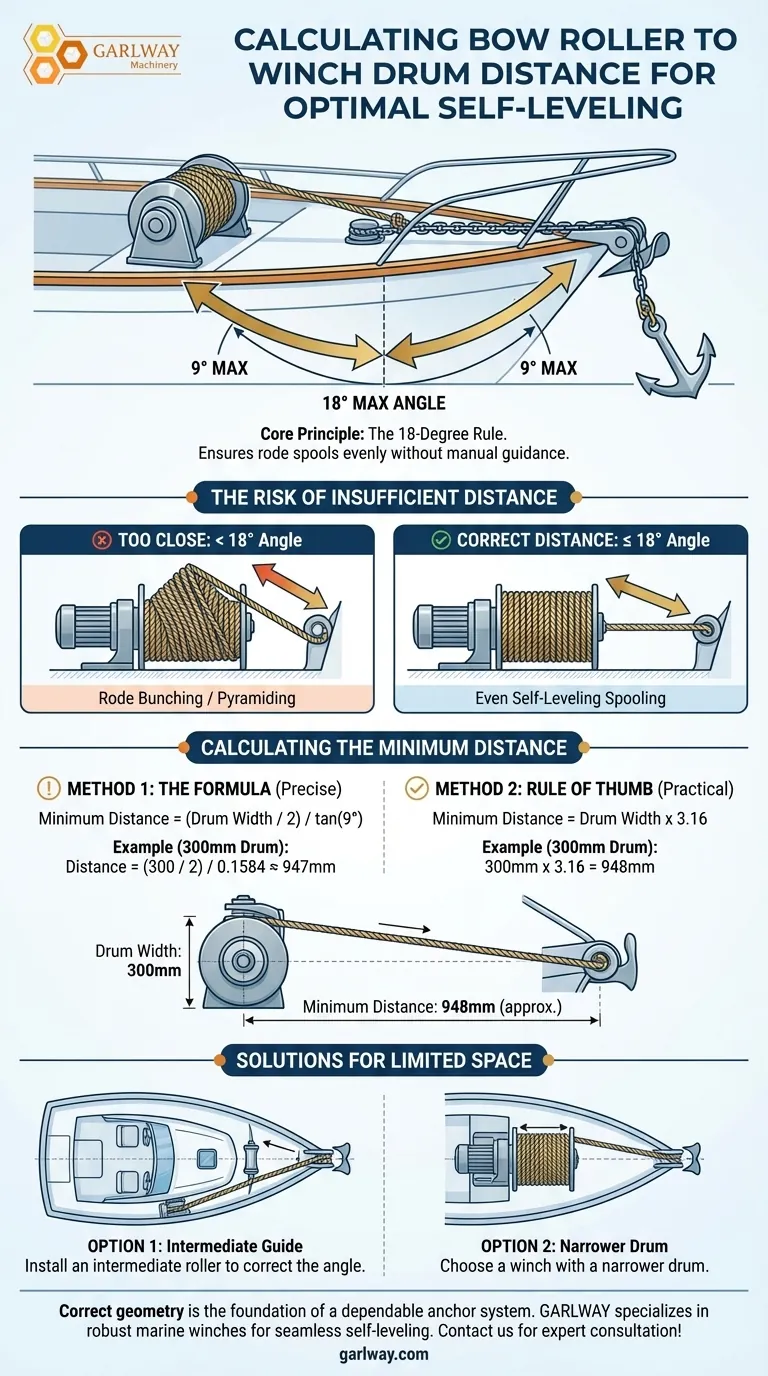
To achieve proper self-leveling, the angle from the center of the bow roller to the extreme edges of the winch drum must be no more than 18 degrees.
If the angle is too steep (i.e., the winch is too close to the roller), the rode will not have enough room to naturally move side-to-side. It will tend to pile up in the middle or on one side, a problem known as "bunching" or "pyramiding."
Calculating the Minimum Distance
You can determine the required distance for your specific winch using a simple calculation or a reliable rule of thumb.
The Formula Explained
The relationship between drum width and distance is based on right-angle trigonometry. The goal is to solve for the distance that keeps the angle to each edge of the drum at 9 degrees or less (for a total of 18 degrees).
The formula is: Minimum Distance = (Drum Width / 2) / tan(9°)
For example, with a 300mm drum: Distance = (300mm / 2) / 0.1584 Distance = 150mm / 0.1584 Distance ≈ 947mm
Therefore, the winch must be installed at least 948mm behind the bow roller.
A Practical Rule of Thumb
For quick field calculations, a simple multiplier is highly effective and easy to remember.
Minimum Distance = Drum Width x 3.16
Using our 300mm drum example: 300mm x 3.16 = 948mm
This rule provides a safe and accurate minimum distance for any drum size.
Understanding the Trade-offs
Achieving this ideal distance is critical, but not always possible on every vessel. Understanding the consequences is key to finding a solution.
The Risk of Insufficient Distance
Installing the winch closer than the calculated minimum will almost certainly lead to poor performance.
The rode will bunch up, creating a pyramid shape on the drum. This can cause the winch to jam, increase wear on the rode, and significantly reduce the effective capacity of the drum.
What If You Lack the Space?
If your boat's layout does not allow for the ideal distance, you have two primary options.
First, you can install an intermediate guide or roller between the bow roller and the winch. This guide effectively becomes the new measuring point, and as long as it is the correct distance from the winch, it will ensure a proper angle of approach.
Second, you can choose a winch with a narrower drum. A narrower drum requires less distance to maintain the 18-degree angle, making it a better fit for space-constrained installations.
Making the Right Choice for Your Installation
Applying this principle correctly ensures your anchoring system is reliable and operates as designed.
- If your primary focus is a new installation: Use the
Drum Width x 3.16rule of thumb to plan your layout and ensure flawless, hands-free operation from day one. - If your primary focus is retrofitting into a tight space: Measure your available distance first, and if it's insufficient, plan to install an intermediate guide or select a winch with a narrower drum.
- If your primary focus is troubleshooting poor spooling: The first step is to measure the distance and calculate the angle; an incorrect installation distance is the most common cause of rode bunching.
Ultimately, correct geometry is the foundation of a dependable self-leveling anchor winch system.
Summary Table:
| Factor | Calculation | Purpose |
|---|---|---|
| Maximum Angle | 18 degrees (9° per side) | Ensures rode self-levels correctly |
| Formula | Distance = (Drum Width / 2) / tan(9°) | Precise calculation for any drum size |
| Rule of Thumb | Distance = Drum Width x 3.16 | Quick, practical field calculation |
| Example (300mm Drum) | 300mm x 3.16 = 948mm | Minimum required distance for reliable spooling |
Need a reliable winch for your vessel? GARLWAY specializes in robust marine winches designed for seamless self-leveling and long-term durability. Our experts can help you select the perfect winch and ensure it's installed with the correct geometry for flawless operation. Contact GARLWAY today for a consultation and get a dependable anchoring solution!
Visual Guide
Related Products
- Best 18000 Pound Drum Anchor Trailer Winch
- Warn Winch Windlass Boat Trailer Winch
- Portable Small Trailer Winch
- Heavy Duty Electric Boat Winch Windlass Anchor
- Belle Mixer Drum Self Loading Mortar Mixers JS3000
People Also Ask
- In what scenarios is a winch particularly useful for trailers? Load Heavy Items Safely & Efficiently
- How do you install a trailer winch? A Step-by-Step Guide for a Safe & Secure Setup
- What should be considered when mounting a winch on a trailer? Ensure a Safe, Aligned Installation
- What are the considerations for equipping a trailer with a winch for hauling a car? A Guide to Safe and Efficient Vehicle Loading
- What are the main types of trailer winches? Choose the Right Power Source for Your Load