
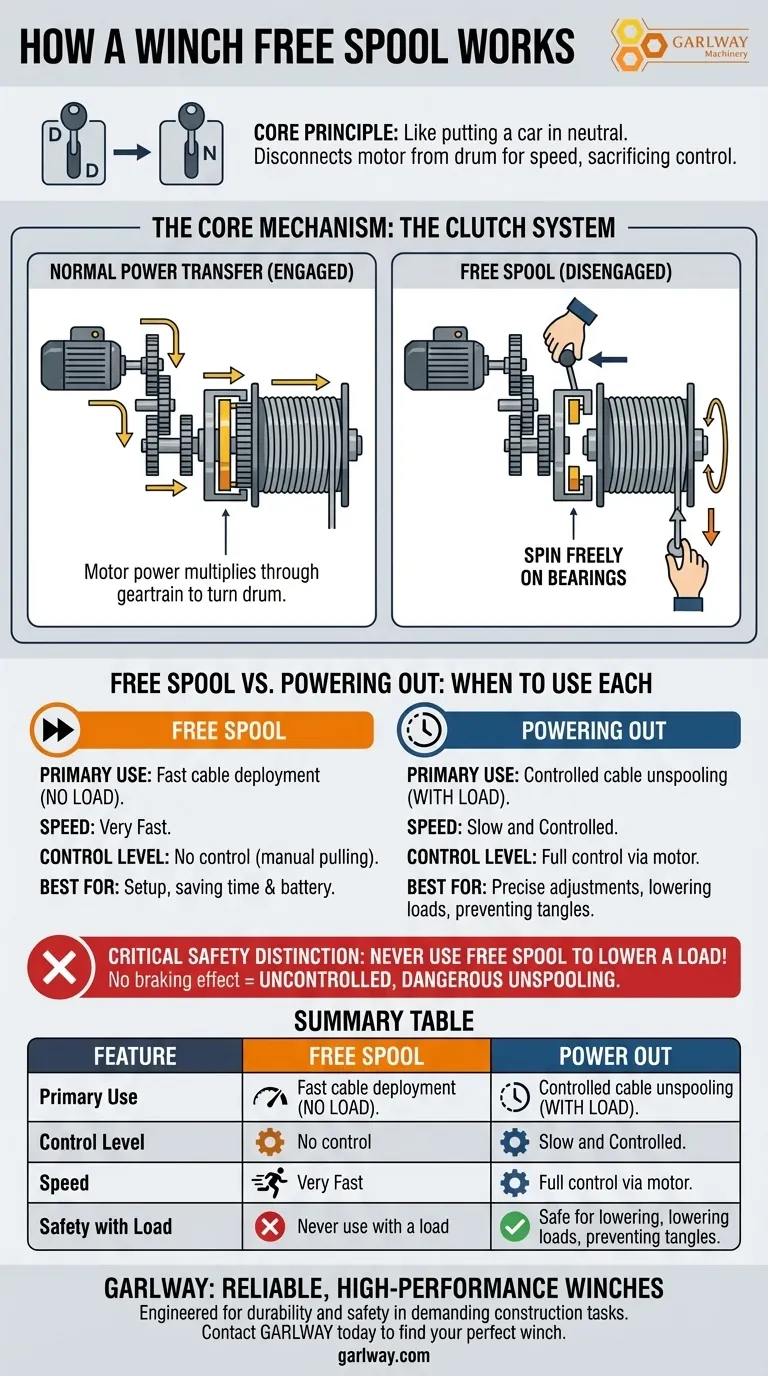
A winch's free spool function works by mechanically disengaging the winch drum from its motor and geartrain. This allows the drum to spin freely, enabling you to pull the winch cable out by hand much faster than you could by using the motor to "power out." It is a clutch mechanism designed purely for rapid deployment of the cable before a load is applied.
The core principle is simple: free spooling is like putting a car in neutral. It disconnects the engine (the winch motor) from the wheels (the winch drum), prioritizing speed for setup over the slow, controlled action of powering the cable out.
The Core Mechanism: The Clutch System
To understand free spooling, you first need to understand how a winch is normally powered. The clutch is the component that connects or disconnects that power.
How Power Is Normally Transferred
A winch motor, whether electric or hydraulic, doesn't connect directly to the drum. It turns a series of reduction gears, known as a geartrain. This geartrain multiplies the motor's torque, generating the immense pulling force the winch needs. The final gear in this train engages with the winch drum to make it turn.
Disengaging for Free Spool
The free spool feature is controlled by a lever or knob. When you activate it, you are physically sliding a clutch mechanism (often a ring gear or dog clutch) out of position. This action creates a physical gap, disconnecting the drum from the geartrain.
The Result: A Free-Spinning Drum
With the drum completely decoupled from the motor and gears, it is no longer held in place by the drivetrain. It can now spin freely on its bearings. This allows you to grab the hook and walk the cable out to your anchor point with minimal resistance.
Free Spool vs. Powering Out: When to Use Each
Choosing between free spool and powering out is a fundamental decision based on the immediate task. One prioritizes speed, the other prioritizes control.
The Case for Free Spool
Use the free spool function when you need to get your cable to an anchor point quickly and there is no load on the line. This is the standard procedure for setting up almost any recovery or pull. It saves time, battery power, and wear on the winch motor.
The Case for Powering Out
Use the "power out" function when you need absolute control over the cable as it unspools. This is essential when you need to let the line out under slight tension to prevent tangles or when making very small, precise adjustments, such as slightly lowering a vehicle.
A Critical Safety Distinction
Never use the free spool function to lower a load. Disengaging the clutch removes the braking effect of the geartrain. A load on the line would cause it to unspool uncontrollably, creating an extremely dangerous situation.
Understanding the Trade-offs
Every operational mode has benefits and potential drawbacks. Understanding them is key to using your winch effectively and safely.
Speed vs. Control
This is the central trade-off. Free spooling sacrifices all control for maximum deployment speed. Powering out sacrifices speed for methodical, absolute control over the line.
Potential for Cable Tangles
If you pull the cable out too quickly or carelessly in free spool mode, you can create a "bird's nest"—a tangled mess of cable on the drum. This can damage the cable and cause it to bind up during the pull. Always try to maintain light, steady tension by hand.
Mechanical Engagement
Always ensure the clutch is fully engaged before beginning a pull. A partially engaged clutch can slip under load, causing damage to the gear teeth. You should hear or feel a solid "clunk" when it locks back into place.
Making the Right Choice for Your Task
Your goal determines which function to use. Applying the right mode at the right time is the mark of a skilled operator.
- If your primary focus is a fast setup for a standard pull: Use the free spool to walk the line quickly to your anchor point, then firmly engage the clutch before you begin winching.
- If your primary focus is letting out line with precise control: Use the power-out function to slowly unspool the cable, which keeps it neat on the drum and prevents uncontrolled movement.
- If your primary focus is safety when repositioning a load: Never use free spool. Always use the power-out function to maintain control through the motor and braking system.
Mastering the use of your winch's clutch is the first step toward conducting safe, efficient, and successful recoveries.
Summary Table:
| Feature | Free Spool | Power Out |
|---|---|---|
| Primary Use | Fast cable deployment (no load) | Controlled cable unspooling |
| Control Level | No control (manual pulling) | Full control via motor |
| Speed | Very Fast | Slow and Controlled |
| Safety with Load | Never use with a load | Safe for lowering/positioning loads |
Need a reliable winch with a robust free spool clutch?
GARLWAY specializes in high-performance construction machinery. Our winches are engineered for durability and safety, providing construction companies and contractors with the precise control needed for demanding recovery and lifting tasks.
Contact GARLWAY today to find the perfect winch for your project's requirements.
Visual Guide
Related Products
- Portable Small Trailer Winch
- Quick Windlass Portable Winch for Truck and Boat Best Boat Winch
- Warn Winch Windlass Boat Trailer Winch
People Also Ask
- What is the significance of trailer winches in the boating industry? Ensure Safe and Efficient Boat Recovery
- What are the considerations for equipping a trailer with a winch for hauling a car? A Guide to Safe and Efficient Vehicle Loading
- What should be considered when mounting a winch on a trailer? Ensure a Safe, Aligned Installation
- What features were incorporated into the upgraded portable winch system? Boost Your Recovery Power & Safety
- How could the twisting issue with a portable winch be mitigated? Achieve Safe, Centered Pulls with Proper Rigging


