In concrete production, precision is not a preference; it is a prerequisite. Accurate material batching is the critical process of measuring ingredients to ensure the final concrete meets the specific strength, durability, and quality requirements dictated by its engineered mix design. Without this precision, the resulting material is unpredictable and can fundamentally compromise the integrity of the structure.
Accurate batching transforms a simple mixture of aggregates, cement, and water into a predictable, high-performance construction material. Inaccuracy in this process introduces uncontrolled variables that directly undermine structural integrity, durability, and project viability.
The Mix Design: An Engineering Formula, Not a Recipe
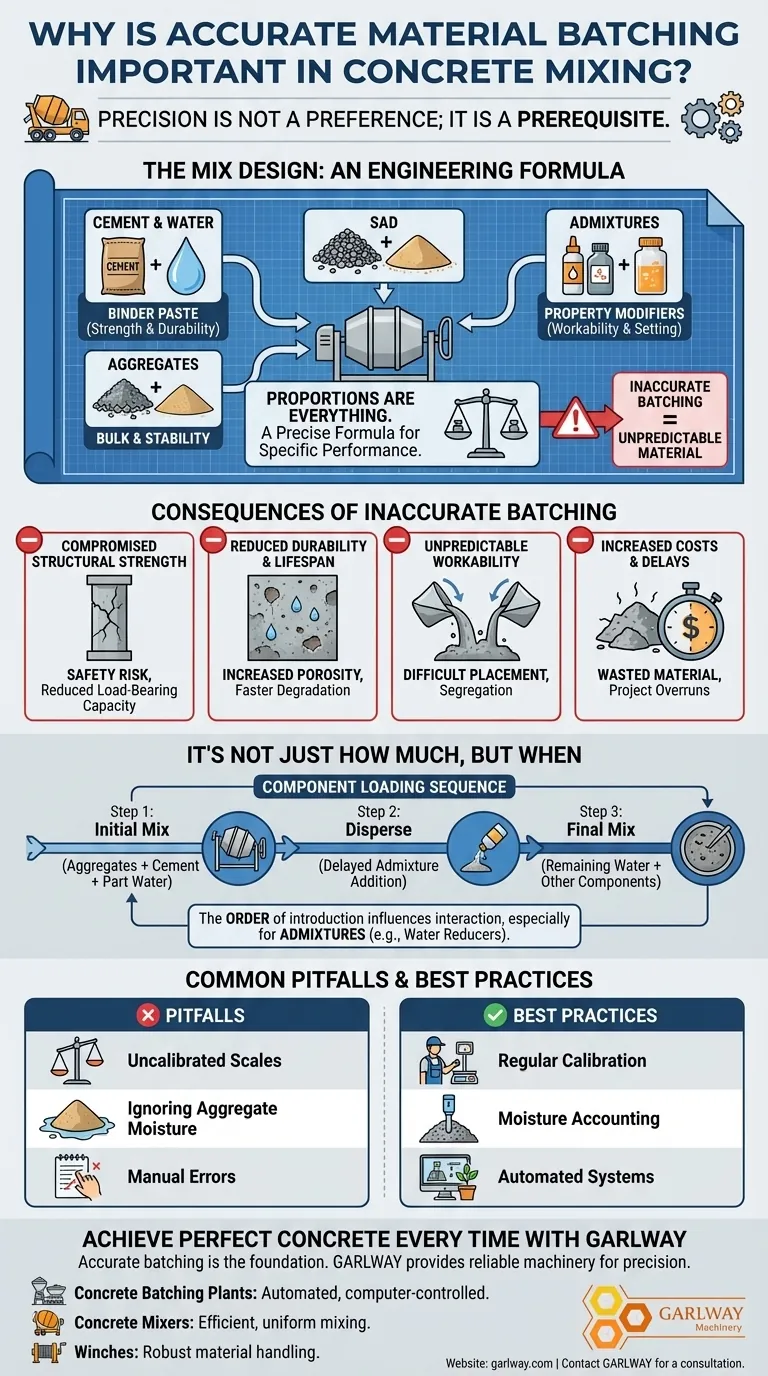
The foundation of any high-quality concrete is the mix design. This is not a rough guideline but a precise formula calculated by engineers to achieve specific performance characteristics for a given application.
Understanding the Goal
A mix design specifies the exact proportions of cement, water, coarse and fine aggregates, and chemical admixtures. This formula is tailored to meet demands like compressive strength, workability, and resistance to environmental factors.
The Role of Each Component
Each ingredient has a distinct function. Cement and water form a paste that binds the aggregates, and the water-to-cement ratio is the single most important factor in determining concrete strength. Aggregates provide bulk and stability, while admixtures can modify properties like setting time or flowability.
Why Proportions Are Everything
Even minor deviations from the mix design can have significant consequences. Too much water weakens the concrete, while too little can make it impossible to place and finish properly. The wrong amount of aggregate affects both strength and volume.
The Consequences of Inaccurate Batching
When batching is imprecise, the failure is not just theoretical. It manifests in tangible defects that can impact a project from the pour to its entire service life.
Compromised Structural Strength
The most critical failure is a loss of compressive strength. If the concrete cannot withstand the loads it was designed for, the safety and stability of the entire structure are at risk.
Reduced Durability and Lifespan
Incorrect proportions can lead to highly porous concrete. This allows water and chemicals to penetrate, leading to faster degradation from freeze-thaw cycles and corrosion of the steel reinforcement within.
Unpredictable Workability
Workability—the ease of placing, consolidating, and finishing fresh concrete—is highly sensitive to batching. An incorrect mix can be too stiff to pump or too fluid, causing the heavy aggregates to segregate from the cement paste.
Increased Costs and Delays
A batch of concrete that fails quality control testing must be rejected. This results in wasted material, project delays, and significant cost overruns.
It's Not Just How Much, But When
Advanced concrete production recognizes that the sequence of adding ingredients also matters. The process of component loading can significantly influence the final properties of the mix.
The Science of Dispersion
The order in which materials are introduced to the mixer affects how well they interact. This is especially true for chemical admixtures, which are designed to perform specific functions at a molecular level.
A Practical Example: Water Reducers
For instance, delaying the addition of a high-range water reducer (superplasticizer) until after the cement and water have initially mixed can improve its effectiveness. This allows the admixture to disperse cement particles more efficiently, achieving the desired workability with a lower, more cost-effective dosage.
Common Pitfalls and Best Practices
Achieving consistent accuracy requires understanding the common points of failure in the batching process and implementing robust controls.
Equipment Calibration is Non-Negotiable
The batching process relies on feeders and weighing devices. These scales and meters must be regularly calibrated to ensure they are measuring accurately. An uncalibrated scale is a primary source of error.
Accounting for Aggregate Moisture
Sand and gravel often contain residual moisture. This water must be measured and accounted for as part of the total water in the mix. Failing to subtract this "free water" from the amount added will lead to a higher-than-specified water-to-cement ratio, directly weakening the concrete.
Manual vs. Automated Systems
While manual batching is possible, it is highly susceptible to human error. Modern computer-controlled batching plants provide far greater precision and repeatability, ensuring every batch is consistent with the approved mix design.
Making the Right Choice for Your Goal
Ensuring batching accuracy is a matter of aligning your quality control processes with your project's primary objectives.
- If your primary focus is structural integrity: Insist on using certified concrete plants with regularly calibrated, automated batching systems to guarantee strict adherence to the engineering mix design.
- If your primary focus is project efficiency: Implement rigorous quality control checks and proper staff training to minimize rejected batches, thereby reducing material waste and preventing costly delays.
- If your primary focus is high-performance concrete: Pay close attention not just to ingredient quantities but also to the specified loading sequence for admixtures to achieve specialized properties reliably.
Ultimately, treating batching as a precise engineering process is the foundation upon which every successful and durable concrete structure is built.
Summary Table:
| Consequence of Inaccurate Batching | Impact on Concrete |
|---|---|
| Compromised Structural Strength | Reduced load-bearing capacity, safety risk |
| Reduced Durability & Lifespan | Increased porosity, faster degradation |
| Unpredictable Workability | Difficult placement, segregation |
| Increased Costs & Delays | Wasted material, project overruns |
Achieve Perfect Concrete Every Time with GARLWAY
Accurate batching is the foundation of durable, high-strength concrete. GARLWAY specializes in providing construction companies and contractors globally with reliable machinery to ensure precision in every batch. Our product range includes:
- Concrete Batching Plants: Automated, computer-controlled systems for consistent, high-volume production.
- Concrete Mixers: Efficient and uniform mixing for optimal quality.
- Winches: Robust equipment for material handling on site.
By partnering with GARLWAY, you gain access to machinery designed for accuracy, durability, and efficiency—minimizing errors, reducing waste, and protecting your project's structural integrity. Let us help you build with confidence.
Contact GARLWAY today for a consultation on the right equipment for your batching needs!
Visual Guide
Related Products
- HZS120 Ready Mix Concrete Batching Plant Commercial Mud Cement Mixer
- HZS35 Small Cement Concrete Mixing Batch Plant
- HZS75 Concrete Batching Plant Cement Mixer Price Concrete Mixer Bunnings Mixing Plant
- HZS180 Ready Mix Concrete Plant for Foundations with Sand and Cement
- Commercial Electric Concrete Mixer Machine HZS 50 Small Batch Plant for Sale
People Also Ask
- What is a ready mix concrete batching plant? The Engine of Modern Construction
- What is the name of the machine used in ready mix? Unpacking the Complete Concrete System
- What is the core component of a concrete batching plant? The Mixer Unit Defines Your Concrete Quality
- What are the types of concrete mixers used in batching plants? Choose the Right Mixer for Your Project
- What are the advantages and disadvantages of concrete batching plants? Maximize Quality & Efficiency