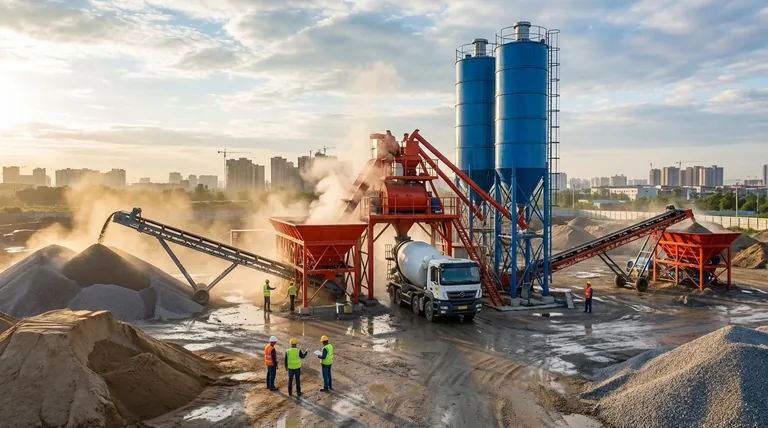
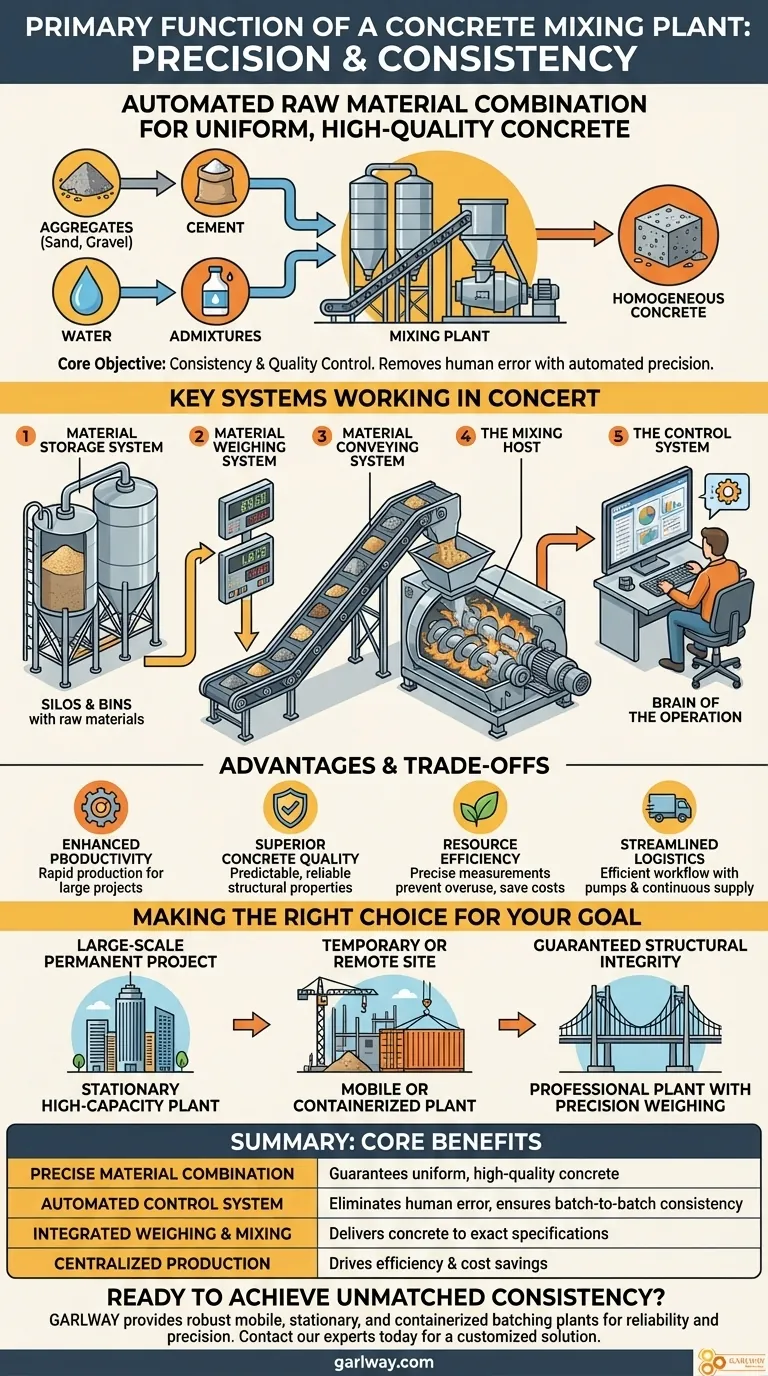
The primary function of a concrete mixing plant is to precisely combine raw materials like aggregates, sand, water, and cement to produce large batches of uniform, high-quality concrete. Its purpose is to automate and centralize this process, moving beyond manual on-site mixing to achieve superior consistency and productivity.
A concrete mixing plant is more than just a mixer; it is an integrated system designed to guarantee that every batch of concrete meets exact specifications, eliminating the variability and inefficiency of traditional methods.
The Core Objective: Consistency and Quality Control
The fundamental goal of a concrete mixing plant is to remove guesswork and human error from the production of concrete. This is achieved through a highly controlled and automated process.
From Raw Materials to a Homogeneous Mix
The plant takes individual ingredients and combines them according to a specific recipe, or "mix design." The goal is to ensure every particle of aggregate is evenly coated with cement paste, creating a single, homogenous material.
The Role of Automation
Modern plants are highly mechanized and automated. A central control system manages the entire sequence, from retrieving materials from storage to the final discharge of the mixed concrete.
Ensuring Uniform Proportions
This automation guarantees that the proportions of each ingredient are identical from one batch to the next. This consistency is critical for achieving the specified strength, durability, and workability required by engineering standards.
The Key Systems of a Mixing Plant
A concrete mixing plant isn't a single machine but a series of interconnected systems working in concert. Understanding these components reveals how quality is maintained.
Material Storage System
This includes the silos for storing cement and the bins for holding different types of aggregates (like sand, gravel, and crushed stone).
Material Weighing System
This is arguably the most critical system for quality control. It uses precise scales to weigh each raw material—including water and any chemical admixtures—before it enters the mixer.
Material Conveying System
This system, typically composed of conveyor belts and screw conveyors, transports the weighed materials from storage to the mixing host.
The Mixing Host
This is the heart of the plant where the actual mixing occurs. It vigorously blends the raw materials for a set period to ensure a completely uniform and homogenous concrete is produced.
The Control System
The control system is the "brain" of the operation. An operator inputs the desired mix design, and the computer orchestrates every step of the weighing, conveying, and mixing process.
Understanding the Advantages and Trade-offs
Choosing centralized mixing over on-site manual methods involves clear trade-offs, with the plant offering significant advantages in professional settings.
Enhanced Productivity
A concrete plant can produce vast quantities of concrete far more rapidly than manual methods. This is essential for large-scale construction projects where delays are costly.
Superior Concrete Quality
By eliminating human error in measurement, the plant produces concrete with predictable and reliable properties. This is non-negotiable for structural applications where safety and longevity are paramount.
Resource Efficiency and Cost Savings
Precise measurements prevent the overuse of expensive materials, particularly cement. Over the course of a large project, these savings can be substantial.
Streamlined Construction Logistics
Centralized plants facilitate a more efficient workflow on the construction site. They enable the use of concrete pumps and a continuous supply chain of mixing, transporting, and pouring machinery.
Making the Right Choice for Your Goal
The type of mixing plant used is dictated entirely by the project's scale and logistical needs.
- If your primary focus is a large-scale, permanent project: A stationary, high-capacity plant is required to serve as a central supply base.
- If your primary focus is a temporary or remote construction site: A mobile or containerized mixing plant provides the flexibility to produce quality concrete on-demand, wherever it's needed.
- If your primary focus is guaranteed structural integrity: The precision weighing and automated control of any professional mixing plant is the only way to ensure concrete meets strict engineering specifications.
Ultimately, using a concrete mixing plant is about controlling variables to deliver a predictable, high-performance building material at scale.
Summary Table:
| Key Function | Core Benefit |
|---|---|
| Precise Material Combination | Guarantees uniform, high-quality concrete |
| Automated Control System | Eliminates human error and ensures batch-to-batch consistency |
| Integrated Weighing & Mixing | Delivers concrete that meets exact engineering specifications |
| Centralized Production | Drives efficiency and cost savings for large-scale construction |
Ready to achieve unmatched consistency and efficiency on your next project?
GARLWAY specializes in providing robust concrete mixing plants, including mobile, stationary, and containerized batching plants, designed for construction companies and contractors who demand reliability and precision. Our solutions ensure your concrete meets the highest standards of strength and durability, project after project.
Contact our experts today to discuss the ideal concrete batching plant for your specific needs and receive a customized solution.
Visual Guide
Related Products
- HZS120 Ready Mix Concrete Batching Plant Commercial Mud Cement Mixer
- HZS35 Small Cement Concrete Mixing Batch Plant
- HZS75 Concrete Batching Plant Cement Mixer Price Concrete Mixer Bunnings Mixing Plant
- HZS180 Ready Mix Concrete Plant for Foundations with Sand and Cement
- Commercial Electric Concrete Mixer Machine HZS 50 Small Batch Plant for Sale
People Also Ask
- What is a ready mix concrete batching plant? The Engine of Modern Construction
- What is the name of the machine used in ready mix? Unpacking the Complete Concrete System
- What is the core component of a concrete batching plant? The Mixer Unit Defines Your Concrete Quality
- What are the types of concrete mixers used in batching plants? Choose the Right Mixer for Your Project
- What are the advantages and disadvantages of concrete batching plants? Maximize Quality & Efficiency