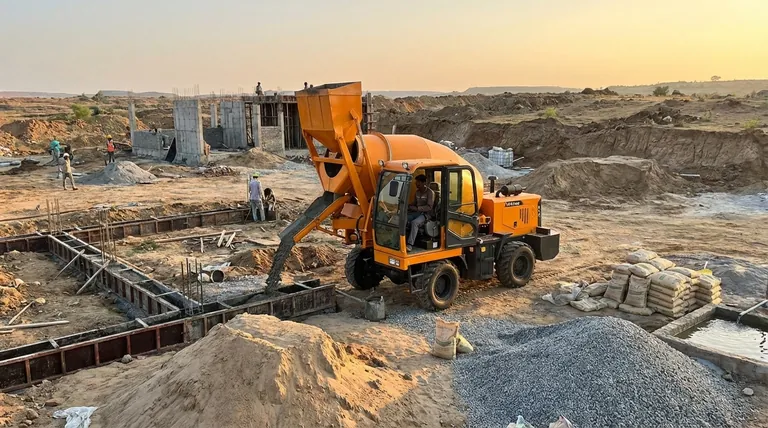
The cost-effectiveness of a self-loading mixer is rooted in its fundamental redesign of the concrete production process. By consolidating the roles of a wheel loader, concrete mixer, and transporter into a single unit, it directly attacks the three largest cost centers in concrete work: labor, materials, and equipment logistics. This allows for precise, on-demand production directly at the pour site, transforming a complex supply chain into a streamlined, on-site operation.
A self-loading mixer should be viewed not just as a piece of equipment, but as a mobile batching plant. Its primary value lies in shifting concrete production from a logistical dependency into a controlled, on-site manufacturing process, which fundamentally reduces waste and operational overhead.
The Core Financial Advantages of On-Site Production
The most significant savings come from eliminating the inefficiencies inherent in traditional concrete delivery. By producing concrete exactly when and where it is needed, you gain direct control over your primary resources.
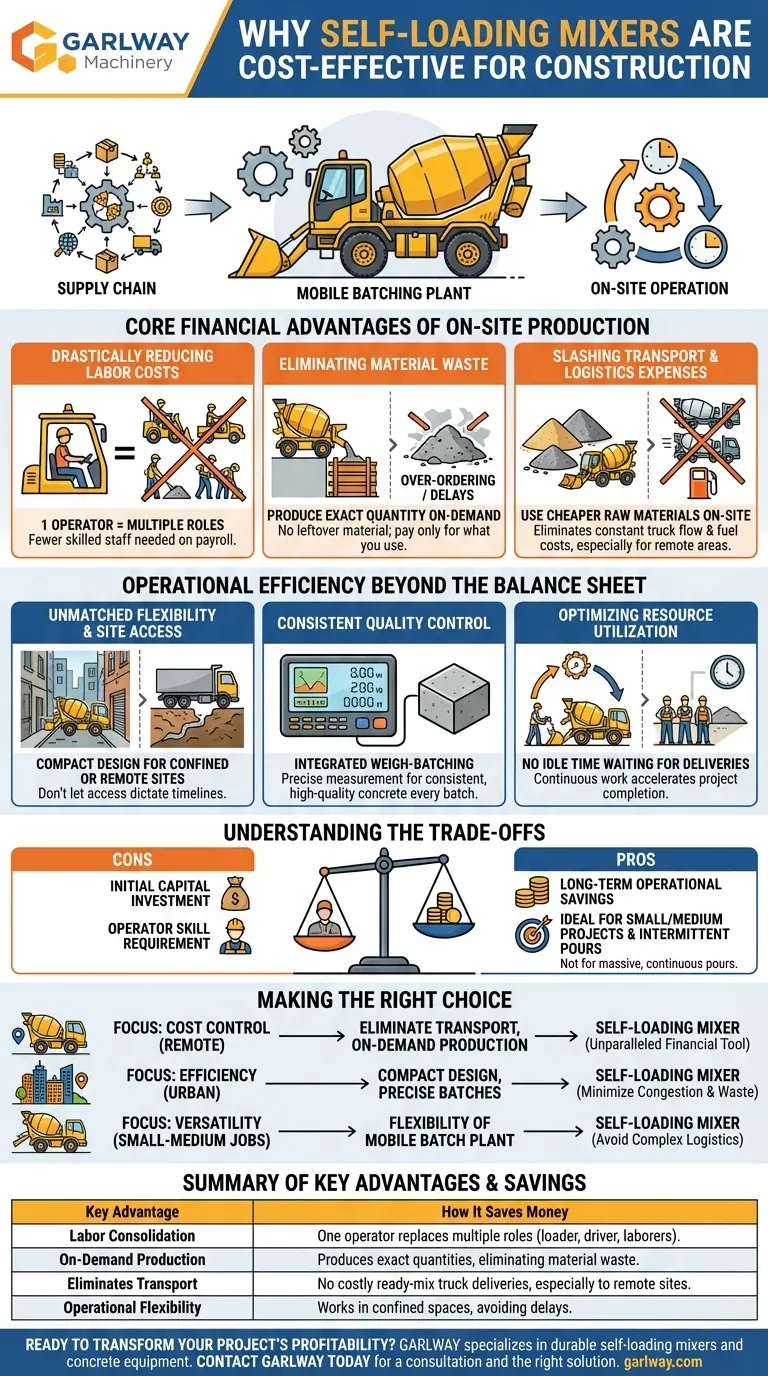
Drastically Reducing Labor Costs
A self-loading mixer is operated by a single person who manages loading aggregates, mixing, and discharging the concrete. This single machine replaces the need for a separate wheel loader operator, a ready-mix truck driver, and often reduces the manual labor required for material handling on site.
This consolidation of functions means fewer skilled operators are needed on the payroll for a given project, leading to substantial savings.
Eliminating Material Waste
Traditional ready-mix concrete often leads to waste through over-ordering to ensure a sufficient supply or discarding batches that are delayed in transit. A self-loading mixer solves this by producing the exact quantity required for the immediate task.
This on-demand capability means there is virtually no leftover material, and you never pay for concrete you don't use.
Slashing Transportation and Logistics Expenses
For projects in remote locations or difficult terrain, the cost of transporting ready-mix concrete can be prohibitive. The self-loading mixer uses raw, unmixed materials that are cheaper to transport and can be stockpiled on-site.
This eliminates the need for a constant flow of ready-mix trucks, reducing fuel consumption, truck rental costs, and the complex coordination required to manage deliveries.
Operational Efficiency Beyond the Balance Sheet
While direct cost reduction is a primary benefit, the operational flexibility and control offered by a self-loading mixer create value that extends beyond simple savings.
Unmatched Flexibility and Site Access
These mixers feature a compact design that allows them to operate effectively in confined urban construction sites where a large ready-mix truck cannot go. Their rugged build also makes them ideal for infrastructure projects in remote areas with limited access.
This adaptability ensures that your project timeline is not dictated by site accessibility challenges.
Consistent Quality Control
With on-site production, your team has complete control over every batch. The integrated electronic weigh-batching systems ensure precise measurement of all materials, leading to highly consistent and high-quality concrete that meets exact project specifications.
This eliminates the quality variables that can arise from different suppliers or transit times associated with ready-mix concrete.
Optimizing Resource Utilization
By centralizing the mixing process on a single, efficient machine, you optimize the use of fuel and time. There is no idle time spent waiting for a concrete delivery, allowing crews to work continuously and efficiently, accelerating project completion.
Understanding the Trade-offs
To make an informed decision, it's crucial to recognize the scenarios where a self-loading mixer presents clear advantages and where its limitations may lie.
Initial Capital Investment
The upfront purchase price of a self-loading mixer is higher than that of a simple stationary mixer. This cost must be weighed against the significant operational savings in labor, materials, and logistics over the machine's lifespan.
Optimal Production Volume
Self-loading mixers are ideal for small to medium-sized projects, intermittent pours, or sites with difficult access. For massive, continuous pours like high-rise foundations, a dedicated on-site batching plant with a fleet of transit mixers may offer greater volume per hour.
Operator Skill Requirement
The operator of a self-loading mixer is responsible for the entire batching process, which requires more training and skill than simply driving a truck. Ensuring you have a properly trained operator is key to leveraging the machine's full potential for quality and efficiency.
Making the Right Choice for Your Project
The decision to use a self-loading mixer should be driven by the specific demands of your project and your primary operational goals.
- If your primary focus is cost control on remote or infrastructure projects: The mixer's ability to eliminate transportation costs and produce on-demand makes it an unparalleled financial tool.
- If your primary focus is efficiency in confined urban spaces: Its compact design and ability to produce precise, small batches as needed will minimize site congestion and material waste.
- If your primary focus is versatility across multiple small-to-medium jobs: A self-loading mixer provides the flexibility of a mobile batch plant, allowing you to service various sites without complex logistical overhead.
Ultimately, a self-loading mixer shifts concrete production from a logistical challenge into a controlled, on-site asset.
Summary Table:
| Key Advantage | How It Saves Money |
|---|---|
| Labor Consolidation | One operator replaces multiple roles (loader, driver, laborers). |
| On-Demand Production | Produces exact quantities needed, eliminating material waste. |
| Eliminates Transport | No need for costly ready-mix truck deliveries, especially to remote sites. |
| Operational Flexibility | Works in confined spaces and difficult terrain, avoiding delays. |
Ready to transform your project's profitability with a mobile batching plant?
GARLWAY specializes in durable and efficient construction machinery, including self-loading mixers, concrete batching plants, and winches, designed for contractors and construction companies globally. Our equipment delivers the on-site control and cost savings detailed in this article.
Contact GARLWAY today for a consultation and discover the right solution for your specific project needs.
Visual Guide
Related Products
- Skid Steer Self Loading Concrete Mixers for Construction
- Belle Mixer Drum Self Loading Mortar Mixers JS3000
- Portable Cement Mixer with Lift Concrete Machine
- Portable Concrete Mixer Machine Equipment for Mixing Concrete
- Portable Ready Mix Concrete Mixer Equipment
People Also Ask
- How does the control system improve production efficiency in a self loading concrete mixer? Automate Mixing for Speed & Quality
- What is the purpose of keeping the drum rotating during transportation in a self loading concrete mixer? Ensure Quality & Consistency
- How does the weighing process work in a self loading concrete mixer? Achieve Precise, On-Site Concrete Batching
- What components are involved in the loading process of a self loading concrete mixer? A Guide to the Key Systems
- How should materials be loaded into a self-loading concrete mixer? Master the Step-by-Step Process