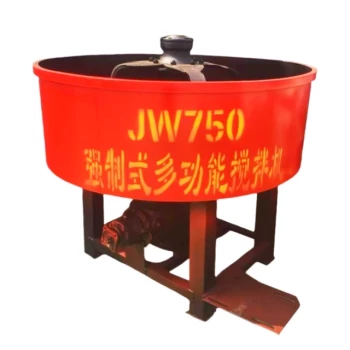
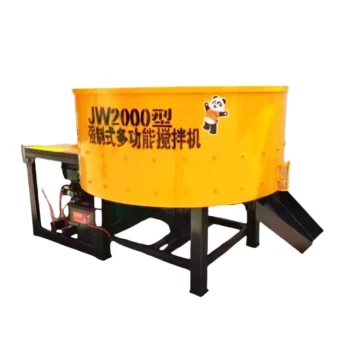
On average, a typical batch mixer can produce approximately 1 to 2 cubic meters of concrete per cycle. This figure, however, represents common on-site equipment and is not a universal constant. The actual output depends entirely on the specific type, size, and design of the mixer being used.
A mixer's true capacity is not a single number but a direct function of its design. Understanding the difference between drum, pan, and open-top mixers is essential for accurately estimating production rates for any given project.

The Core Types of Batch Mixers
The term "batch mixer" covers a wide range of equipment, each designed for different scales and applications. The machine's mechanical design is the primary factor determining its output per cycle.
Drum Mixers
Drum mixers are the most common type seen on construction sites. They use a rotating drum to lift and tumble the aggregates, cement, and water.
These can be gravity mixers, which rely solely on the tumbling motion, or revolving mixers, which have internal fins or shelves to improve the mixing action. Their capacity typically falls within the 1 to 2 cubic meter range.
Pan Mixers
Pan mixers utilize a stationary cylindrical pan with rotating paddles or blades inside. This design provides a more forceful and consistent shearing action.
They are often preferred for producing high-quality, uniform concrete, such as for precast elements. Their batch capacities can vary widely but are chosen for mix quality as much as for volume.
Open-Top Mixers
These are high-capacity, stationary units designed for large-scale production, often found in precast factories or large batching plants.
Due to their robust design and industrial application, open-top mixers can handle significantly larger volumes, with capacities reaching up to 1000 gallons (approximately 3.8 cubic meters) or more per batch.
Key Factors Beyond Mixer Type
Even with the correct type of mixer, several operational factors influence the actual production rate over a workday.
Cycle Time
Capacity per batch is only one part of the equation. The total cycle time—which includes loading raw materials, mixing, and discharging the finished concrete—determines how many batches you can produce per hour.
Mixer Specifications
Manufacturers provide specific ratings for their equipment. It is critical to consult the manufacturer's data sheet for the rated mixing capacity, as this is the most reliable figure.
Site Logistics
A mixer's output is ultimately limited by how quickly it can be supplied with aggregates, cement, and water. Inefficient site layout or slow material handling can easily become the bottleneck, regardless of the mixer's potential capacity.
Understanding the Trade-offs
Choosing a mixer involves balancing capacity with other critical project requirements. A higher output is not always the best solution.
Capacity vs. Mix Quality
Forcing a mixer to cycle too quickly or overloading it can compromise the homogeneity and strength of the concrete. Pan mixers, for instance, are often chosen for their superior mixing action, which guarantees higher quality, even if their cycle time is longer than a simple drum mixer.
Output vs. Portability
The largest mixers are stationary by necessity. For projects requiring concrete at multiple locations across a site, a smaller, more mobile drum mixer provides essential versatility, even at the cost of lower batch volume. The logistical advantage often outweighs the lower output per cycle.
Making the Right Choice for Your Goal
To select the appropriate equipment, you must align the mixer's capabilities with your project's primary objective.
- If your primary focus is on-site versatility for standard construction: A revolving drum mixer with a 1-2 cubic meter capacity is the industry standard and most practical choice.
- If your primary focus is superior strength and consistency for precast products: A pan mixer is the correct tool, as its mixing action ensures the highest quality concrete.
- If your primary focus is maximum hourly output for a large-scale plant: A high-capacity stationary drum or open-top mixer is required to meet industrial production demands.
Ultimately, understanding the mechanics behind the machine is the key to accurate project planning and execution.
Summary Table:
| Mixer Type | Typical Capacity per Cycle | Primary Use Case |
|---|---|---|
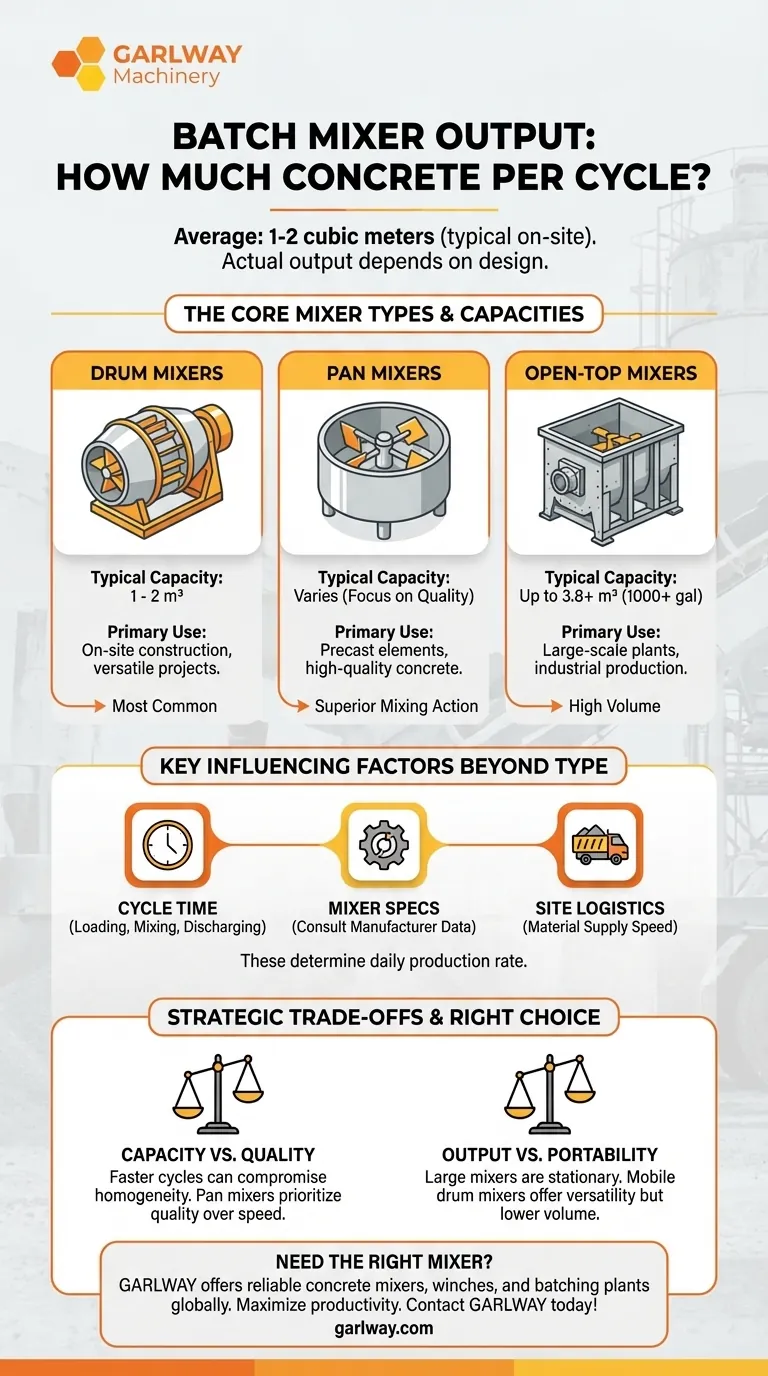
| Drum Mixer | 1 - 2 cubic meters | On-site construction, versatile projects |
| Pan Mixer | Varies (focus on mix quality) | Precast elements, high-quality concrete |
| Open-Top Mixer | Up to 3.8+ cubic meters | Large-scale plants, industrial production |
Need the right batch mixer for your project's specific output and quality requirements? GARLWAY specializes in construction machinery, offering a full range of reliable concrete mixers, winches, and batching plants tailored for construction companies and contractors globally. Our experts can help you select the ideal equipment to maximize your productivity and ensure consistent results. Contact GARLWAY today for a personalized consultation and quote!
Visual Guide
Related Products
- Commercial Electric Concrete Mixer Machine HZS 50 Small Batch Plant for Sale
- HZS90 Large Multiquip Concrete Mixers for Construction
- HZS120 Ready Mix Concrete Batching Plant Commercial Mud Cement Mixer
- HZS25 Best Cement Mixer for Quick Mix Concrete at Bunnings
- HZS75 Concrete Batching Plant Cement Mixer Price Concrete Mixer Bunnings Mixing Plant
People Also Ask
- What are the types of concrete mixers used in batching plants? Choose the Right Mixer for Your Project
- What is the core component of a concrete batching plant? The Mixer Unit Defines Your Concrete Quality
- Why is proper maintenance important for a concrete batch mix plant? Maximize Uptime & Profitability
- Why buy concrete batch plant parts only from the manufacturer? Protect Your Investment and Maximize Uptime
- What are the two main types of concrete batch mixers? Choose the Right Mixer for Your Project