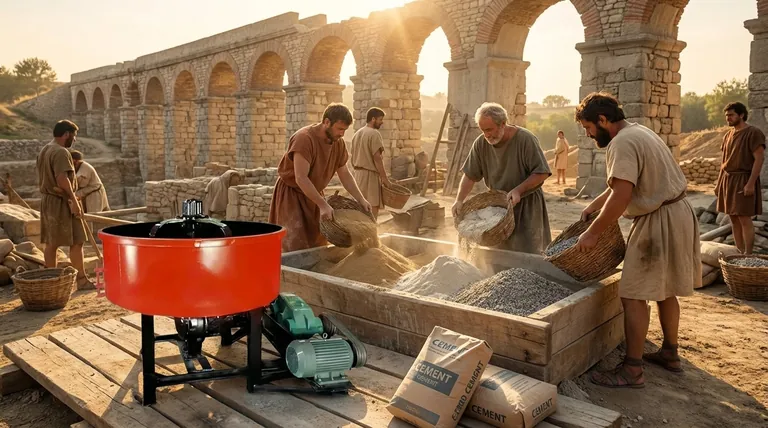
The concept of volumetric concrete mixing has ancient roots, dating back to the Roman Empire. Roman engineers mixed construction materials by volume as a practical way to build structures and support their armies' advances across Europe. This fundamental principle was later employed on a massive scale for projects like the Panama Canal, long before the invention of the modern mobile volumetric mixer.
The history of volumetric mixing is one of consistent evolution. While the core principle of proportioning materials by volume is ancient, the technology was refined over centuries to solve the timeless construction challenges of waste, logistics, and on-demand production.
The Ancient Principle: Proportioning by Volume
Roman Engineering and Logistics
The Romans needed a simple, repeatable method for creating mortar and concrete in the field, far from established cities and quarries.
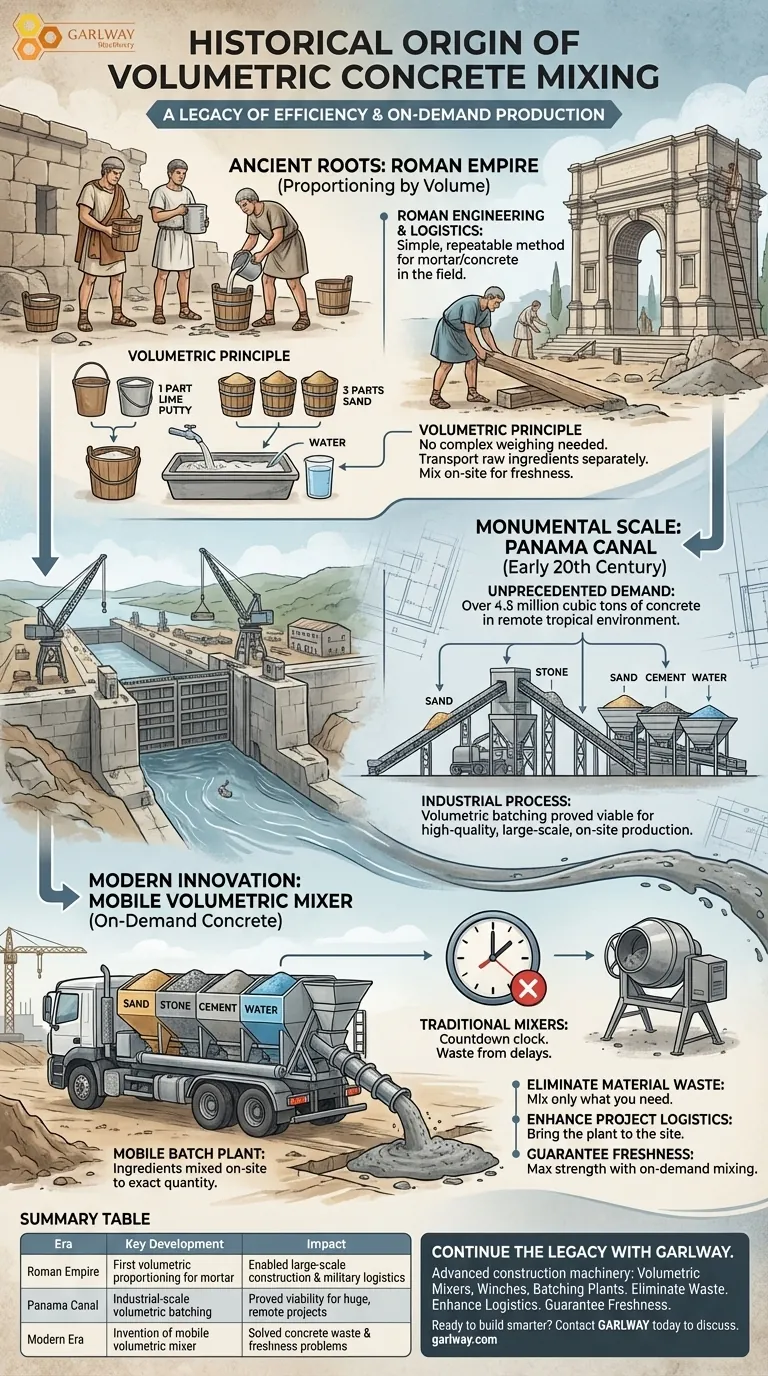
Proportioning by volume—for example, one part lime putty to three parts sand—was a straightforward and reliable system that did not require complex weighing equipment.
The Problem of Transport
Transporting pre-mixed, wet mortar or concrete over long distances was impossible due to its limited working time before hardening.
The Roman solution was to transport the raw, dry ingredients and water separately. This allowed them to mix the materials on-site, ensuring maximum freshness and strength for their structures.
A Principle Proven on a Monumental Scale
The Panama Canal Challenge
The construction of the Panama Canal in the early 20th century required an unprecedented amount of concrete—over 4.5 million cubic tons.
This massive undertaking, located in a remote tropical environment, necessitated a highly efficient, large-scale method for on-site concrete production.
From Principle to Industrial Process
Volumetric proportioning was a key part of the industrial process used at the Panama Canal. Large batching plants were set up to mix the raw materials by volume continuously.
This project proved the viability of the volumetric method for producing consistent, high-quality concrete on a scale never before imagined, setting the stage for future innovations.
The Modern Innovation: The Mobile Volumetric Mixer
Solving the Freshness Problem
Traditional barrel or drum mixers mix all the concrete at a central plant. This starts a countdown clock, as the concrete must be discharged before it begins to set, often leading to waste if there are delays or miscalculations.
The modern volumetric mixer was developed to solve this exact problem.
The Birth of On-Demand Concrete
A volumetric mixer is effectively a mobile batch plant. It carries sand, stone, cement, and water in separate compartments.
These ingredients are mixed on-site to the exact quantity required. This process ensures the concrete is always fresh and eliminates the waste associated with leftover batches, representing the culmination of the principle first used by the Romans.
The Legacy of Volumetric Mixing
Understanding the history of this technology reveals the persistent challenges in construction that engineers have worked to solve for centuries.
- If your primary focus is the core principle: Remember that it is simply a method of proportioning ingredients by volume, a practice that has been effective for millennia due to its simplicity and reliability.
- If your primary focus is the modern technology: Recognize the volumetric mixer as the ultimate solution to the ancient problem of transporting a perishable product, allowing for fresh concrete to be created on demand.
Ultimately, the history of volumetric mixing is a story of solving a fundamental construction challenge: creating high-quality concrete precisely when and where it is needed.
Summary Table:
| Era | Key Development | Impact |
|---|---|---|
| Roman Empire | First use of volumetric proportioning for mortar and concrete. | Enabled large-scale construction and military logistics. |
| Panama Canal (Early 20th Century) | Industrial-scale volumetric batching for massive concrete demand. | Proved the method's viability for huge, remote projects. |
| Modern Era | Invention of the mobile volumetric mixer. | Solved the problem of concrete waste and freshness with on-demand mixing. |
Continue the legacy of efficient, on-site concrete production with GARLWAY.
For construction companies and contractors globally, GARLWAY specializes in advanced construction machinery, including volumetric concrete mixers, winches, and concrete batching plants. Our solutions directly address the historical challenges of waste, logistics, and freshness, empowering you to:
- Eliminate Material Waste: Mix only the concrete you need, precisely when you need it.
- Enhance Project Logistics: Bring the batch plant to your site, reducing transport costs and delays.
- Guarantee Freshness: Ensure maximum strength and quality with concrete mixed on-demand.
Ready to build smarter? Contact GARLWAY today to discuss how our machinery can bring historical efficiency to your modern projects.
Visual Guide
Related Products
- Belle Cement Mixer JS2000 Volumetric Concrete Mixer for Harbor Freight
- JS1000 Volumetric Concrete Mortar Mixer for Sale Skid Steer Cement Mixer
- Harbor Freight JS1500 On Site Concrete Mixing Volumetric Cement Mixer
- Portable Concrete Mixer Machine Equipment for Mixing Concrete
- HZS25 Best Cement Mixer for Quick Mix Concrete at Bunnings
People Also Ask
- What is a volumetric concrete mixer? A Mobile Concrete Batch Plant for On-Demand Mixing
- What is the predicted future for volumetric concrete mixers? Growth Driven by On-Demand Efficiency
- How does a volumetric concrete mixer contribute to sustainability? Reduce Waste, Water, and Emissions On-Site
- How does volumetric concrete compare to ready-mix concrete? Choose the Right Method for Your Project
- What types of concrete can be produced with volumetric mixers? Achieve On-Demand Mixing for Any Project