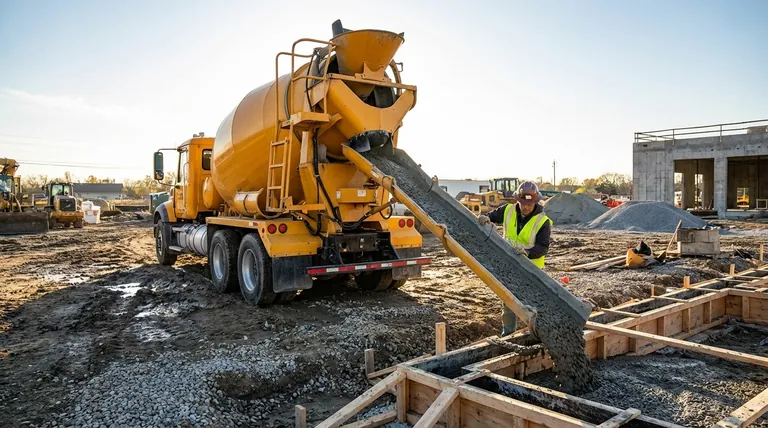
At its core, the discharge of ready-mix concrete from a truck's drum is a simple yet ingenious process: the direction of the drum's rotation is reversed. While one direction mixes the material, the opposite direction uses the same internal blades to push the concrete out, guided by chutes to its destination.
The critical insight is that a concrete mixer drum uses the same set of internal spiral blades for two opposite functions. The direction of rotation is the only thing that changes to switch from mixing the concrete to discharging it.
The Dual-Action Mechanism Explained
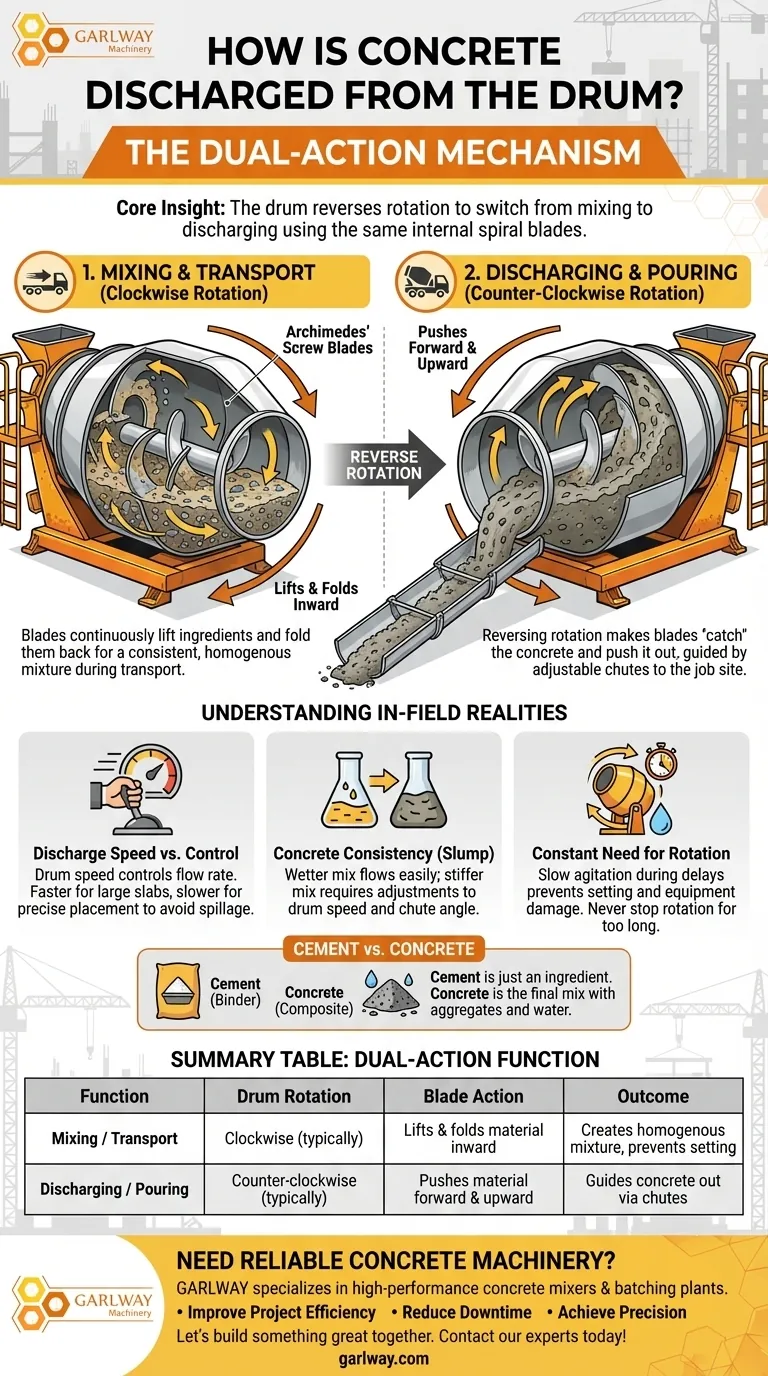
The entire operation relies on a design principle that is thousands of years old, famously known as the Archimedes' screw. The spiral blades, or fins, welded to the inside of the drum act as the threads of a massive screw.
How Mixing Works
To mix the concrete and keep it agitated during transport, the drum rotates in one direction (often clockwise when viewed from the back).
This rotation causes the spiral blades to continuously lift the aggregates, sand, cement, and water from the bottom and fold them back toward the rear of the drum. This ensures a consistent, homogenous mixture.
How Discharging Works
To discharge the concrete, the operator simply reverses the drum's rotation (to counter-clockwise).
This reversal changes the function of the blades. Instead of folding the material inward, they now "catch" the concrete and push it forward, up and out of the drum's opening.
The Role of Chutes
Once the concrete exits the drum, it falls onto a series of adjustable chutes.
These chutes are simply metal troughs that the operator can pivot and extend to guide the flowing concrete precisely to the formwork or desired location on the job site.
Understanding the Trade-offs and In-Field Realities
While the principle is simple, a skilled operator must manage several factors to ensure a smooth and accurate pour.
Discharge Speed vs. Control
The speed of the drum's reverse rotation directly controls the flow rate of the concrete.
A faster rotation discharges the material quickly, which can be efficient for large slabs. However, it can be difficult to control, risking spillage. A slower rotation provides a more manageable flow for smaller or more precise placements.
The Impact of Concrete Consistency
The "slump," or wetness, of the concrete mix significantly affects how it flows.
A wetter mix will discharge much more easily and quickly than a stiff, dry mix. Operators must adjust the drum speed and chute angle to account for the specific consistency of the batch.
The Constant Need for Rotation
Concrete begins to harden, or set, the moment water is added.
The drum must remain in slow, agitating rotation during transport and any on-site delays. If the drum stops for too long, the concrete can begin to harden inside, a catastrophic failure for the equipment.
A Quick Note: Cement vs. Concrete
It's a common point of confusion, but the material discharged from the truck is concrete, not cement.
Cement is just one ingredient—a fine powder that acts as the binder. Concrete is the final composite material made from cement, water, sand, and larger aggregates like gravel.
Key Principles for Operation
Understanding the mechanics translates directly to how the equipment is used on a job site.
- For efficient mixing and transport: The key is slow, continuous rotation in the mixing direction to keep the material agitated and prevent it from setting.
- For a controlled discharge: The key is to use the reverse rotation, carefully managing its speed to dictate the flow rate based on the job's requirements.
- For equipment longevity: The key is to never allow the concrete to remain static inside the drum, ensuring it is always cleaned thoroughly after a pour.
This elegant dual-function design is what makes the modern concrete mixer truck such a remarkably efficient and indispensable piece of construction machinery.
Summary Table:
| Function | Drum Rotation | Blade Action | Outcome |
|---|---|---|---|
| Mixing / Transport | Clockwise (typically) | Lifts and folds material inward | Creates a homogenous mixture, prevents setting |
| Discharging / Pouring | Counter-clockwise (typically) | Pushes material forward and upward | Guides concrete out of the drum via chutes |
Need Reliable Concrete Machinery for Your Projects?
GARLWAY specializes in high-performance construction machinery, including robust concrete mixers and batching plants designed for efficiency and durability on the job site.
We help construction companies and contractors:
- Improve Project Efficiency with machinery that ensures consistent mixing and controlled pouring.
- Reduce Downtime with reliable, heavy-duty equipment built for demanding conditions.
- Achieve Precision with designs that offer excellent control over the concrete discharge process.
Let's build something great together. Contact our experts today to find the perfect concrete solution for your business!
Visual Guide
Related Products
- Concrete Cement Mixer Machine Drum Mixer for Construction
- Belle Mixer Drum Self Loading Mortar Mixers JS3000
- Ready Mixer Machine for Construction Ready Mix Machinery
- JW1000 Mobile Cement Mixer Concrete Mixer Truck and Batching Plant
- JDY350 Electric Hydraulic Mortar Mud Concrete Mixer
People Also Ask
- What are the key advantages of using drum mixers in concrete mixing? Boost Volume & Efficiency on Your Site
- What are the key components that maintain concrete mix consistency in the drum? Ensure Uniform Quality from Plant to Site
- How do cement mixers enhance safety on construction sites? Reduce Strain, Hazards, and Accidents
- When was the first concrete mixer developed and by whom? Discover the 1900 Breakthrough
- What is the average lifespan of a concrete mixer? Maximize Your Equipment's Lifespan & ROI