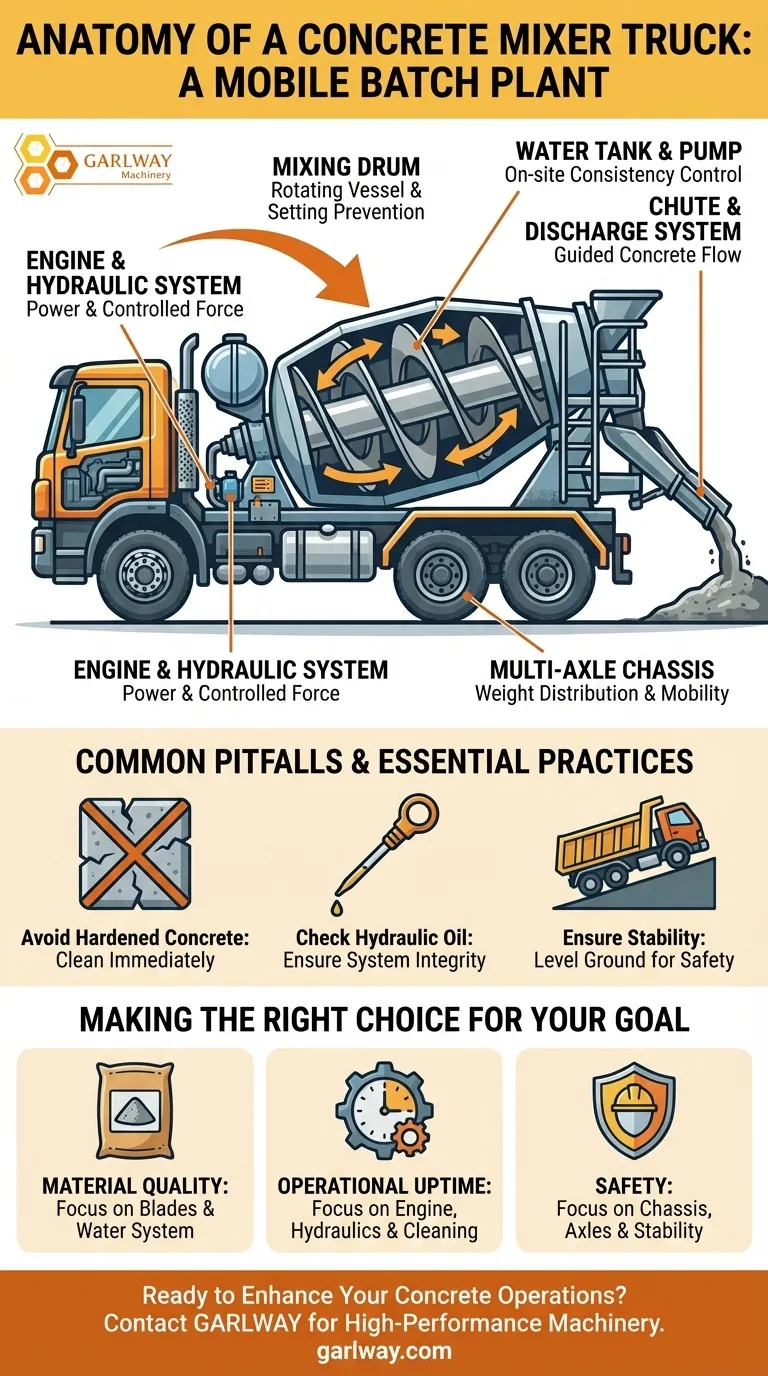
At its core, a concrete mixer truck is an integrated system designed to mix raw materials and deliver ready-to-pour concrete. Its main components are the rotating mixing drum, internal spiral blades, a water tank for consistency control, a hydraulic system to power the rotation, and a powerful engine mounted on a multi-axle chassis built to handle immense weight.
The critical insight is not just knowing the parts, but understanding that a mixer truck is a mobile batch plant. Each component works in precise coordination to ensure the concrete remains in a perfect, unhardened state from the plant to the job site.
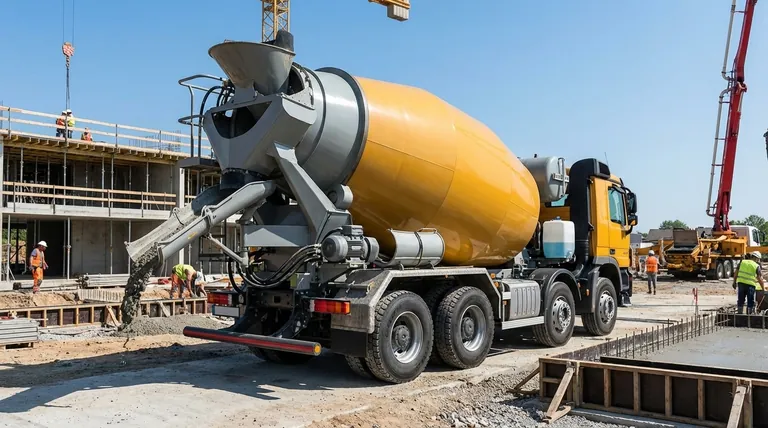
The Anatomy of a Mixer Truck: A Component-by-Component Look
To understand how a mixer truck functions, we must first break down its essential systems. Each part serves a distinct and vital purpose in the concrete delivery process.
The Mixing Drum
The most recognizable feature is the rotating drum, which serves a dual purpose. It contains the raw ingredients—cement, sand, aggregate, and water—and acts as the primary mixing vessel.
During transit, its slow rotation constantly agitates the mixture, preventing it from setting prematurely.
The Internal Mixing Mechanism
Inside the drum are continuous spiral blades or turbines. These are engineered to achieve a uniform mix as the drum turns.
When the drum rotates in one direction, the blades pull the materials deeper into the drum and fold them over, ensuring a thorough blend. When reversed, these same blades push the mixed concrete out for discharge.
The Engine and Hydraulic System
A powerful engine, often between 250 to over 400 horsepower, provides power for both the truck itself and the mixing functions.
This engine drives a hydraulic system, which is the true workhorse. It provides the immense, controlled force needed to rotate the heavy, concrete-filled drum and operate the discharge chute.
The Water System
Most trucks are equipped with an onboard water tank and pump. This allows the operator to add a precise amount of water to the mix on-site.
This capability is crucial for adjusting the concrete's consistency, or "slump," to meet the specific requirements of the job right before the pour.
The Chute and Discharge System
The chute is a series of hinged troughs at the rear of the truck. It guides the flow of concrete from the drum to the exact location where it's needed.
The operator can manipulate the chute's angle and extension to control the pour with precision, whether filling forms, foundations, or a concrete pump.
The Chassis and Axles
The entire system is mounted on a heavy-duty truck chassis. This includes multiple axles specifically designed to distribute the massive weight of the concrete load legally and safely on the road.
Common Pitfalls and Essential Practices
Owning or operating a mixer truck involves more than just driving. The nature of concrete demands strict operational discipline to avoid costly damage and ensure safety.
The Problem of Hardened Concrete
The single greatest operational risk is allowing concrete to harden inside the drum. This can render the entire truck useless.
It is absolutely vital to clean the drum immediately and thoroughly after every single delivery. This often involves an initial water rinse followed by washing with abrasive materials to remove all residue.
Pre-Trip System Integrity
Smooth operation depends on the health of the machinery. A key preventative measure is checking the hydraulic oil levels before each trip.
Low fluid levels can lead to failed drum rotation, which can quickly result in a catastrophic loss of the entire concrete batch.
Stability During Loading and Pouring
The truck's high center of gravity, especially when loaded, makes it vulnerable to tipping.
Operators must always ensure the truck is positioned on stable, level ground before beginning loading or discharge operations to prevent dangerous and costly accidents.
Making the Right Choice for Your Goal
Understanding these components allows you to focus on the aspects that matter most for your specific objectives.
- If your primary focus is material quality: The performance of the internal blades and the precision of the water system are your most critical components.
- If your primary focus is operational uptime: The reliability of the engine and hydraulic system, combined with a strict cleaning protocol, is paramount.
- If your primary focus is safety: Proper use of the multi-axle chassis for weight distribution and ensuring ground stability during pours are non-negotiable.
Ultimately, viewing the concrete mixer truck as a complete, interdependent system is the key to its effective and profitable operation.
Summary Table:
| Component | Primary Function | Key Insight |
|---|---|---|
| Mixing Drum | Holds and mixes concrete; prevents setting during transit. | The core vessel; its rotation is critical. |
| Spiral Blades | Folds and mixes materials; reverses to discharge concrete. | Ensures a uniform, high-quality mix. |
| Hydraulic System | Powers the drum rotation and discharge chute. | The workhorse; requires regular fluid checks. |
| Water Tank | Holds water for on-site consistency adjustment. | Crucial for achieving the perfect "slump." |
| Chassis & Axles | Supports the immense weight and provides mobility. | Designed for legal road use and stability. |
Ready to Enhance Your Concrete Operations?
Understanding the components is the first step; owning reliable equipment is the next. GARLWAY specializes in high-performance construction machinery, including robust concrete mixers and batching plants designed for construction companies and contractors who demand durability, efficiency, and uptime.
Let us help you build with confidence. Contact GARLWAY today to discuss your project needs and discover how our machinery can drive your profitability.
Visual Guide
Related Products
- Ready Mixer Machine for Construction Ready Mix Machinery
- JW1000 Mobile Cement Mixer Concrete Mixer Truck and Batching Plant
- Mini Cement Mortar Mixer Truck for Construction
- Harbor Freight JS1500 On Site Concrete Mixing Volumetric Cement Mixer
- HZS90 Large Multiquip Concrete Mixers for Construction
People Also Ask
- What are the purposes of low-speed agitation in truck mixers? Preserve Concrete Quality During Transit
- How is ready-mixed concrete transported from a commercial concrete batching plant? Ensuring Quality & Timely Delivery
- What are the main ingredients mixed in a concrete mixer truck? Master the Formula for Strong Concrete
- In what ways does a mobile concrete mixer improve quality control and consistency? Achieve Superior On-Site Concrete Quality
- What types of construction projects typically use concrete mixer trucks? From Highways to Home Foundations