The Intuition Trap
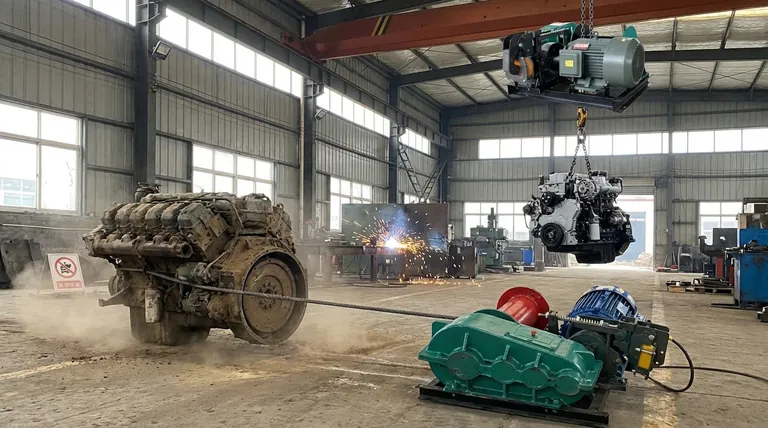
Picture a workshop. An engine block, weighing hundreds of pounds, needs to be lifted from a chassis. In the corner sits a powerful 12,000 lb truck winch. The cable is steel, the motor is strong. The temptation to use it is immense. It looks like it can do the job.
This is a classic cognitive trap. Our brains often equate similar appearances with similar functions. But in the world of mechanical forces, this assumption can lead to disaster. A winch and a hoist are built to solve two fundamentally different physical problems, and confusing them is a gamble against gravity.
The Physics of the Problem: Pulling vs. Lifting
The core distinction isn't in the motor's power or the cable's strength. It's in the nature of the force being overcome.
Pulling is a Fight Against Friction
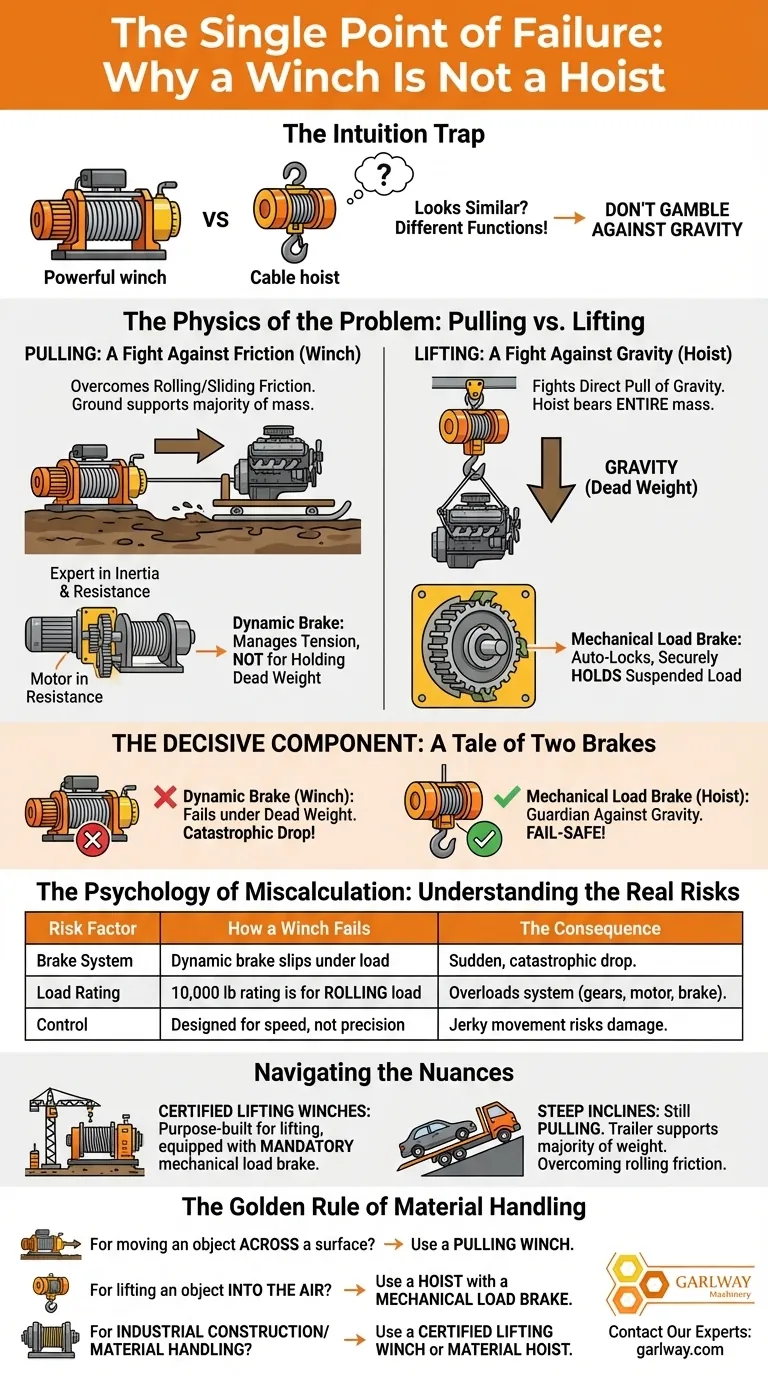
A winch is designed to pull a load horizontally. Its job is to conquer the forces of rolling or sliding friction. When recovering a vehicle from mud, the winch drags the weight across a surface. While the force is significant, the ground is supporting the majority of the object's mass.
The winch is an expert in overcoming inertia and resistance.
Lifting is a Fight Against Gravity
A hoist is designed to lift a load vertically. It fights directly against the full, unrelenting pull of gravity on a "dead weight" load. There is no surface for support; the hoist's internal components bear the entire mass.
This is a constant, unforgiving battle where the only thing preventing a freefall is the integrity of the machine.
The Decisive Component: A Tale of Two Brakes
The single most critical difference—the one that separates a safe lift from a catastrophic drop—is the braking system.
The Winch's Dynamic Brake: A Helper for Tension
A standard pulling winch uses a dynamic brake. This system is designed to provide resistance and prevent the drum from free-spooling when the motor stops. It often relies on the gear train and motor power to function. It's meant to manage tension, not to securely hold a suspended load against the full force of gravity. It was never designed to be a fail-safe.
The Hoist's Mechanical Brake: A Guardian Against Gravity
A hoist employs a mechanical load brake. This is an ingenious piece of engineering designed for one purpose: to automatically and physically lock the load in place. The moment the lifting force stops or power is cut, this brake engages. It doesn't require power to work; in fact, the weight of the load itself often helps to seat the brake more securely.
This fail-safe design is the fundamental reason a hoist can be trusted to suspend an object overhead. It is the guardian that stands between the load and the ground.
The Psychology of Miscalculation: Understanding the Real Risks
Using a winch for a vertical lift isn't just using the wrong tool; it's a profound miscalculation of risk, often driven by a misunderstanding of the equipment's ratings.
| Risk Factor | How a Winch Fails | The Consequence |
|---|---|---|
| Brake System | Dynamic brake is not rated to hold a suspended dead weight. | Slips under load, leading to a sudden, catastrophic drop. |
| Load Rating | A 10,000 lb rating is for a rolling load, not a 10,000 lb dead lift. | Overloads the entire system—gears, motor, and especially the brake. |
| Control | Designed for high-speed pulling, not precise positioning. | Jerky, uncontrolled movement risks damaging the load and its surroundings. |
The most dangerous misunderstanding is the load rating. A winch's capacity is based on a set of ideal, low-friction circumstances. Lifting that same weight vertically places an exponentially greater strain on every component, particularly the one component not designed for the task: the brake.
Navigating the Nuances
While the rule is clear, the terminology can sometimes be confusing, especially in industrial settings.
The Exception: Certified Lifting Winches
In heavy industries like construction and mining, you will find machines called "winches" that are designed for lifting. These are specialized material hoists or lifting winches. Crucially, they are explicitly designed, certified, and equipped with the mandatory mechanical load brake for vertical lifting.
These are not standard vehicle recovery winches. They are purpose-built hoists, engineered for the unique demands of construction sites where safety and reliability are paramount. This is a domain where precision-engineered equipment, like the solutions offered by GARLWAY, is non-negotiable.
The Gray Area: Steep Inclines
Pulling a car onto a flatbed trailer involves an incline, but it is not a vertical lift. The trailer ramp still supports the majority of the vehicle's weight. The winch is primarily overcoming rolling friction and only a fraction of gravity's pull. This remains firmly in the category of "pulling."
The Golden Rule of Material Handling
The choice is simple and should be guided by the direction of force.
- For moving an object across a surface? You need a pulling winch.
- For lifting an object into the air? You must use a hoist with a mechanical load brake.
- For industrial construction or material handling? You need a certified lifting winch or material hoist designed for that specific environment.
Choosing the right tool isn't about efficiency; it's a fundamental commitment to safety. The invisible difference in a brake system is the line between a successful task and a preventable disaster. To ensure your project is built on a foundation of safety and reliability, it’s crucial to match the machine to the mission. Contact Our Experts
Visual Guide
Related Products
- Warn Winch Windlass Boat Trailer Winch
- Electric and Hydraulic Winch for Heavy Duty Applications
- Small Electric Winch 120V and 240V for Compact Applications
- 12000 lb Electric Boat Trailer Winch with Windlass Anchor Warn
- Quick Windlass Portable Winch for Truck and Boat Best Boat Winch
Related Articles
- Beyond the Bumper: The Critical System Choice in Powering Your Trailer Winch
- Force vs. Mass: The Critical Difference in Sizing a Boat Winch
- Lines of Force: The Unseen Geometry of a Boat Winch
- More Than a Number: The Engineering Psychology of Choosing a Boat Winch
- How to Choose and Optimize Winch Speed for Maximum Efficiency