A Moment of Temptation on the Job Site
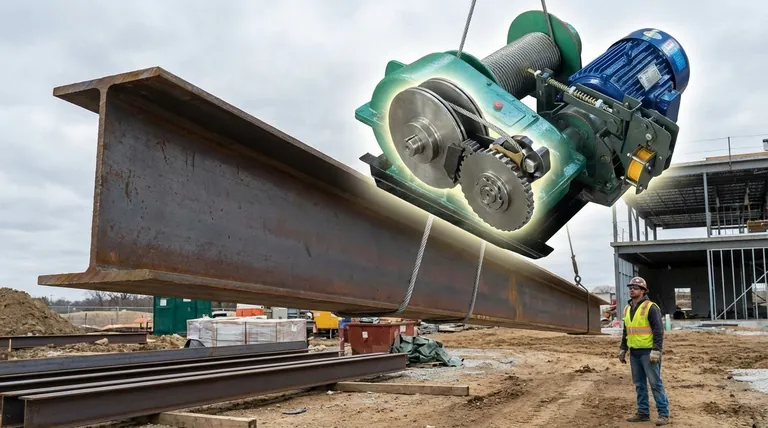
Picture a construction site. A steel I-beam, weighing several tons, needs to be lifted two stories and guided into place. Nearby sits a heavy-duty truck equipped with a powerful winch, its cable strong enough to pull the truck itself out of the deepest mud.
The thought is almost inevitable: "Why not just use the winch to lift the beam?"
It's a logical-seeming shortcut. The tool is right there, it's powerful, and it seems capable. This moment of temptation, however, is born from a profound misunderstanding of physics and engineering. It's a cognitive bias where we mistake one type of strength for another, ignoring the silent, relentless force the tool was never designed to fight: gravity.
The Psychology of a Flawed Assumption
Our brains are wired for efficiency. We see a cable and a motor and think "pull." But pulling a truck horizontally is fundamentally different from suspending it in the air.
Horizontal pulling primarily fights friction and inertia. Once the object is moving, the force required often lessens. Suspending an object, however, is a constant, unending battle against the full force of gravity. There is no rest.
The assumption that a tool for one is suitable for the other is a failure to update our mental model. It’s a dangerous oversimplification, and in the world of heavy machinery, oversimplification can be catastrophic.
Two Tools, Two Different Physics Problems
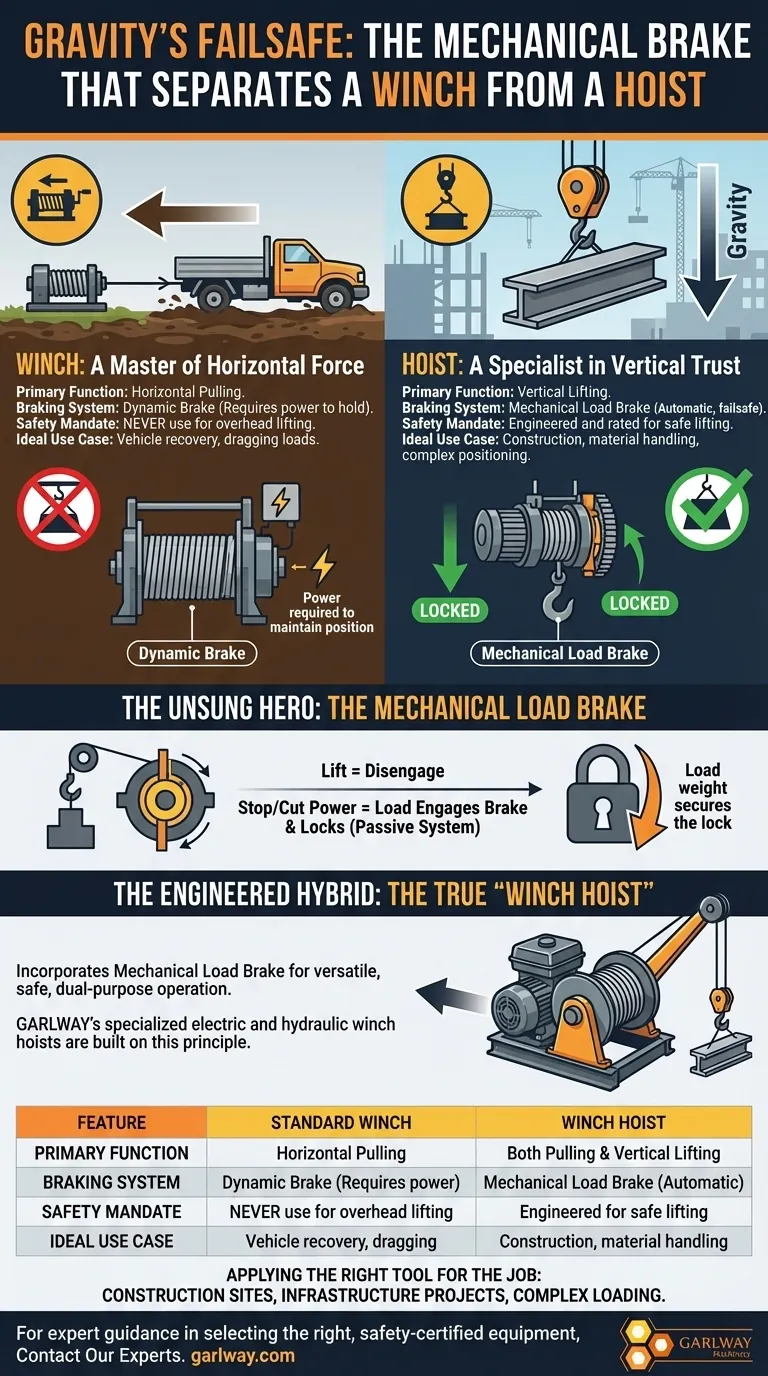
The terms "winch" and "hoist" are often used interchangeably, but they describe tools built to solve two entirely different physical challenges. The difference lies not in their power, but in their failsafe.
The Winch: A Master of Horizontal Force
A standard winch is a master of pulling. It's designed to drag loads across a surface.
- Primary Function: Horizontal pulling.
- Braking System: Most winches use a dynamic brake. This system requires power to hold the load and is designed to manage the forces of dragging, not to securely suspend a weight against gravity. It's an active brake, not a passive lock.
Think of it as a tool for managing momentum. It's perfect for vehicle recovery or pulling heavy materials onto a trailer. But it has no respect for the constant, unforgiving pull of a suspended load.
The Hoist: A Specialist in Vertical Trust
A hoist is designed with a single, solemn purpose: to lift, lower, and securely hold a load in the air. Its entire design philosophy is built around a worst-case scenario, like a sudden loss of power.
- Primary Function: Vertical lifting.
- Braking System: A hoist is defined by its mechanical load brake. This is the critical distinction.
The Unsung Hero: The Mechanical Load Brake
The mechanical load brake is a beautifully simple piece of engineering. It’s an automatic, passive system that uses the weight of the load itself to engage the brake.
When you lift, the brake disengages. The moment you stop lifting or if power is cut, the load's own downward force instantly engages the brake, locking it in place. It doesn't require electricity or hydraulic pressure to hold. It simply holds.
This is not just a feature; it's a pledge. It’s the engineering guarantee that gravity will not win. Using a standard winch without this brake for a vertical lift is like driving a car with no parking brake on a steep hill—it might hold for a moment, but failure is inevitable.
The Engineered Hybrid: The True "Winch Hoist"
This is where the distinction becomes a solution. A true "winch hoist" is not just a powerful winch. It is a winch that has been purposefully engineered to also serve as a hoist.
It bridges the gap by incorporating that non-negotiable mechanical load brake into a machine designed for the rigors of both pulling and lifting. This makes it an incredibly versatile tool, but only when it is explicitly designed and rated for this dual purpose.
GARLWAY's specialized electric and hydraulic winch hoists are built on this principle. They provide the raw pulling power needed on construction sites, combined with the certified, load-holding brake systems required for safe vertical material handling.
| Feature | Standard Winch | Winch Hoist |
|---|---|---|
| Primary Function | Horizontal Pulling | Both Pulling & Vertical Lifting |
| Braking System | Dynamic Brake (Requires power to hold) | Mechanical Load Brake (Automatic, failsafe) |
| Safety Mandate | NEVER use for overhead lifting | Engineered and rated for safe lifting |
| Ideal Use Case | Vehicle recovery, dragging loads | Construction, material handling, complex positioning |
Applying the Right Tool for the Job
The versatility of a true winch hoist makes it indispensable in modern construction, mining, and logistics.
- Construction Sites: Precisely lifting and pulling steel beams, concrete forms, and heavy components into position with a single machine.
- Infrastructure Projects: Moving equipment and materials safely across uneven terrain where both horizontal and vertical movement is necessary.
- Complex Loading: Guiding heavy, unconventional machinery onto trailers or ships where a combination of dragging and controlled lifting ensures stability.
Ultimately, choosing the right tool isn't about semantics. It's about respecting the forces at play and making a decision grounded in safety and engineering principles. Understanding the role of the mechanical load brake is the foundation of a safe and efficient operation. For any project demanding the flexibility of both powerful pulling and secure lifting, a purpose-built winch hoist is the only responsible choice.
For expert guidance in selecting the right, safety-certified equipment for your construction needs, Contact Our Experts.
Visual Guide
Related Products
- Small Electric Winch 120V and 240V for Compact Applications
- Quick Windlass Portable Winch for Truck and Boat Best Boat Winch
- Electric and Hydraulic Winch for Heavy Duty Applications
- Portable Small Trailer Winch
- Electric Hoist Winch Boat Anchor Windlass for Marine Applications
Related Articles
- How to Maximize Electrical Winch Performance in Challenging Environments
- How Electric Winch Safety Features Prevent Catastrophic Industrial Accidents
- How to Choose Between Manual and Electric Winches for Your Project
- How Electric Winches Solve Industrial Safety and Cost Challenges
- How Electric Winches’ Engineering Enhances Efficiency and Safety in Heavy-Duty Applications


