Introduction
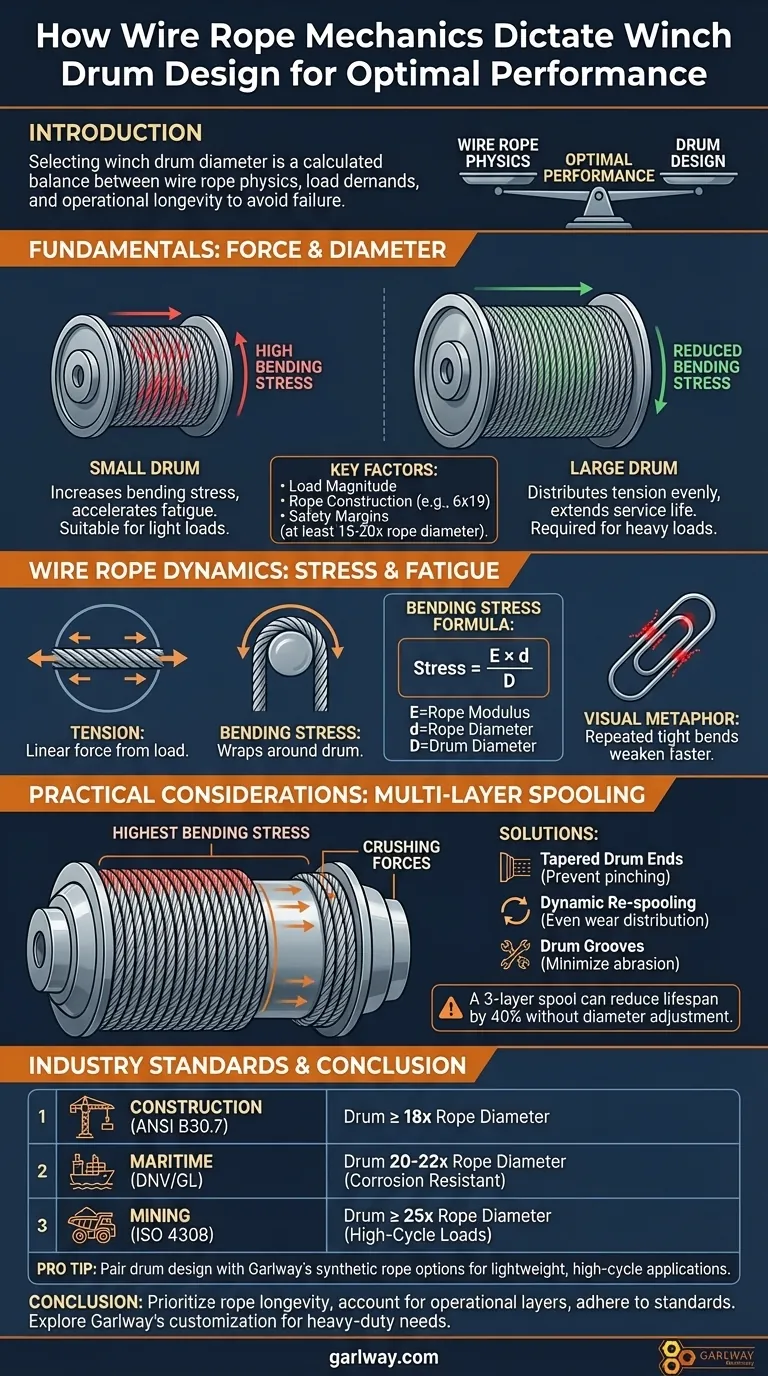
Selecting the right winch drum diameter isn’t just about fitting a rope—it’s a calculated balance between wire rope physics, load demands, and operational longevity. Engineers and equipment specifiers must account for bending stress, fatigue cycles, and industry standards to avoid premature rope failure or drum deformation. This guide breaks down the critical relationship between wire rope dynamics and drum sizing, offering actionable insights for construction, maritime, and mining applications.
Fundamentals of Winch Drum Engineering
Relationship Between Pulling Force and Drum Diameter
The drum diameter directly influences a winch’s load capacity. A larger drum reduces the rope’s bending angle, distributing tension more evenly across its strands. For example, doubling the drum diameter can halve the bending stress on the wire rope, significantly extending its service life.
Key factors to consider:
- Load magnitude: Heavier loads require larger drums to mitigate concentrated stress.
- Rope construction: 6×19 or 8×19 wire ropes (common in Garlway winches) need proportional drum diameters to prevent inner strand wear.
- Safety margins: Industry guidelines often recommend a drum diameter at least 15–20× the rope’s diameter for general applications.
Ever wondered why offshore winches use massive drums? The answer lies in saltwater corrosion resistance—larger drums reduce bending cycles, delaying rope degradation.
Wire Rope Dynamics: Tension, Bending Stress, and Fatigue
Wire ropes endure two primary stresses:
- Tension: The linear force from the load.
- Bending stress: Created when the rope wraps around the drum.
Bending stress formula (simplified):
[ \text{Stress} = \frac{E \times d}{D} ]
Where:
- (E) = Rope’s modulus of elasticity
- (d) = Rope diameter
- (D) = Drum diameter
A smaller drum diameter ((D)) exponentially increases stress, accelerating metal fatigue. Mining winches, for instance, use drums 25× the rope diameter to handle abrasive environments.
Visual metaphor: Think of bending a paperclip—repeated tight bends weaken it faster than gentle curves. The same applies to wire ropes.
Practical Considerations in Drum Sizing
Multi-Layer Rope Spooling and Diameter Adjustments
Spooling multiple rope layers complicates stress distribution. The first layer bears the highest bending stress, while outer layers face crushing forces.
Solutions:
- Tapered drum ends: Prevent rope pinching between layers.
- Dynamic re-spooling: Automated systems in Garlway winches evenly distribute wear.
- Drum grooves: Guide ropes to minimize cross-layer abrasion.
Did you know? A 3-layer spool can reduce rope lifespan by 40% if the drum diameter isn’t adjusted. Always recalculate minimum diameter for multi-layer setups.
Industry-Specific Standards (Construction, Maritime, Mining)
- Construction: ANSI B30.7 mandates drums ≥18× rope diameter for mobile cranes.
- Maritime: DNV/GL standards require corrosion-resistant drums 20–22× rope diameter.
- Mining: ISO 4308 specifies drums ≥25× rope diameter for high-cycle loads.
Pro tip: Pair drum design with Garlway’s synthetic rope options for lightweight, high-cycle applications like tow winches.
Conclusion: Engineering a Balanced Winch System
- Prioritize rope longevity by matching drum diameter to bending stress limits.
- Account for operational layers—each added spool layer demands a larger drum core.
- Adhere to industry standards while leaving room for dynamic load variations.
For heavy-duty applications, explore Garlway’s drum customization options, designed to align wire rope mechanics with real-world durability needs.
Visual Guide
Related Products
- Best 18000 Pound Drum Anchor Trailer Winch
- Warn Winch Windlass Boat Trailer Winch
- Portable Small Trailer Winch
- Heavy Duty Electric Boat Winch Windlass Anchor
- Belle Mixer Drum Self Loading Mortar Mixers JS3000
Related Articles
- Beyond the Bumper: The Critical System Choice in Powering Your Trailer Winch
- The Physics of the Pull: Why Rope Management Defines Your Winch
- How Anchor Winch Technology Transforms Fishing Efficiency Through Smart Relocation
- How to Choose the Right Winch for Heavy-Duty Applications: A Scenario-Based Guide
- How to Choose the Right Trailer-Mounted Winch for Your Industry Needs