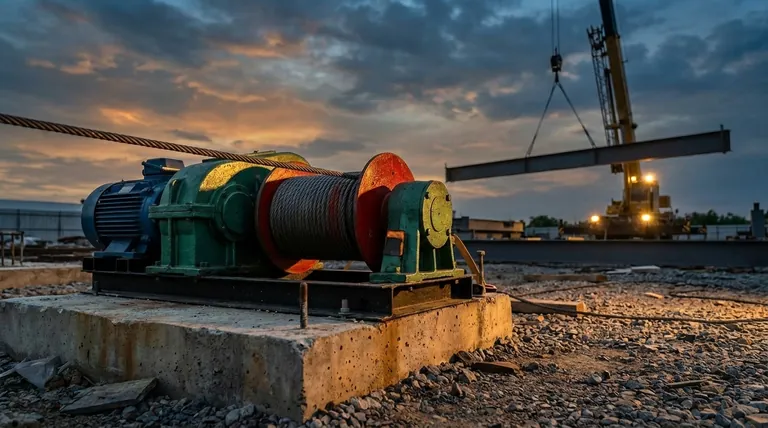
A Moment of Truth
Imagine a construction foreman watching a multi-ton steel beam sway precariously over a foundation, held by a single cable. Or a ship's captain trying to set an anchor in a rising storm, with the vessel drifting dangerously toward a reef.
In these moments, control is everything. The tool responsible for that control—the winch—is not just a piece of machinery. It is the physical manifestation of a decision. It represents a calculated balance between power, complexity, and trust.
Understanding how a winch works is to understand a fundamental principle of engineering: the elegant conversion of energy into controlled, overwhelming force.
Mechanical Advantage as a Philosophy
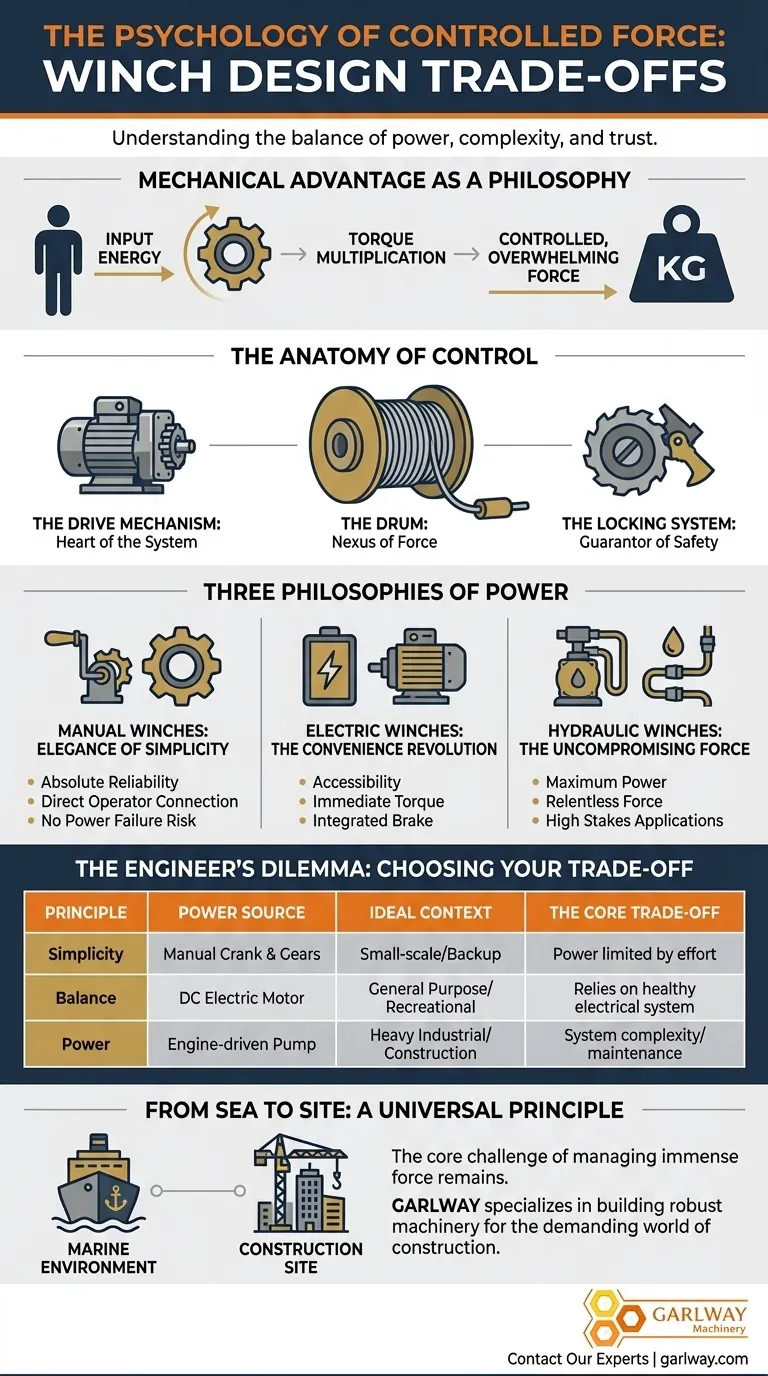
At its heart, a winch is a system of mechanical advantage. It takes an input energy—be it the physical effort of a human, the chemical energy in a battery, or the fluid pressure from a pump—and multiplies it into the torque needed to manage an immense load.
This isn't just about making work easier. It's about imposing order on chaos. It replaces the brute, unpredictable strain of manual lifting with a managed, predictable, and profoundly safer process. The psychology is simple: a winch provides the confidence to command forces far greater than ourselves.
The Anatomy of Control
Every winch, regardless of its power source, is built around three core concepts that work in harmony.
- The Drum: This is the nexus of force, the point of contact between the machine and the load. As the anchor rode or lifting cable winds onto this central cylinder, raw power is translated into precise movement.
- The Drive Mechanism: The heart of the system. This is the motor or gearbox that generates the rotational force. The nature of this drive defines the winch's character, its power, and its limitations.
- The Locking System: This is the guarantor of safety. A ratchet or brake system prevents the drum from unwinding under load, transforming a dynamic action into a static, secure state. It is the mechanism that allows us to trust the machine.
Three Philosophies of Power
The primary difference between winch types lies in how they power the drive mechanism. This choice is less about technology and more about a philosophy of use, reflecting a different set of priorities for the operator.
Manual Winches: The Elegance of Simplicity
A manual winch uses a hand-crank and a gearbox to multiply human effort. There are no wires to corrode or hydraulic lines to leak.
Its philosophy is one of absolute reliability. In situations where a power failure is not an option or simplicity is paramount, the direct connection between operator and machine provides an unmatched sense of control and trust. It is engineering reduced to its most dependable form.
Electric Winches: The Convenience Revolution
By far the most common type in modern applications, the electric winch strikes a powerful balance.
- A switch sends power from a DC battery to an electric motor.
- The motor generates immediate, consistent torque.
- An integrated brake engages and disengages automatically.
The philosophy here is accessibility. Electric winches democratized immense pulling power, making it available at the push of a button. They represent a sweet spot on the curve—powerful enough for most serious jobs, yet simple enough for straightforward installation and maintenance.
Hydraulic Winches: The Uncompromising Force
Found on large commercial vessels and heavy construction equipment, hydraulic systems operate on a different scale. An engine-driven pump pressurizes fluid, which drives a hydraulic motor with relentless force.
This philosophy is one of maximum power. When the loads are astronomical and performance cannot be compromised, hydraulics are the only answer. The trade-off is complexity—pumps, hoses, and reservoirs require expert installation and diligent maintenance. It is the choice for professionals whose work involves the highest stakes.
The Engineer's Dilemma: Choosing Your Trade-off
Selecting a winch is an exercise in understanding your operational reality. There is no single "best" type; there is only the right tool for the job, and every choice involves a trade-off.
| Principle | Power Source | Ideal Context | The Core Trade-off |
|---|---|---|---|
| Simplicity | Manual Crank & Gears | Small-scale, backup, remote use | Power is limited by human effort. |
| Balance | DC Electric Motor | General purpose, recreational, light commercial | Relies on a healthy electrical system. |
| Power | Engine-driven Pump | Heavy industrial, commercial, construction | System complexity and maintenance cost. |
From Sea to Site: A Universal Principle of Work
The physics governing a marine winch holding a vessel against a two-knot current are the same as those for a construction winch lifting a concrete panel onto the tenth floor of a skyscraper. The environment changes, but the core challenge of managing immense force remains.
Whether your domain is the open sea or a high-rise construction site, mastering these forces requires equipment built on a deep understanding of these principles. Robustness, reliability, and a design philosophy that matches your needs are non-negotiable. At GARLWAY, we specialize in building machinery for the demanding world of construction, where these trade-offs are weighed every single day. Our winches are engineered to provide that critical, controlled force you can trust.
If you need a solution designed for power and reliability in the toughest environments, let's talk about the right system for your project. Contact Our Experts
Visual Guide
Related Products
- Warn Winch Windlass Boat Trailer Winch
- Electric and Hydraulic Winch for Heavy Duty Applications
- Small Electric Winch 120V and 240V for Compact Applications
- 12000 lb Electric Boat Trailer Winch with Windlass Anchor Warn
- Quick Windlass Portable Winch for Truck and Boat Best Boat Winch
Related Articles
- Beyond the Bumper: The Critical System Choice in Powering Your Trailer Winch
- Force vs. Mass: The Critical Difference in Sizing a Boat Winch
- Lines of Force: The Unseen Geometry of a Boat Winch
- More Than a Number: The Engineering Psychology of Choosing a Boat Winch
- How to Choose and Optimize Winch Speed for Maximum Efficiency





