The Moment of Truth
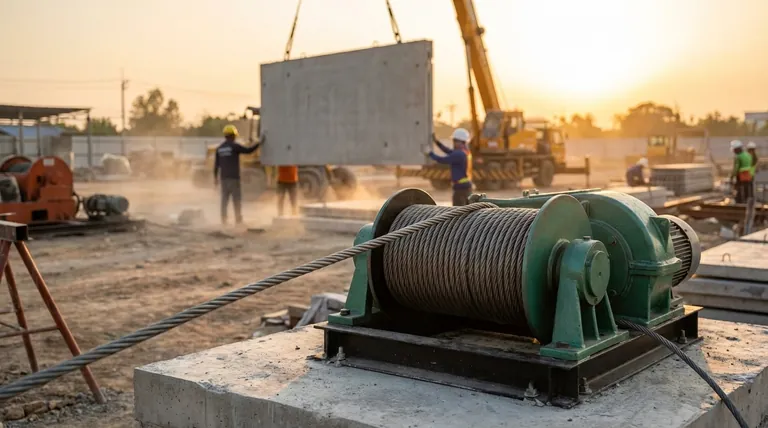
Picture a massive precast concrete panel suspended mid-air, dozens of stories above the ground. Below, a construction crew guides it into place. The entire operation—the safety of the crew, the integrity of the structure, the project's timeline—hinges on the steady, unwavering pull of a single machine: the winch.
This is the winch's moment of truth. It’s a machine so fundamental we often overlook its elegance. At its core, a winch does one thing: it converts rotational energy into linear pulling force.
But the real story, the one that separates success from failure on a job site, lies in how it creates that force.
The Anatomy of a Pull
Every winch, from a small off-road unit to a massive industrial hoist, is a symphony of simple mechanical principles working in concert.
The Drum: The Center of Rotation
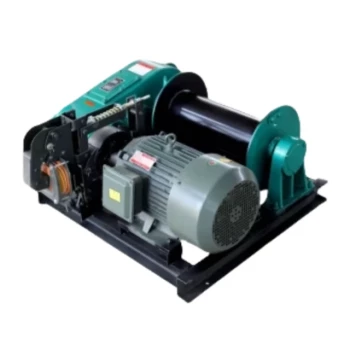
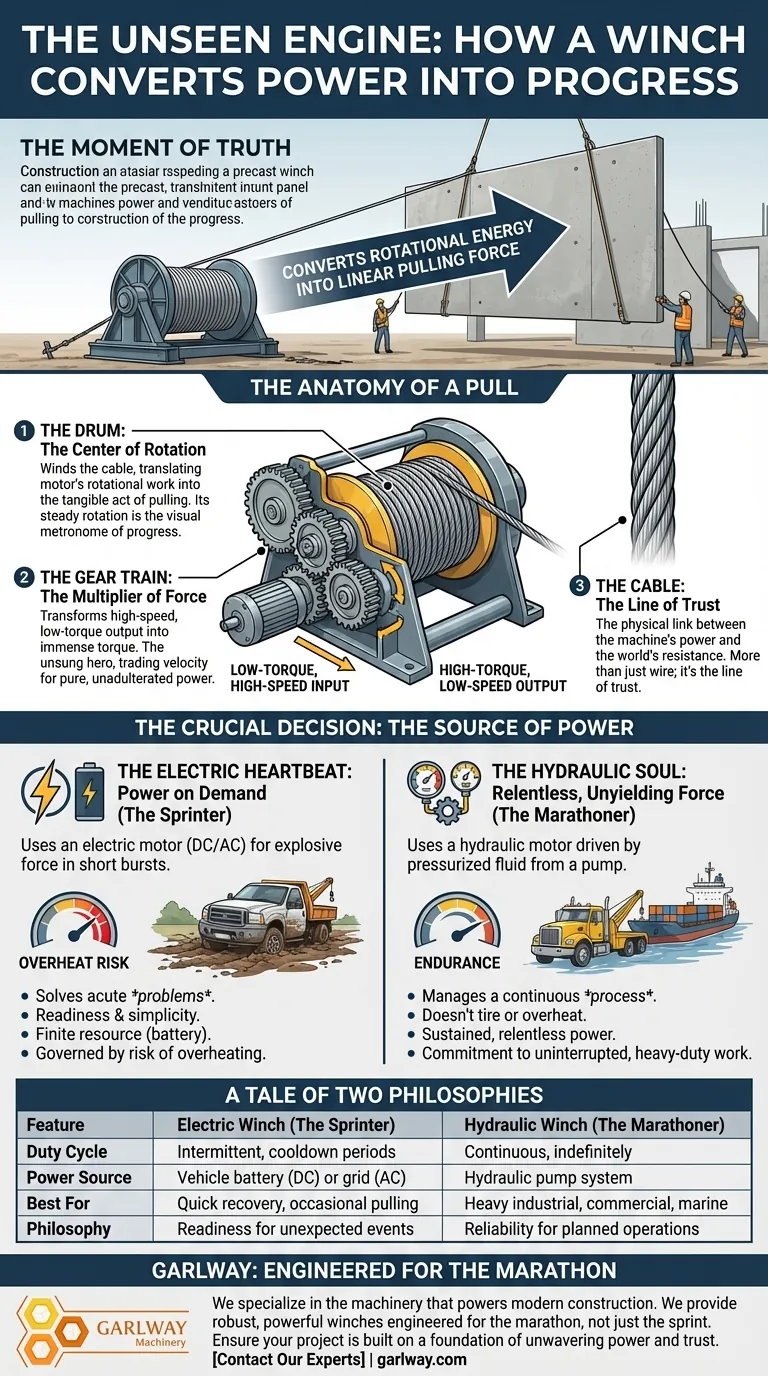
The drum is the heart of the winch. It’s the spool that winds the cable, translating the motor’s rotational work into the tangible act of pulling. Its steady rotation is the visual metronome of progress.
The Gear Train: The Multiplier of Force
Between the power source and the drum lies the gear train. This is where the magic happens. It takes the high-speed, low-torque output of a motor and transforms it into the low-speed, immense torque needed to move mountains. It’s the unsung hero, trading velocity for pure, unadulterated power.
The Cable: The Line of Trust
The steel cable is the physical link between the machine's power and the world's resistance. It’s more than just wire; it's the line of trust. Its integrity is non-negotiable, the conduit through which the entire system's force is delivered.
The Crucial Decision: The Source of Power
While the mechanics of the pull are universal, the source of power defines the winch's character, its limitations, and its soul. This choice is less about engineering preference and more about operational philosophy.
The Electric Heartbeat: Power on Demand
An electric winch is a sprinter. It uses an electric motor, powered by DC from a vehicle's battery or AC from the grid, to deliver explosive force in short bursts.
- The Scenario: Recovering a stuck vehicle from mud. The need is immediate, intense, and brief.
- The Psychology: This is a tool for solving acute problems. Its value lies in its readiness and simplicity of installation. However, it operates on a finite resource—battery power—and is governed by the risk of overheating. It's a bet on a quick resolution.
The Hydraulic Soul: Relentless, Unyielding Force
A hydraulic winch is a marathon runner. It uses a hydraulic motor driven by pressurized fluid from a pump. It’s a more complex system, but that complexity buys something invaluable: endurance.
- The Scenario: Maneuvering barges, operating a tow truck, or powering equipment on an industrial construction site where work is continuous.
- The Psychology: This is a tool for managing a continuous process. It doesn't tire or overheat. Its power is sustained and relentless. The choice for a hydraulic system is a commitment to uninterrupted, heavy-duty work, where reliability isn't a feature but a prerequisite.
A Tale of Two Philosophies
The decision between electric and hydraulic isn't about which is "better." It's about matching the tool to the temperament of the task. One is built for the emergency; the other is built for the enterprise.
| Feature | Electric Winch (The Sprinter) | Hydraulic Winch (The Marathoner) |
|---|---|---|
| Duty Cycle | Intermittent; requires cooldown periods | Continuous; can run indefinitely |
| Power Source | Vehicle battery (DC) or grid (AC) | Hydraulic pump system |
| Best For | Quick recovery, occasional pulling | Heavy industrial, commercial, marine use |
| Philosophy | Readiness for unexpected events | Reliability for planned operations |
On a professional construction site, this isn't an abstract choice. It's a critical decision that impacts safety, efficiency, and budget. The demand is for relentless performance, day in and day out. This is the domain where industrial-grade equipment isn't just preferred; it's required.
At GARLWAY, we specialize in the machinery that powers modern construction. We understand that whether you're operating a high-capacity winch, a concrete mixer, or a full-scale batching plant, you're not just buying a machine—you're investing in reliability. We provide robust, powerful winches engineered for the marathon, not just the sprint.
To ensure your project is built on a foundation of unwavering power and trust, let's find the right solution for your operational needs. Contact Our Experts
Visual Guide
Related Products
- Warn Winch Windlass Boat Trailer Winch
- Electric and Hydraulic Winch for Heavy Duty Applications
- Small Electric Winch 120V and 240V for Compact Applications
- 12000 lb Electric Boat Trailer Winch with Windlass Anchor Warn
- Quick Windlass Portable Winch for Truck and Boat Best Boat Winch
Related Articles
- Beyond the Bumper: The Critical System Choice in Powering Your Trailer Winch
- Force vs. Mass: The Critical Difference in Sizing a Boat Winch
- Lines of Force: The Unseen Geometry of a Boat Winch
- More Than a Number: The Engineering Psychology of Choosing a Boat Winch
- How to Choose and Optimize Winch Speed for Maximum Efficiency