The Psychology of Immense Force
Picture a construction site. A multi-ton precast concrete panel hangs suspended, needing to be eased into place with millimeter precision. Or imagine a fully-loaded truck, its wheels spinning uselessly in deep mud, gravity and friction holding it captive.
These scenarios share a common problem: an overwhelming force that renders human strength irrelevant. The challenge isn't just about moving an object; it's about imposing order on a chaotic physical reality. This is the world where the winch operates—not as a tool of brute force, but as an instrument of control.
The Foundational Principle: Taming Energy
At its heart, a winch is a beautiful demonstration of engineering elegance. It doesn't create power. It masterfully converts it.
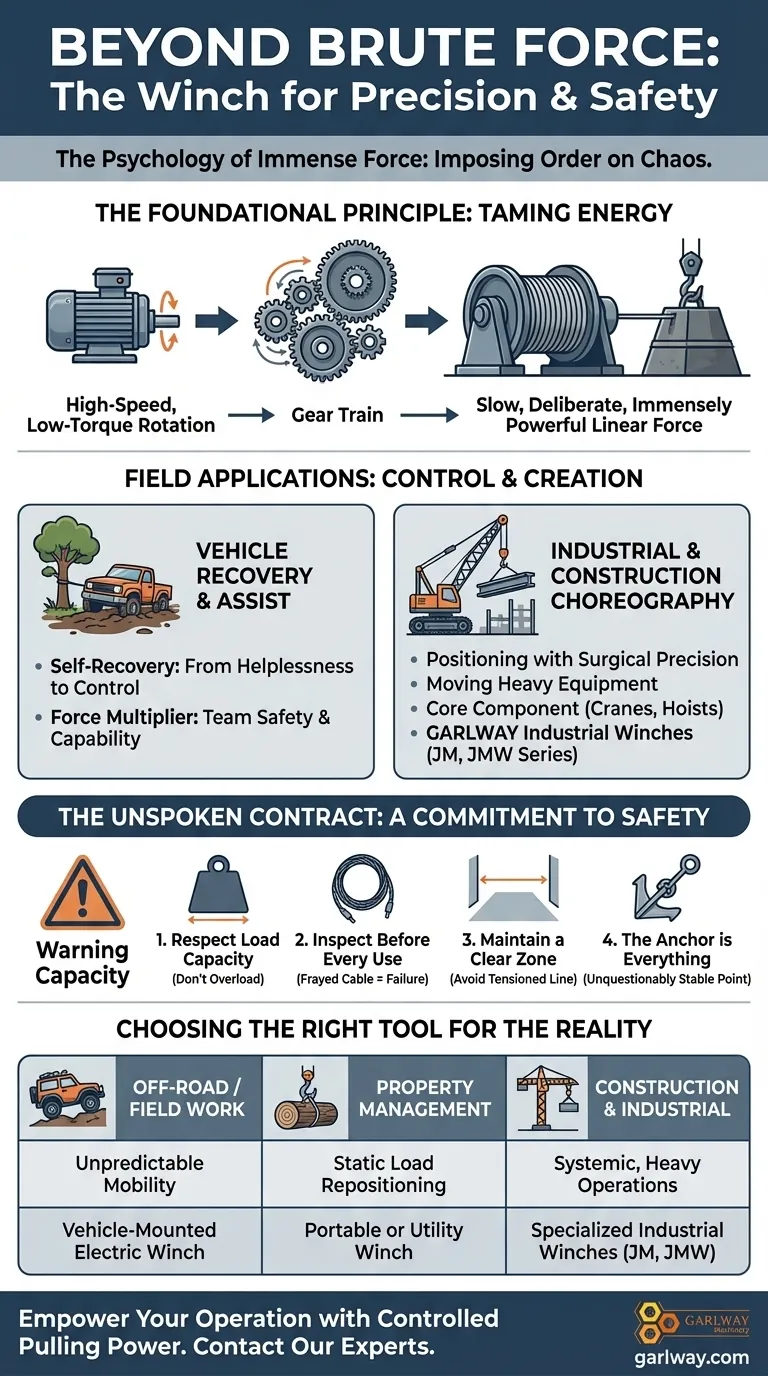
A motor's high-speed, low-torque rotation is channeled through a gear train, transforming it into slow, deliberate, and immensely powerful linear force. This conversion is the mechanical advantage that allows a small, manageable input to overcome an otherwise impossible load. It's the difference between a chaotic struggle and a controlled operation.
Field Application I: Taming Unpredictable Environments
The most famous application of the winch is in vehicle recovery, but its role goes deeper than just pulling a truck out of the mud. It's a tool for restoring autonomy.
From Helplessness to Control: The Self-Recovery Scenario
To be stuck is to be helpless. Whether on a remote trail or a muddy work site, immobilization means schedules are broken, safety is compromised, and control is lost.
A vehicle-mounted winch is a declaration of independence. By anchoring to a stable point—a mature tree, a solid rock, or another vehicle—an operator can methodically pull their own vehicle free. It transforms a moment of high-stress crisis into a procedural, solvable problem.
The Duty to Assist: A System-Wide Force Multiplier
An equipped vehicle does more than just save itself. It becomes a mobile anchor point, capable of rescuing others. In a fleet or on a team, a single winch-equipped vehicle elevates the capability and safety of the entire group, ensuring no one is left behind.
Field Application II: Shaping the Built World
While vehicle recovery is dramatic, the winch's most profound impact is on the industrial and construction landscape. Here, it is less a rescue device and more a fundamental tool for creation.
The Construction Site Choreography
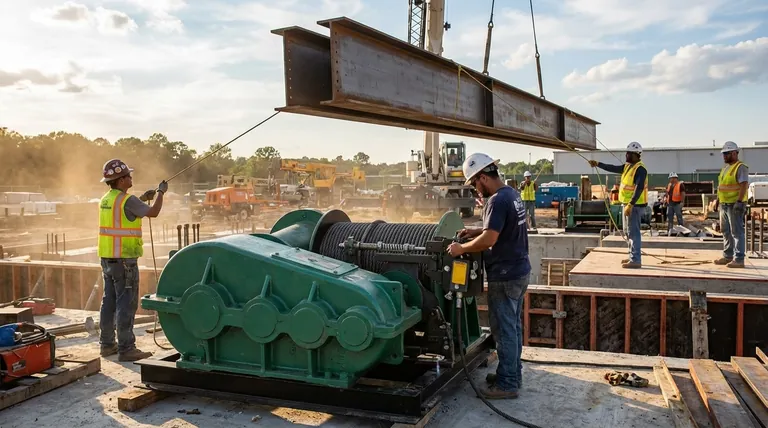
On a busy construction site, a winch is a choreographer of heavy materials. It’s used to:
- Position heavy steel beams with surgical precision.
- Drag essential equipment across uneven ground.
- Tension cables and structural elements.
Using snatch blocks and multiple anchor points, a winch operator can guide massive loads safely and efficiently, performing tasks that would be impossible or dangerously unstable with cranes alone.
The Engine Within the Engine: Industrial Integration
In the world of heavy machinery, the winch is often the invisible workhorse. It's the critical component inside cranes, hoists, and specialized systems used in mining, shipping, and civil engineering projects.
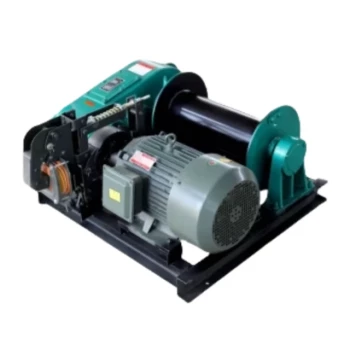
For these applications, specialized industrial winches are essential. Series like the JM slow-speed winch are designed for precise positioning, while the JMW series provides heavy-duty pulling power for large-scale construction. These are not accessories; they are core components engineered for constant, reliable performance under extreme loads. Leading suppliers like GARLWAY provide these robust, purpose-built winches that form the backbone of modern construction and industry.
The Unspoken Contract: A Commitment to Safety
The immense power of a winch comes with a non-negotiable contract of responsibility. A failure is not just an equipment breakdown; it's a catastrophic release of stored energy.
The Physics of Failure
Understanding safety means understanding physics. A tensioned winch line contains enormous kinetic energy. If it snaps, or if an anchor point fails, that energy is released in an instant, turning the cable into a devastating projectile.
Adhering to safety protocols is not about bureaucracy; it's about respecting the forces at play.
- Respect the Load Capacity: Never exceed the winch's rated limit. Overloading stresses the motor, gears, and cable to their breaking point.
- Inspect Before Every Use: A frayed cable or a damaged hook is a critical failure waiting to happen. A two-minute inspection prevents disaster.
- Maintain a Clear Zone: The area around the tensioned line is a no-go zone. Simple as that.
The Anchor is Everything
A winch is only as strong as its anchor. Whether it's the vehicle's frame or a dedicated concrete mounting, the anchor point must be unquestionably stable. A weak anchor guarantees failure. It's a stark reminder that any system is only as strong as its weakest link.
Choosing the Right Tool for the Right Reality
To leverage a winch effectively, you must match its design to the problem you are solving.
| Task Category | Dominant Challenge | Recommended Solution |
|---|---|---|
| Off-Road / Field Work | Unpredictable Mobility & Terrain | Vehicle-mounted electric winch |
| Property Management | Static Load Repositioning (Logs, Rocks) | Portable or vehicle-mounted utility winch |
| Construction & Industrial | Systemic, Repeatable Heavy Operations | Specialized industrial winches (e.g., JM, JMW series) |
Understanding your primary challenge—whether it's conquering a muddy trail or building a bridge—is the first step toward selecting a tool that empowers you, rather than complicates your work.
From providing a lifeline in the wilderness to precisely positioning the building blocks of our infrastructure, the winch is a testament to focused power. It’s a tool that allows us to safely and methodically impose our will on the physical world. For any serious construction or industrial operation, having the right pulling solution isn't a luxury; it's fundamental to safe and efficient progress. If you are facing a challenge that requires controlled, reliable pulling power, Contact Our Experts.
Visual Guide
Related Products
- Warn Winch Windlass Boat Trailer Winch
- Electric and Hydraulic Winch for Heavy Duty Applications
- Small Electric Winch 120V and 240V for Compact Applications
- 12000 lb Electric Boat Trailer Winch with Windlass Anchor Warn
- Quick Windlass Portable Winch for Truck and Boat Best Boat Winch
Related Articles
- Beyond the Bumper: The Critical System Choice in Powering Your Trailer Winch
- Force vs. Mass: The Critical Difference in Sizing a Boat Winch
- Lines of Force: The Unseen Geometry of a Boat Winch
- More Than a Number: The Engineering Psychology of Choosing a Boat Winch
- How to Choose and Optimize Winch Speed for Maximum Efficiency