The Illusion of a Simple Task
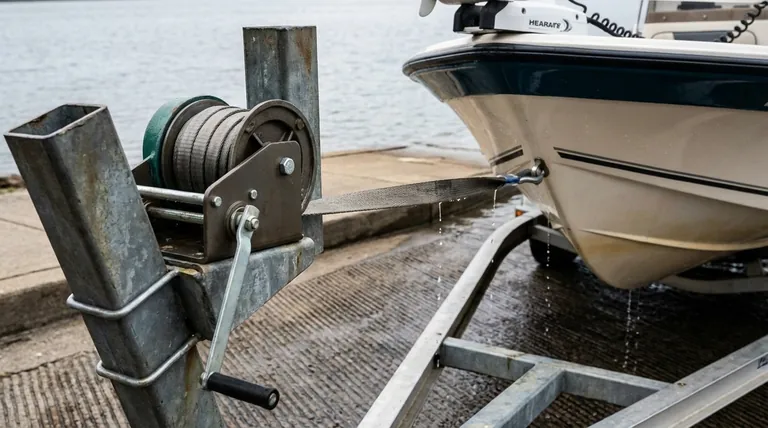
At the boat ramp, the final act of the day seems beautifully simple: loading the boat onto the trailer. The electric hum of the winch, the steady pull of the strap, the gentle glide of the hull onto the bunks. It looks like a one-dimensional problem solved by a single piece of equipment.
This is a dangerous illusion.
Our minds are wired to simplify. We see the winch, we see the boat, and we see a straight line connecting them. What we don't see are the complex, invisible lines of force at play. The process is not a simple pull; it is a carefully orchestrated ballet of physics, where a single misstep can introduce catastrophic stress into the system.
The Mount: A System, Not a Spot
We tend to ask, "Where does the winch attach?" The better question is, "How does the winch integrate into the trailer's structural system?"
The Structural Backbone
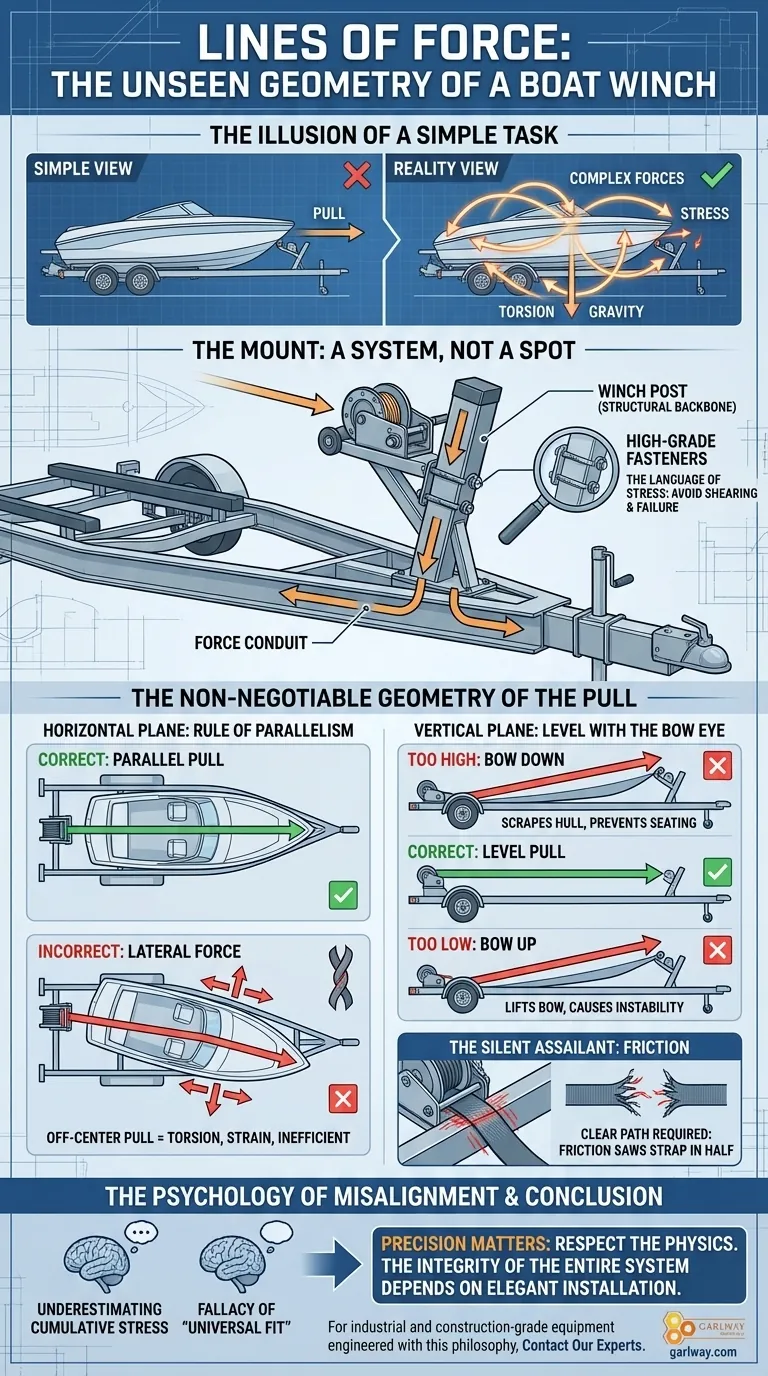
The winch doesn't just bolt onto the trailer. It bolts to the winch post—a dedicated, heavy-duty vertical support engineered to be the trailer's anchor point. This post is the system's backbone, designed to absorb and redirect the immense pulling force required to haul thousands of pounds of boat and water against the pull of gravity.
Think of it less as a post and more as a conduit for force, channeling the energy from the winch, through the trailer frame, and into the ground.
Fasteners: The Language of Stress
The winch is secured to its mounting plate with high-grade bolts. These are not mere fasteners; they are the vocabulary in a conversation about stress. Using underrated hardware is like trying to describe immense pressure with inadequate words—the communication will inevitably break down, resulting in shearing and failure. Corrosion resistance isn't an option; it's a requirement for maintaining the integrity of this language over time.
The Non-Negotiable Geometry of the Pull
A winch is designed for one thing: a straight, unimpeded pull. Any deviation from this line introduces parasitic forces that degrade equipment and compromise safety. The proper alignment is a matter of geometric precision.
The Horizontal Plane: A Rule of Parallelism
The winch strap must pull straight back, perfectly parallel to the trailer's main frame.
An off-center pull introduces lateral, or sideways, force. The winch isn't designed for this. This torsion twists the strap, puts uneven strain on the spooling mechanism, and attempts to pull the boat sideways onto the rollers. It's an inefficient and dangerous way to work, inviting failure at every turn.
The Vertical Plane: Level with the Bow Eye
The height of the winch relative to the boat's bow eye is just as critical. The ideal is a perfectly level line of pull.
A slight deviation in this vertical angle fundamentally changes the physics of the load, causing the system to fight itself.
| Winch Position | The Physical Reaction | The Consequence |
|---|---|---|
| Too High | Pulls the bow downward | Scrapes the hull, prevents the boat from seating properly on rollers. |
| Too Low | Pulls the bow upward | Lifts the bow off the bunks, causing instability and making it hard to secure. |
The Silent Assailant: Friction
Finally, the path from the winch drum to the bow eye must be completely clear. A strap that rubs, even slightly, against the trailer frame or a roller is a strap that is being slowly sawed in half. Friction is a silent and patient force of destruction, and its effects only become apparent when the strap's integrity has already been compromised.
The Psychology of Misalignment
Most winch failures are not due to the equipment itself, but to human error rooted in common cognitive biases.
We underestimate the power of small, cumulative stresses. The "good enough" alignment that seems fine on a calm day becomes the point of failure during a difficult retrieval in choppy water. We fall for the fallacy of the "universal fit," forgetting that every boat and trailer combination is a unique system that requires precise, individual adjustment.
Understanding this isn't just about mechanics; it's about respecting the physics. The integrity of the entire loading operation—and the safety of your investment—depends not on the brute strength of the winch, but on the elegant precision of its installation.
When the integrity of your entire system depends on the quality and placement of its components, precision matters. For industrial and construction-grade equipment engineered with this philosophy at its core, Contact Our Experts.
Visual Guide
Related Products
- Electric 120V Boat Winch by Badlands
- 12000 lb Electric Boat Trailer Winch with Windlass Anchor Warn
- Heavy Duty Electric Boat Winch Windlass Anchor
- 12000 lb Heavy Duty Electric Boat Winch
- Quick Windlass Portable Winch for Truck and Boat Best Boat Winch
Related Articles
- How to Choose Between Reversible and Friction Electric Winches: A Transmission Guide
- The Unseen System: How an Electric Winch Manages Force and Eliminates Fear
- How to Choose Between Manual and Electric Winches for Your Project
- When Automation Fails: The Critical Role of Manual Override in Electric Winches
- Beyond Brute Force: The Calculated Power of the Electric Winch