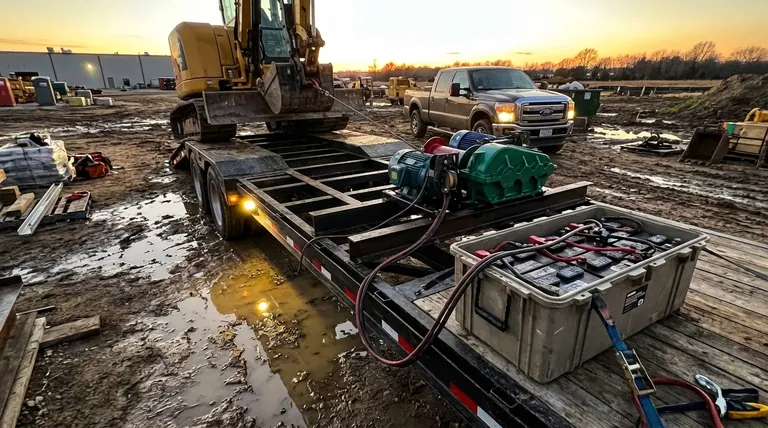
The Moment of Truth is Not the Pull, But the Power
Picture this: It's the end of a long day on the construction site. A heavy piece of equipment sits on your trailer, needing to be winched into place. The winch is a marvel of mechanical advantage, but at this moment, its strength is meaningless.
The only thing that matters is the flow of electrons.
How you designed your winch's power system months ago will determine whether this is a smooth, two-minute task or the beginning of a frustrating battle with a dead vehicle battery and costly downtime. Choosing a power source is not just a technical detail; it's a strategic decision about future reliability.
Two Philosophies of Power
At its core, the choice boils down to two distinct approaches: treating the winch as a temporary accessory of your truck, or building it into a self-sufficient system on the trailer itself.
Method 1: The Tethered Approach
The most common method is to power the winch directly from your tow vehicle's battery. A heavy-gauge wiring kit runs from the engine bay to the rear bumper, creating a lifeline to the winch.
This is the path of simplicity and lower upfront cost. It avoids the need for a second battery to buy, mount, and maintain. For the operator who uses a winch to load a small ATV a few times a year, it’s a perfectly logical solution.
The critical discipline here is to always keep the tow vehicle's engine running during operation. The alternator is essential to replenish the high amperage draw, preventing you from stranding yourself. This system is simple, but it is entirely dependent.
Method 2: The Self-Sufficient System
The professional's choice is to install a dedicated, deep-cycle battery directly on the trailer. The winch connects to this onboard power source via a short, efficient cable.
This creates an independent system. The power delivery is more robust and consistent, as it avoids the voltage drop that can occur over the long run of cable from a truck's engine. It also completely isolates and protects your tow vehicle's electrical system from the massive strain of a heavy pull.
Of course, this system requires more investment—in the battery, a protective box, and a reliable charging solution (either from the tow vehicle or an AC charger). But it buys something invaluable: resilience.
The Psychology of the Choice: Simplicity vs. Resilience
We are psychologically wired to favor the simpler, cheaper option. The "tethered approach" feels more intuitive and requires less immediate effort and expense. This often leads to the "it's just for occasional use" justification.
But risk is a combination of probability and consequence.
While the probability of failure might be low for light, infrequent use, the consequences of failure for a professional are enormous. A dead battery on a remote job site isn't an inconvenience; it's a cascade of delays, lost labor costs, and potential damage to a reputation.
Investing in a dedicated battery system is an investment in future peace of mind. You are engineering a solution designed to work flawlessly under pressure, when you're tired, and when failure is not an option. It's the difference between hoping it works and knowing it will.
From Theory to Practice: System Integrity
Regardless of the power source, the system's integrity depends on its physical installation and operational discipline.
-
The Foundation: The winch must be mounted for a perfectly straight, unobstructed pull. The physics are unforgiving. A bad angle creates uneven spooling and immense stress on the cable and drum.
-
The Anchor: The mount itself must be unshakable, bolted directly to the trailer's frame or a dedicated steel plate. It becomes part of the trailer's backbone.
-
The Discipline: Before any pull, the tow vehicle must be in neutral with the parking brake set. Wheel chocks on the trailer are not optional; they are essential for stability. This isn't a checklist; it's the disciplined practice of a professional.
Making the Professional's Choice
Your decision should be dictated by the demands of your work, not just the initial cost.
| Method | Best For | Key Advantage | Main Drawback |
|---|---|---|---|
| Direct from Vehicle | Infrequent, light-duty use | Simplicity & lower initial cost | Strain on vehicle's electrical system |
| Dedicated Battery | Frequent, heavy-duty use | Superior power & system resilience | Higher cost, weight & complexity |
For construction companies and professional contractors, where machinery is heavy and uptime is critical, the choice is clear. The robust, reliable power of a dedicated battery system isn't a luxury; it's a fundamental component of a professional-grade tool. At GARLWAY, we build machinery like winches, concrete mixers, and batching plants for this very environment—where performance cannot be left to chance.
Building a reliable power system ensures your winch is always ready to perform. To equip your operation with tools built for resilience, Contact Our Experts.
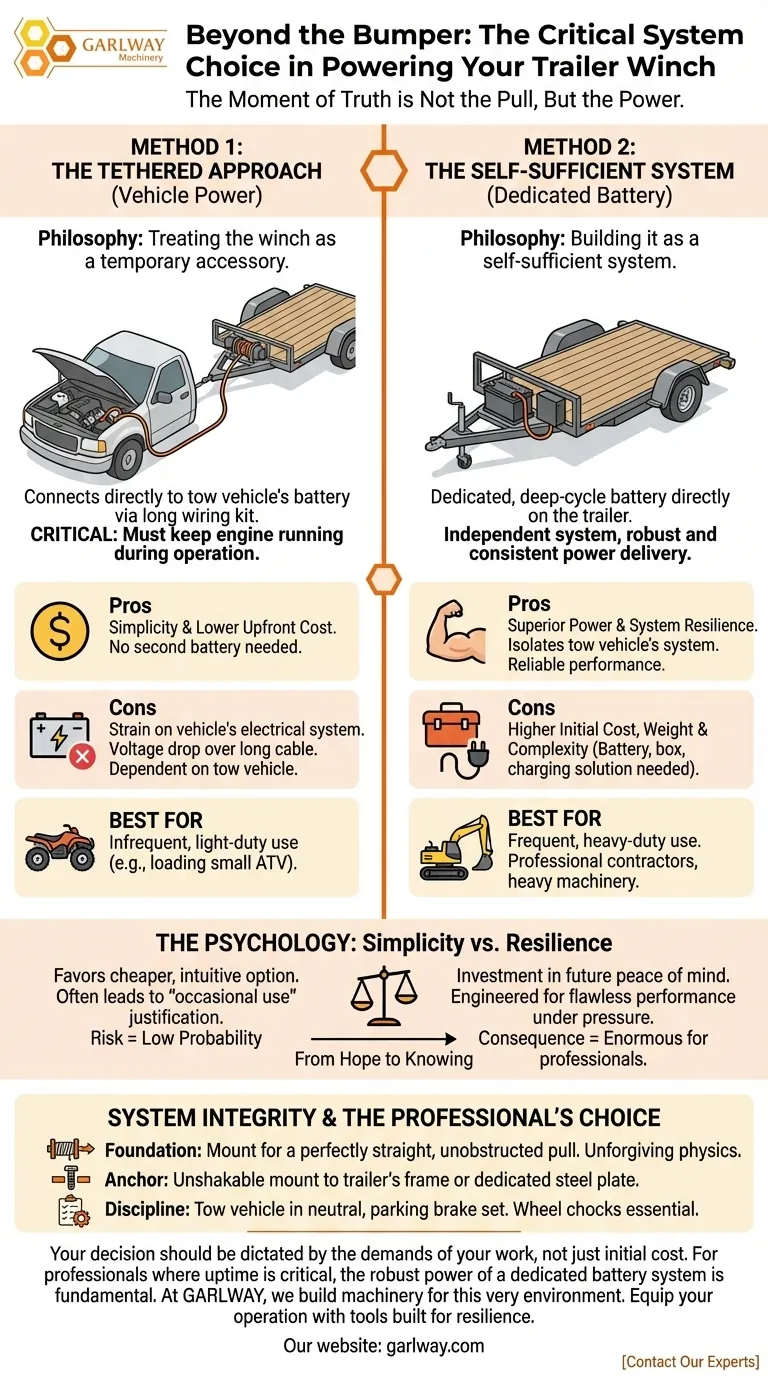
Visual Guide
Related Products
- 12000 lb Electric Boat Trailer Winch with Windlass Anchor Warn
- Portable Small Trailer Winch
- Best 18000 Pound Drum Anchor Trailer Winch
- Warn Winch Windlass Boat Trailer Winch
- Quick Windlass Portable Winch for Truck and Boat Best Boat Winch
Related Articles
- How Boat Anchor Winches Prevent Injuries and Enhance Marine Safety
- Why Boat Anchor Winches Earn "Best Accessory" Status: A Deep Dive into User Satisfaction Drivers
- How Electric Winches Outperform Hydraulic Systems in Heavy-Duty Applications
- How Electric Winches Outperform Hydraulic Systems in Cost and Efficiency
- Beyond Brute Force: The Engineering and Psychology of a Reliable Winch





