The Two-Body Problem at the Boat Ramp
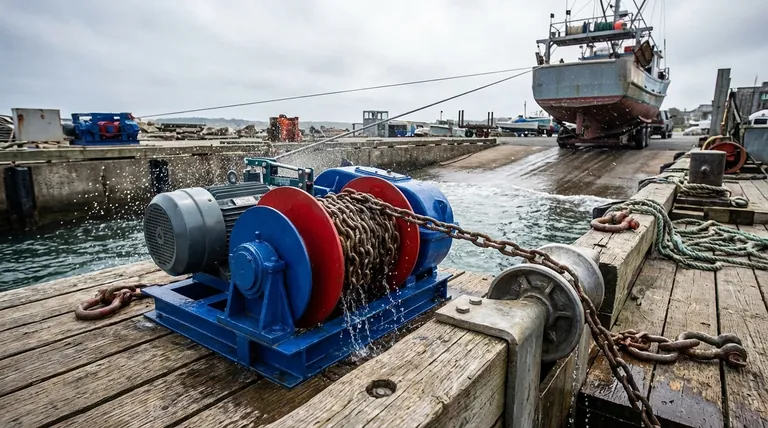
Picture a busy boat ramp on a Saturday morning. A skipper confidently backs their trailer down the slope. The boat is aligned, the hook is set. They hit the switch on the electric winch. A hum, a strain, and then… nothing. The boat, seemingly defying the power of the new machine, sits stubbornly in the water.
This scene, or worse, one involving a catastrophic failure, plays out far too often. It’s rarely due to a faulty winch. It's due to a failure in understanding the physics of the task.
Boat owners make one common, costly mistake: they assume a winch's job is to pull the boat's weight. But the real question is not what you are moving, but how you are moving it. Confusing the force needed to roll a boat onto a trailer with the force needed to lift an anchor from the seabed is a fundamental error in judgment.
A Tale of Two Forces
In engineering, a problem must be correctly defined before it can be solved. A boat winch presents two entirely different problems masquerading as one.
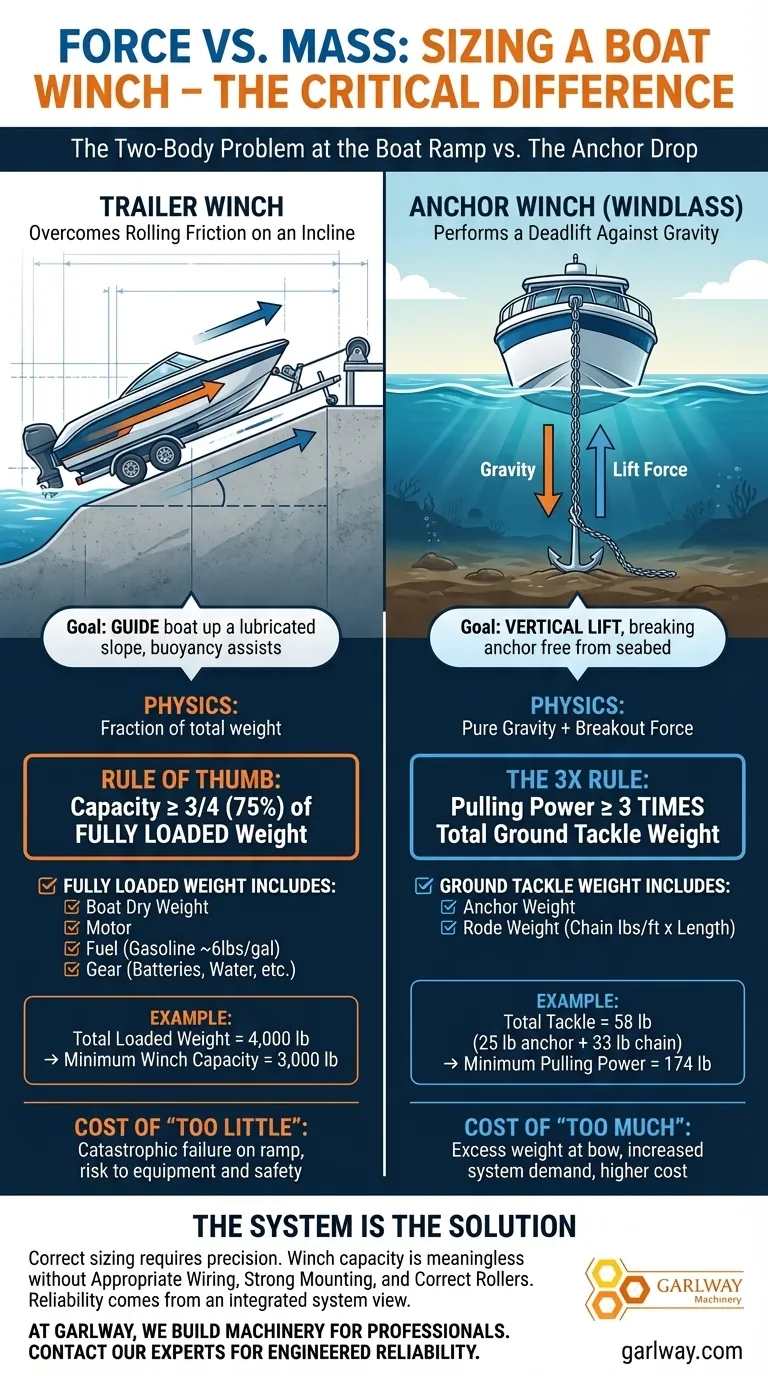
- A Trailer Winch overcomes rolling friction on an incline.
- An Anchor Winch (Windlass) performs a deadlift against gravity.
Applying the logic of one to the other is like using a hammer to turn a screw. It might work by brute force, but you're guaranteed to strip something in the process.
Sizing for the Ramp: The Trailer Winch
A trailer winch has a surprisingly forgiving job. It doesn't lift your boat. It simply guides it up a gentle, lubricated slope (the ramp and trailer bunks), with the water's buoyancy helping for much of the journey.
The Physics of the Pull
The force required is a fraction of the boat's total weight. The industry-standard calculation reflects this reality.
Rule of Thumb: A trailer winch needs a rated capacity of at least 2/3 to 3/4 of your boat's fully loaded weight.
The Discipline of "Fully Loaded"
The most common error here is underestimating the total weight. "Dry weight" is a dangerously misleading number. Your calculation must be comprehensive.
- Boat's Dry Weight: The manufacturer's starting point.
- Motor Weight: Often one of the heaviest single components.
- Fuel Weight: Don't forget a full tank (gasoline is ~6 lbs or 2.7 kg per gallon).
- Gear Weight: Batteries, water tanks, safety equipment, coolers, and personal gear add up quickly.
A Practical Formula:
- Total Loaded Weight = Boat + Motor + Fuel + All Gear
- Minimum Winch Capacity = Total Loaded Weight x 0.75
For a 4,000 lb total package, a 3,000 lb capacity winch is your starting point.
Sizing for the Drop: The Anchor Winch
An anchor winch, or windlass, faces a far more brutal task. Its job has nothing to do with the size of your boat. Its sole focus is the dead weight of your ground tackle (the anchor and its rode).
A Problem of Pure Gravity
Here, the winch performs a vertical lift. It must haul the anchor and chain straight up, fighting gravity every inch of the way. Furthermore, it needs a significant power reserve to break the anchor free from a muddy or rocky seabed.
The 3X Rule: An anchor winch must have a maximum pulling power of at least three times the total weight of your ground tackle.
This 3x multiplier is not arbitrary. It is a critical safety margin. It accounts for the immense suction of the seabed, the friction of the rode against your bow roller, and the added strain from wind and waves trying to pull you away from your anchor.
Calculating Ground Tackle Weight
- Anchor Weight: The weight stamped on your anchor.
- Rode Weight: The weight of your chain (lbs/ft or kg/m) multiplied by its length.
- Total Tackle Weight = Anchor Weight + Rode Weight
- Minimum Pulling Power = Total Tackle Weight x 3
A 25 lb anchor with 30 feet of chain weighing 33 lbs results in 58 lbs of tackle. Your winch needs a minimum pull of 174 lbs to handle it safely in adverse conditions.
The Psychology of Engineering Margins
Choosing a winch isn't just about math; it's about risk management. Our brains often default to simple heuristics like "bigger is better," but the reality is more nuanced.
The High Cost of "Too Little"
An undersized winch is a liability. A failing trailer winch can send thousands of pounds of boat and motor careening back down a ramp. A windlass that can't retrieve an anchor in a squall can leave a vessel dangerously adrift. The consequences are severe.
The Hidden Penalties of "Too Much"
While safer, oversizing has its own costs. A needlessly powerful winch is more expensive, places a heavier demand on your electrical system, and adds significant weight. On a windlass, this extra weight is at the bow, which can negatively affect your boat's performance and handling.
The goal is not to buy the biggest winch, but the correctly sized winch.
The System Is the Solution
Finally, remember the winch is just one component in a system. Its rated capacity is meaningless if it is not paired with appropriate wiring, a strong mounting point, and correctly aligned rollers. In heavy-duty applications, from marine work to large-scale construction, reliability comes from viewing the entire operation as a single, integrated system.
Choosing the right winch is an act of precision. It requires you to correctly identify the physical task and apply the right formula. It’s a small moment of engineering clarity that pays dividends in safety, reliability, and peace of mind.
| Winch Type | Governed By | Capacity Rule | Example Calculation |
|---|---|---|---|
| Trailer Winch | Boat's Fully Loaded Weight | At least 3/4 of total weight | 4,000 lb boat → 3,000 lb winch |
| Anchor Winch | Weight of Anchor & Rode | At least 3x total tackle weight | 58 lb tackle → 174 lb winch |
At GARLWAY, we build machinery for professionals who understand these stakes. If you need a winch that is engineered for a specific task and built for unwavering reliability, Contact Our Experts.
Visual Guide
Related Products
- Electric 120V Boat Winch by Badlands
- 12000 lb Electric Boat Trailer Winch with Windlass Anchor Warn
- Heavy Duty Electric Boat Winch Windlass Anchor
- 12000 lb Heavy Duty Electric Boat Winch
- Quick Windlass Portable Winch for Truck and Boat Best Boat Winch
Related Articles
- How to Choose Between Reversible and Friction Electric Winches: A Transmission Guide
- The Unseen System: How an Electric Winch Manages Force and Eliminates Fear
- How to Choose Between Manual and Electric Winches for Your Project
- When Automation Fails: The Critical Role of Manual Override in Electric Winches
- Beyond Brute Force: The Calculated Power of the Electric Winch