The Illusion of a Simple Machine
At a glance, a winch is the essence of simplicity: a drum, a gear, a handle or a motor. It’s a tool for pulling. This perceived simplicity is its greatest trap.
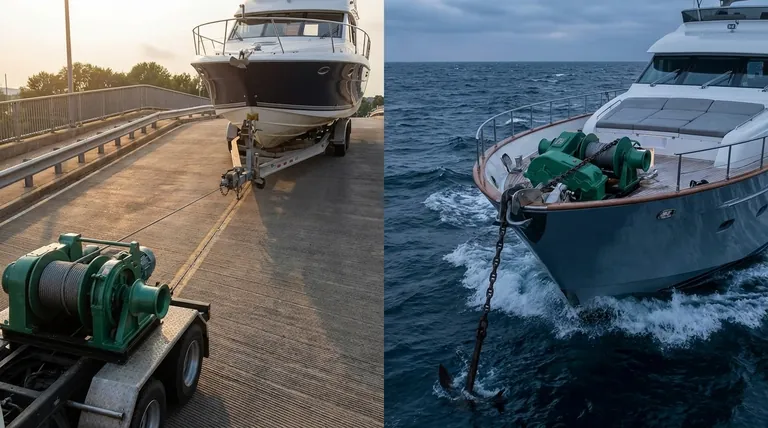
We tend to apply a single mental model to it, but a winch on a boat trailer and a winch on a bow (a windlass) operate in two entirely different physical and psychological universes. Choosing the right one isn't about matching a number to your boat's length; it's about correctly identifying the problem you are trying to solve.
The anxiety of a busy boat ramp on a windy day is a different kind of stress from hearing your anchor drag in a 2 a.m. squall. The winch you trust in each scenario is sized against a completely different enemy.
Two Worlds of Force: Trailer vs. Anchor
The fundamental error is failing to distinguish between overcoming rolling friction and fighting dead weight. They are not interchangeable.
Trailer Winch: A Battle Against Friction and Gravity
A trailer winch pulls your boat up an incline. Its primary job is to overcome the rolling friction of trailer bunks or rollers and the gravitational pull of the ramp's angle. It's a calculated, short-duration effort.
Anchor Windlass: A War Against a Vertical Load
An anchor windlass lifts your ground tackle (anchor and rode) straight up from the seabed. It is fighting the pure, dead weight of your gear against gravity, plus the additional forces of current, wind, and the suction of a buried anchor.
These two machines are specialized tools for two distinct tasks. Using one for the other's job is a recipe for failure.
Sizing for the Ramp: The Trailer Winch
Sizing a trailer winch is an exercise in honest accounting.
The Baseline: The "Half-Weight" Rule
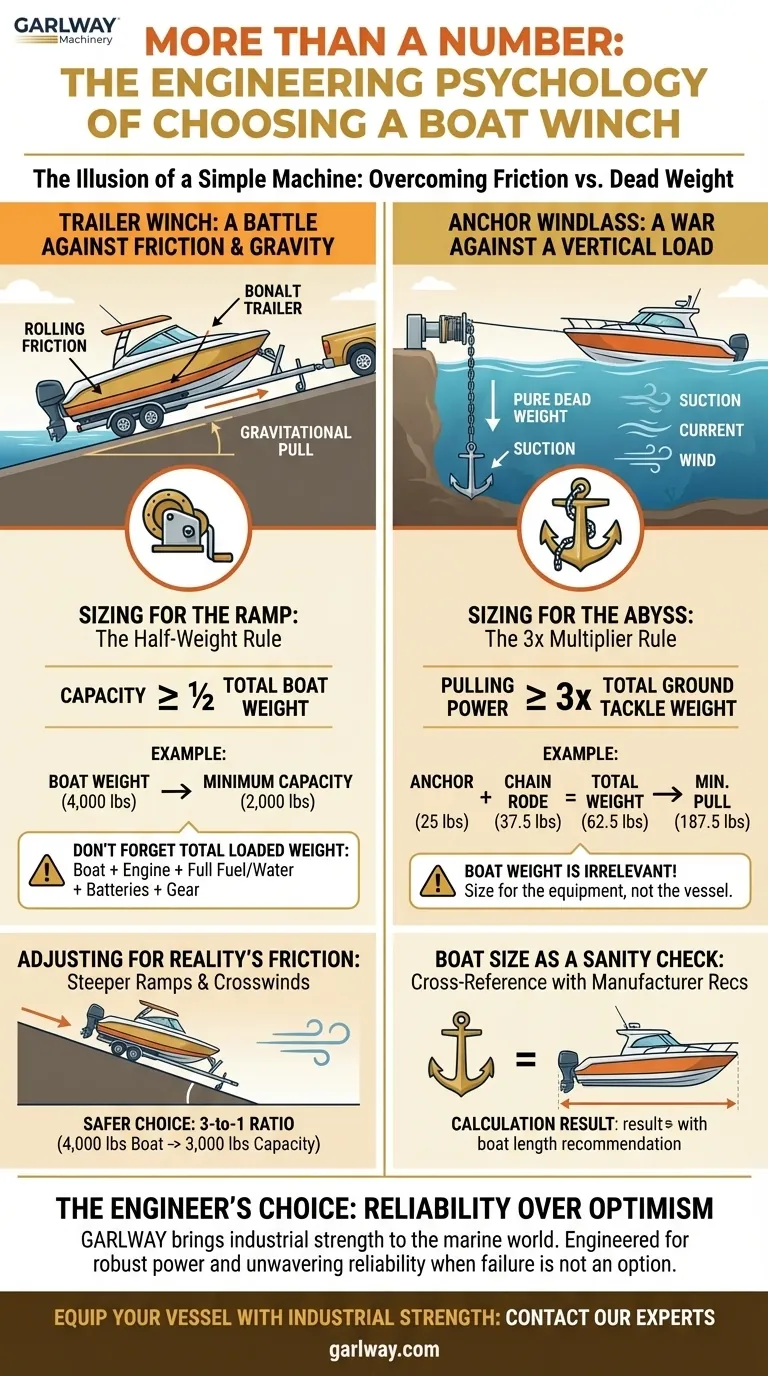
The starting point is a simple rule of thumb: select a winch with a capacity of at least half your boat's total weight.
- Boat Weight: 4,000 lbs
- Minimum Winch Capacity: 2,000 lbs
This works for ideal conditions: a well-maintained trailer and a shallow, smooth ramp. But the real world is rarely ideal.
The Cognitive Blind Spot: "Total Weight"
Your boat's "weight" is not the dry weight in the brochure. This is the most common and dangerous sizing mistake. You must calculate its fully loaded weight.
- Boat + Engine
- Full Fuel and Water Tanks
- Batteries
- All your gear, coolers, and equipment
Forgetting this extra mass is like miscalculating your budget; the error compounds under pressure.
Adjusting for Reality's Friction
The 2-to-1 ratio is a minimum. A steeper ramp, a crosswind, or worn-out trailer bunks dramatically increase the required force. For challenging conditions, a 3-to-1 ratio is a much safer and more reliable choice.
- Boat Weight: 4,000 lbs
- Safer Winch Capacity: 3,000 lbs
Investing in this margin isn't overkill; it's buying peace of mind for that day when conditions are working against you.
Sizing for the Abyss: The Anchor Windlass
Here, the weight of your boat is almost completely irrelevant. An anchor windlass is sized for the equipment it lifts, not the vessel it's attached to.
The Core Calculation: The 3x Multiplier
The rule for an anchor windlass is resolute: it must have a pulling power of at least three times the total weight of your ground tackle.
This 3x factor is your safety margin. It provides the power to break an anchor free from a muddy bottom and absorb the shock loads from waves that can snap a lesser machine.
An Audit of Your Ground Tackle
To apply the rule, you must know the weight of your system.
| Component | Example Weight |
|---|---|
| Anchor | 25 lbs |
| Chain Rode | 50 ft of 1/4" chain @ ~0.75 lbs/ft = 37.5 lbs |
| Total Weight | 62.5 lbs |
| Min. Pull | 62.5 lbs x 3 = 187.5 lbs |
Boat Size as a Sanity Check
Manufacturers often recommend a windlass model based on boat length. Use this as a cross-reference. If your calculation suggests a much smaller windlass than recommended for your boat's size, it's a strong signal that your anchor and rode may be dangerously undersized for your vessel.
The Engineer's Choice: Reliability Over Optimism
Undersizing a winch is a bet against reality. It's a gamble that the ramp will always be shallow, the wind calm, and the anchor never stuck. When that bet fails, the consequences can be severe. A trailer winch failure can send your boat careening back into the water. A stalled windlass can leave you stranded in deteriorating weather.
This is where an industrial mindset pays dividends. Equipment used in construction is not built on optimism; it's built for unforgiving environments where failure is not an option. GARLWAY brings this exact philosophy from construction sites to the marine world. Our winches are engineered for the robust power and unwavering reliability that professionals depend on when managing immense loads.
Choosing the right winch is an act of engineering foresight. By correctly identifying the force you need to manage and selecting a tool built for that specific task, you ensure safety, control, and confidence.
If you want to equip your vessel with machinery built on a foundation of industrial strength, Contact Our Experts.
Visual Guide
Related Products
- Electric 120V Boat Winch by Badlands
- 12000 lb Electric Boat Trailer Winch with Windlass Anchor Warn
- Heavy Duty Electric Boat Winch Windlass Anchor
- 12000 lb Heavy Duty Electric Boat Winch
- Quick Windlass Portable Winch for Truck and Boat Best Boat Winch
Related Articles
- How to Choose Between Reversible and Friction Electric Winches: A Transmission Guide
- The Unseen System: How an Electric Winch Manages Force and Eliminates Fear
- How to Choose Between Manual and Electric Winches for Your Project
- When Automation Fails: The Critical Role of Manual Override in Electric Winches
- Beyond Brute Force: The Calculated Power of the Electric Winch