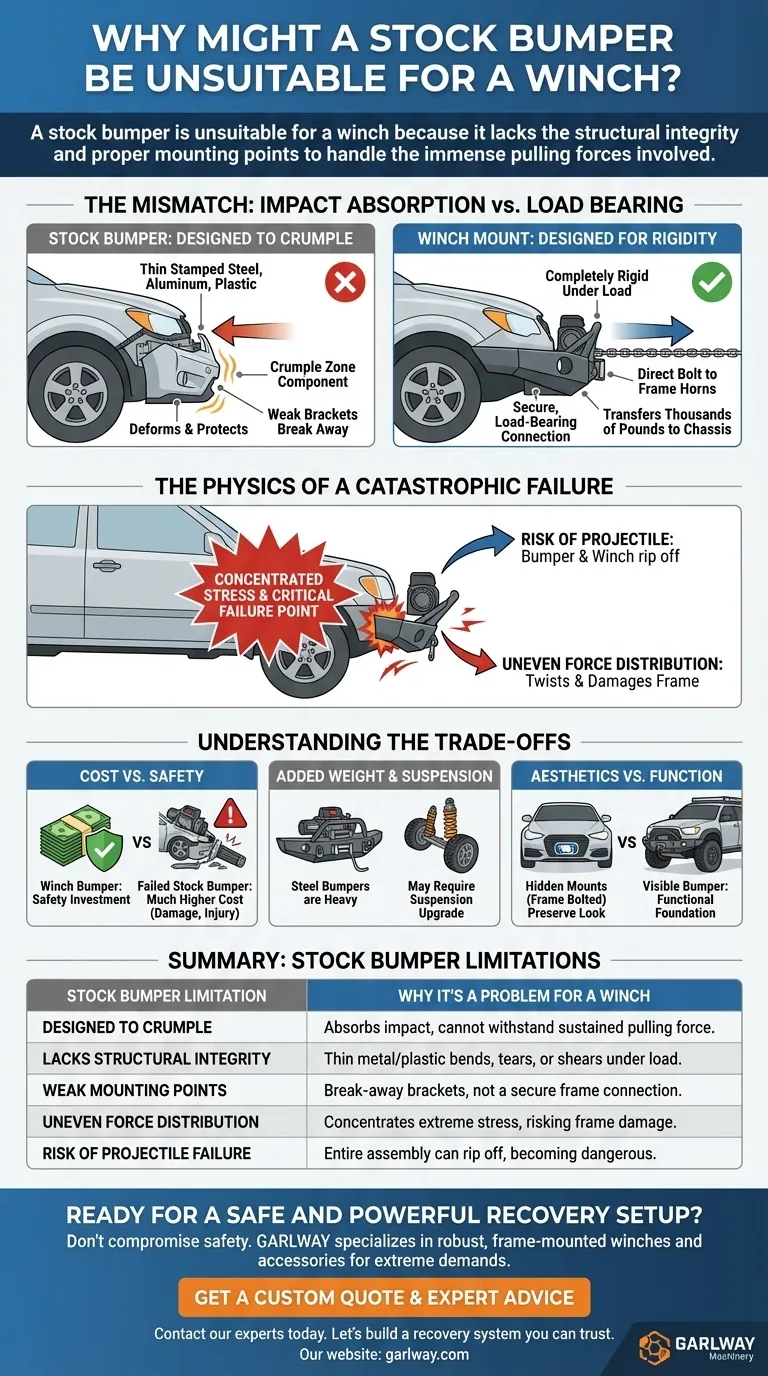
In short, a stock bumper is unsuitable for a winch because it fundamentally lacks the structural integrity and proper mounting points to handle the immense pulling forces involved. Stock bumpers are engineered to crumple during an impact, whereas a winch mount must be absolutely rigid and transfer thousands of pounds of force directly to the vehicle's frame.
A winch concentrates extreme pulling forces onto a very small area. Mounting it to a stock bumper, which is designed for impact absorption, creates a critical point of failure that can lead to catastrophic damage to the vehicle and severe safety risks.

The Mismatch: Impact Absorption vs. Load Bearing
The core reason a stock bumper cannot support a winch lies in its intended purpose. Vehicle manufacturers design standard components with a very different set of physical challenges in mind.
Designed for Crumpling, Not Pulling
A stock bumper's primary job is to absorb and dissipate energy during a low-speed collision. It is part of the vehicle's crumple zone.
These bumpers are often made of thin stamped steel, aluminum, and plastic, all designed to deform and protect more critical components behind them. This is the exact opposite of what is required for a winch mount, which must be completely rigid under load.
Lacking Structural Integrity
The materials and construction of a stock bumper are simply not sufficient. A winch can exert forces ranging from 8,000 to over 12,000 pounds.
Attempting to subject the thin metal and plastic of a stock bumper to this kind of sustained pulling force will cause it to bend, tear, or shear off completely.
No Connection to the Frame's Strength
A proper winch bumper is engineered to bolt directly to the strongest parts of your vehicle: the ends of the chassis frame horns.
Stock bumpers, in contrast, often attach using lighter-weight brackets designed to break away during a collision. They do not provide the secure, load-bearing connection necessary to transfer the winch's pulling power to the vehicle's chassis.
The Physics of a Catastrophic Failure
Understanding what happens during a winch pull clarifies the danger. A winch doesn't just pull; it creates an enormous amount of focused stress on its mounting points.
The Risk of a Projectile
If a winch is improperly mounted to a stock bumper, the most likely outcome is that the bumper itself will fail.
The entire assembly—bumper and winch—can be ripped from the vehicle under load, becoming a massive and highly dangerous projectile.
Uneven and Damaging Load Distribution
A dedicated winch bumper includes a thick steel plate and reinforced structure designed to distribute the pulling force evenly across the vehicle's frame.
Without this, the force is concentrated on the bumper's weak mounting points, which can twist and damage the very frame you are trying to use for recovery.
Understanding the Trade-offs
Choosing to install a winch correctly involves more than just the winch itself. It requires a systems-based approach where the bumper is a critical safety component.
Cost vs. Safety
While a purpose-built winch bumper is a significant investment, it is a non-negotiable safety requirement. The cost of vehicle damage, a ruined winch, or personal injury resulting from a failed stock bumper mount is orders of magnitude higher.
Added Weight and Suspension
Steel winch bumpers are heavy and will add considerable weight to the front of your vehicle. This can affect handling and may require an upgrade to your front suspension springs to compensate for the added load and prevent sagging.
Aesthetics vs. Function
Some "hidden winch mounts" exist, which allow a winch to be mounted to the frame behind the stock bumper. While this preserves the factory look, it's crucial to ensure these kits are professionally engineered to bolt directly and securely to the frame, completely bypassing the bumper for any load-bearing tasks.
Making the Right Choice for Your Goal
The bumper you choose must be the foundation of your vehicle recovery system.
- If your primary focus is safe and effective vehicle recovery: A dedicated, frame-mounted winch bumper is the only acceptable option.
- If your primary focus is preserving the stock look: You must either forgo a winch or invest in a high-quality hidden mount kit that bolts directly to the frame.
- If you are on a tight budget: It is safer to wait and save for a proper bumper than to risk an improper and dangerous installation on your stock bumper.
Ultimately, treating the winch and bumper as an integrated system is the key to ensuring both off-road capability and operational safety.
Summary Table:
| Stock Bumper Limitation | Why It's a Problem for a Winch |
|---|---|
| Designed to Crumple | Absorbs impact energy but cannot withstand sustained pulling force. |
| Lacks Structural Integrity | Made of thin metal/plastic; will bend, tear, or shear under winch load. |
| Weak Mounting Points | Attaches with break-away brackets, not a secure connection to the vehicle's frame. |
| Uneven Force Distribution | Concentrates extreme stress, risking damage to the vehicle's frame. |
| Risk of Projectile Failure | Entire assembly can rip off, becoming a dangerous projectile. |
Ready for a Safe and Powerful Recovery Setup?
Don't compromise safety by mounting a winch to an inadequate stock bumper. GARLWAY specializes in robust, frame-mounted winches and accessories designed for the extreme demands of construction and off-road recovery.
We provide the reliable foundation your vehicle needs.
Contact our experts today to discuss the right winch and mounting solution for your specific vehicle and requirements. Let's build a recovery system you can trust.
Get a Custom Quote & Expert Advice
Visual Guide
Related Products
- Warn Winch Windlass Boat Trailer Winch
- Electric and Hydraulic Winch for Heavy Duty Applications
- Small Electric Winch 120V and 240V for Compact Applications
- 12000 lb Electric Boat Trailer Winch with Windlass Anchor Warn
- Quick Windlass Portable Winch for Truck and Boat Best Boat Winch
People Also Ask
- What are the main components of a boat trailer winch? A Guide to Safe & Efficient Boat Loading
- What factors should be considered when choosing a boat trailer winch? Ensure Safe and Effortless Boat Loading
- What is the purpose of boat trailer winches? Safely and Efficiently Load Your Boat
- What are the two main types of boat trailer winches? Manual vs. Electric Explained
- How often should a boat trailer winch be replaced? Your Guide to Safety and Longevity