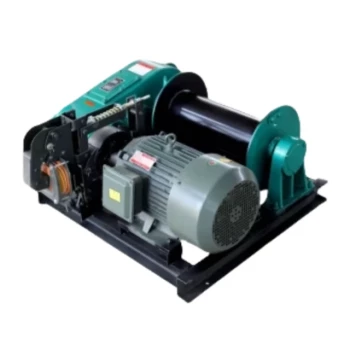
While there are many ways to classify winches, the most fundamental and common distinction is based on their power source. The two primary types are manual winches (operated by hand) and powered winches, with the powered category being dominated by electric winches and, in heavy-duty applications, hydraulic winches.
The most useful way to understand winches is by their power source—manual, electric, or hydraulic—as this directly dictates their intended use, pulling capacity, and operational limitations.

The Primary Classification: Power Source
The method used to generate pulling force is the clearest way to categorize any winch. This determines everything from its size and cost to its speed and endurance.
Manual Winches
Manual winches are the simplest form, relying entirely on physical effort. They are typically operated with a hand crank or a lever.
They are valued for their simplicity, portability, and the fact they require no external power source. However, they are significantly slower and require far more effort than powered options.
Electric Winches
This is the most common type of winch found on consumer vehicles like trucks, Jeeps, and ATVs. They use a powerful 12-volt DC electric motor connected directly to the vehicle's battery.
Electric winches offer an excellent balance of immense pulling power, relative ease of installation, and operational speed. Their main limitation is a "duty cycle," meaning they can overheat if run continuously for too long and can put a significant strain on the vehicle's battery.
Hydraulic Winches
Hydraulic winches are the workhorses of the industrial world. Instead of an electric motor, they use a hydraulic pump, typically driven by the vehicle's power steering pump or a dedicated PTO (Power Take-Off) system.
These winches are designed for heavy, continuous use and can run all day without overheating. This makes them ideal for commercial applications like tow trucks and industrial equipment, but their complexity and cost make them uncommon for recreational use.
A Deeper Look: How the Line is Managed
Beyond the power source, another important distinction is the mechanical design of the drum itself.
Spool Winches (The Standard)
Nearly all common vehicle recovery winches are spool winches. The drum serves two purposes: it provides the pulling force and it stores the winch line (wire rope or synthetic rope).
As the line is retrieved, it wraps around and is stored directly on the drum.
Capstan Winches (The Grip Multiplier)
A capstan winch uses a rotating drum (the capstan) to create pulling force through friction, but it does not store the line on the drum.
The operator wraps the line around the capstan a few times, and the capstan's rotation multiplies the pulling force on the free end. These are common in marine, utility, and theatrical rigging applications where very long lines or precise control is needed.
Understanding the Trade-offs
Choosing a winch involves balancing competing factors. Understanding these trade-offs is key to selecting the right tool for the job.
Power vs. Portability
Manual winches offer the ultimate portability but have the lowest pulling capacity. Hydraulic winches offer the most power but are complex, permanent installations. Electric winches sit in the middle, offering high power in a relatively compact, vehicle-mounted package.
Duty Cycle and Overheating
This is the critical difference between electric and hydraulic systems. Electric winches generate significant heat and can only pull for short bursts before needing to cool down. Hydraulic winches can pull continuously as long as the vehicle's engine is running, as the hydraulic fluid helps dissipate heat.
Installation Complexity and Cost
Manual winches require no real installation. Electric winches require heavy-gauge wiring to the vehicle's battery and a robust mounting plate. Hydraulic winches are the most complex, requiring integration with the vehicle's hydraulic system and are typically the most expensive option.
Making the Right Choice for Your Application
Your specific goal will determine which type of winch is the most logical choice.
- If your primary focus is occasional recovery for an off-road vehicle: An electric winch provides the best combination of power, convenience, and affordability.
- If your primary focus is industrial or commercial use with heavy, continuous loads: A hydraulic winch is the only reliable choice for demanding, long-duration pulls.
- If your primary focus is portability, backup use, or situations without a power source: A manual winch provides a simple, dependable, albeit slow, solution.
Understanding these core categories allows you to select the right tool based on power, application, and operational demands.
Summary Table:
| Feature | Manual Winch | Electric Winch | Hydraulic Winch |
|---|---|---|---|
| Power Source | Human Effort | Vehicle Battery | Hydraulic Pump |
| Best For | Portability, Backup | Off-Road Recovery | Heavy-Duty Industrial Use |
| Duty Cycle | Unlimited | Limited (Risk of Overheating) | Continuous |
| Installation | Simple | Moderate | Complex |
Need a reliable winch for your construction or contracting project?
GARLWAY specializes in high-performance construction machinery, offering durable electric winches, concrete mixers, and concrete batching plants designed for demanding environments. Our solutions provide the power and reliability you need to keep your projects on schedule.
Contact GARLWAY today for a customized solution that meets your specific requirements!
Visual Guide

Related Products
- Warn Winch Windlass Boat Trailer Winch
- Small Electric Winch 120V and 240V for Compact Applications
- Quick Windlass Portable Winch for Truck and Boat Best Boat Winch
- Portable Small Trailer Winch
- Electric and Hydraulic Winch for Heavy Duty Applications
People Also Ask
- What are the main components of a boat trailer winch? A Guide to Safe & Efficient Boat Loading
- What factors should be considered when choosing a boat trailer winch? Ensure Safe and Effortless Boat Loading
- What is the purpose of boat trailer winches? Safely and Efficiently Load Your Boat
- What are the two main types of boat trailer winches? Manual vs. Electric Explained
- How often should a boat trailer winch be replaced? Your Guide to Safety and Longevity