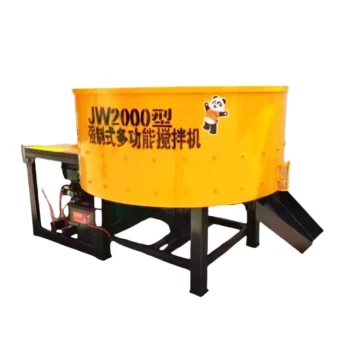
To put it simply, concrete is an ideal material for constructing buildings because it is incredibly strong under compression and can be easily molded into any required shape on-site. Its suitability, however, is entirely dependent on a rigorously controlled mixing process, which transforms simple raw materials into a durable, high-performance structural element.
The true value of concrete isn't just its inherent strength, but its transformation from a fluid mixture into a rigid, custom-formed foundation for a structure. This transformation must be precise to ensure the building's safety and longevity.
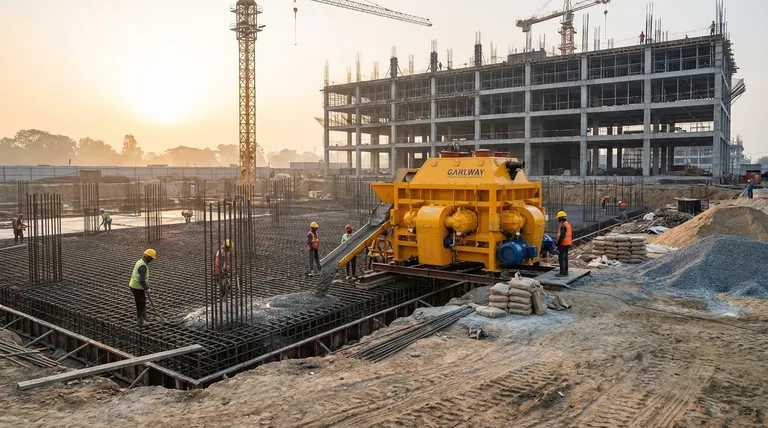
The Core Strengths of Concrete
Concrete's dominance in construction is built on a few fundamental properties that make it exceptionally well-suited for creating the foundations and skeletons of buildings.
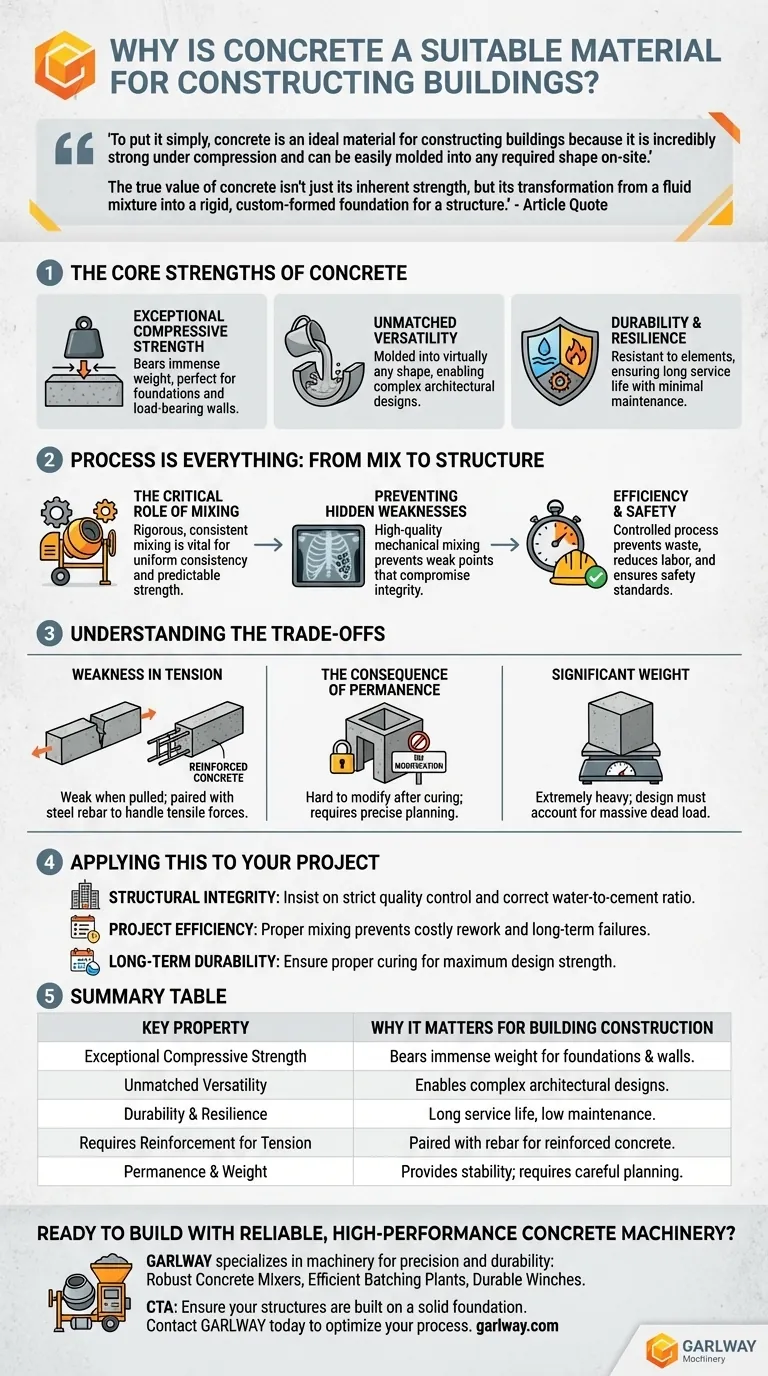
Exceptional Compressive Strength
Concrete’s primary advantage is its ability to resist compressive forces. It can bear immense weight pressing down on it without breaking, making it perfect for columns, walls, and foundations that support the entire load of a building.
Unmatched Versatility
Because concrete starts as a semi-liquid slurry, it can be poured into forms of virtually any shape or size. This allows architects and engineers to design complex foundations, curved walls, and massive support beams tailored to a specific project's needs.
Durability and Resilience
Once cured, concrete is highly resistant to fire, water, and rot. This durability ensures a long service life for the structure with minimal maintenance compared to materials like wood or steel, which require special coatings and treatments.
Process is Everything: From Mix to Structure
The potential of concrete is only realized through meticulous process control. The quality of the final structure is decided the moment the raw materials are combined.
The Critical Role of Mixing
A rigorous and consistent mixing process is vital. As the references state, proper mixing ensures a uniform consistency, which is crucial for predictable strength and durability throughout the entire structure.
Preventing Hidden Weaknesses
Improperly mixed concrete can have pockets of aggregate or cement paste, creating weak points that can compromise the integrity of the entire building. A high-quality mechanical mixer is essential to prevent this.
Efficiency and Safety
A controlled mixing process also prevents material waste and reduces labor time. Most importantly, it ensures the final product meets safety standards, creating a reliable foundation that will perform as designed for decades.
Understanding the Trade-offs
While concrete is an exceptional material, it is not without its limitations. Acknowledging these trade-offs is key to using it effectively.
Weakness in Tension
Concrete is very weak when pulled apart—a force known as tension. This is why it is almost always paired with steel reinforcement bars (rebar), creating reinforced concrete. The steel handles the tensile forces while the concrete handles the compression.
The Consequence of Permanence
As noted, concrete foundations cannot be easily modified after they have cured. This permanence is an advantage for stability but a significant disadvantage if design changes are needed late in the construction process. Mistakes are literally set in stone.
Significant Weight
Concrete is extremely heavy. The design of the structure and the foundation must account for the massive dead load of the concrete itself, which can impact soil requirements and overall engineering complexity.
Applying This to Your Project
Understanding these principles allows you to focus on what truly matters for a successful concrete structure.
- If your primary focus is structural integrity: Insist on strict quality control over the mixing process and adherence to the specified water-to-cement ratio.
- If your primary focus is project efficiency: Recognize that investing time in proper mixing prevents costly rework, material waste, and long-term structural failures.
- If your primary focus is long-term durability: Ensure that beyond the mix, the concrete is properly cured after being poured, as this step is critical for it to reach its maximum design strength.
Ultimately, mastering the process is how you unlock the full potential of this foundational building material.
Summary Table:
| Key Property | Why It Matters for Building Construction |
|---|---|
| Exceptional Compressive Strength | Bears immense weight, ideal for foundations, columns, and load-bearing walls. |
| Unmatched Versatility | Can be poured into any shape, enabling complex architectural designs. |
| Durability & Resilience | Resists fire, water, and rot, ensuring long service life with minimal maintenance. |
| Requires Reinforcement for Tension | Weak under tension, so steel rebar is used to create reinforced concrete. |
| Permanence & Weight | Provides stability but is hard to modify; structures must account for its heavy dead load. |
Ready to Build with Reliable, High-Performance Concrete Machinery?
For construction companies and contractors, the quality of your concrete mix is the foundation of your project's success. GARLWAY specializes in construction machinery designed to deliver precision and durability.
We provide:
- Robust Concrete Mixers for consistent, homogenous batches.
- Efficient Concrete Batching Plants for large-scale project efficiency.
- Durable Winches to support your heavy lifting needs on site.
Ensure your structures are built on a solid foundation. Contact GARLWAY today to discuss how our machinery can optimize your concrete mixing process and enhance your project's safety and longevity.
Visual Guide
Related Products
- Portable Concrete Mixer Machine Equipment for Mixing Concrete
- Portable Cement Mixer with Lift Concrete Machine
- Portable Ready Mix Concrete Mixer Equipment
- HZS180 Ready Mix Concrete Plant for Foundations with Sand and Cement
- Construction Products Concrete Plant Machine Mixing Concrete Mixer
People Also Ask
- Why is it necessary to use a portable concrete mixer? Gain Total Control & Efficiency
- How much concrete can you pour with a portable mixer? Find the Perfect Fit for Your Project
- What types of projects are portable concrete mixers suitable for? Ideal for DIY & Small-Scale Construction
- How much does a portable concrete mixer hold? A Guide to Choosing the Right Capacity
- What types of portable concrete mixers exist? Find the Perfect Mixer for Your Project