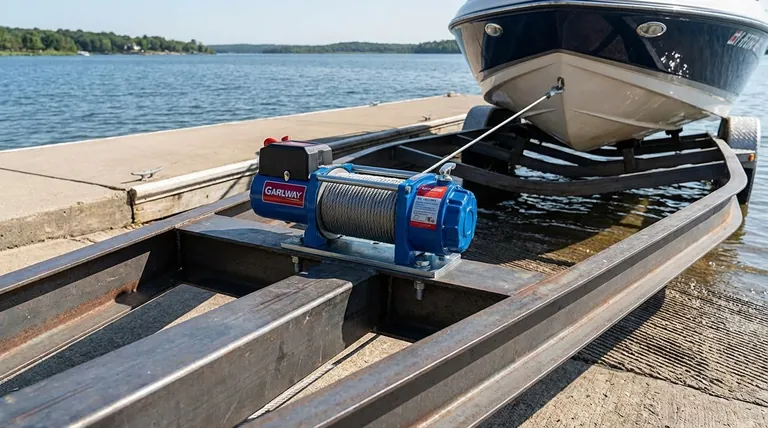
To properly mount a winch on a trailer, it must be perfectly centered and positioned so the cable or strap pulls in a straight, unobstructed line to the vehicle's attachment point. The winch should be bolted directly to the trailer's frame or a dedicated mounting plate, ensuring the height is correctly aligned with the load you intend to pull.
The core principle of any successful winch installation is not just securing the winch, but creating a system where the pulling force is exerted in a perfectly straight line. Any deviation from this line introduces stress, uneven wear, and a significant risk of failure.
The Principles of a Safe Winch Mount
Properly mounting a winch is fundamentally about managing immense forces safely and efficiently. Getting it wrong can damage your winch, your trailer, and the cargo you're loading.
Achieving a Straight Line Pull
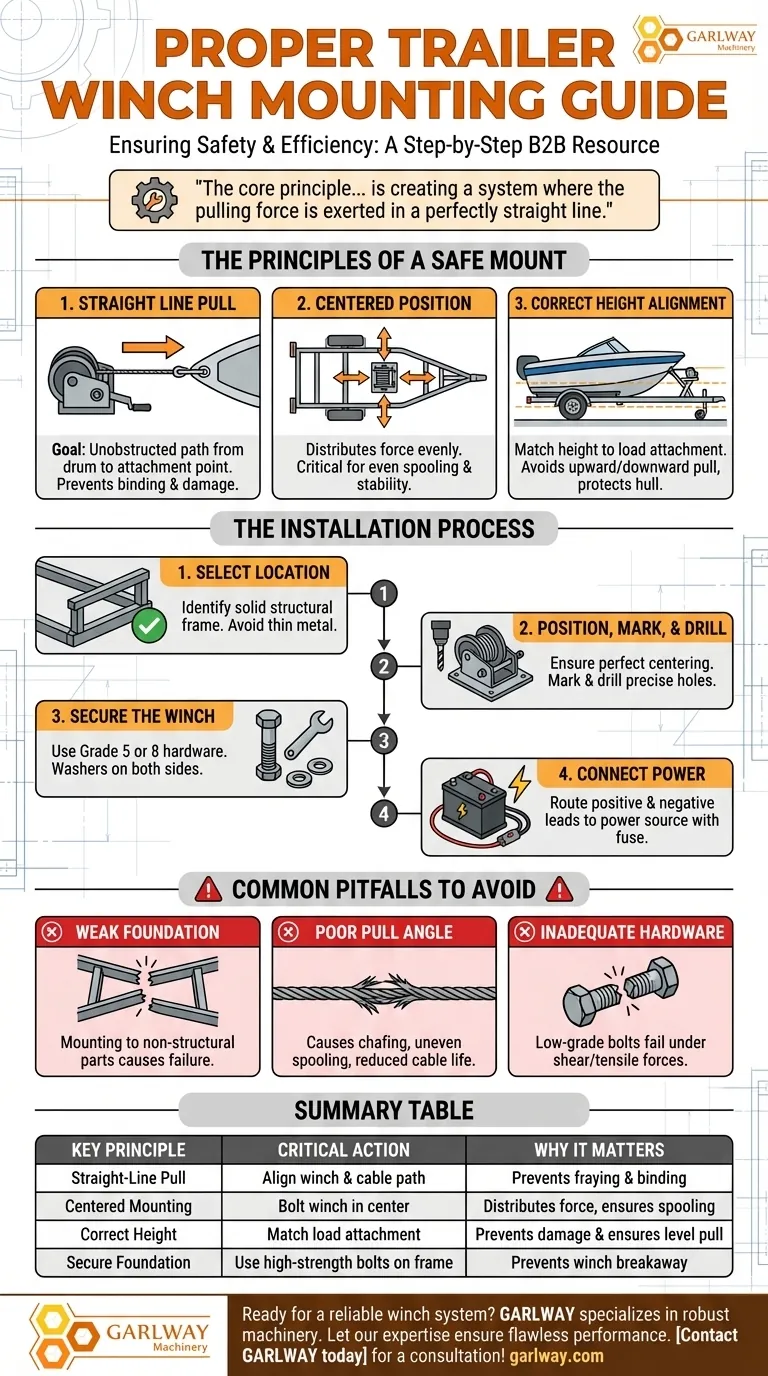
The single most important goal is to ensure the winch cable or strap maintains a straight line from the winch drum to the attachment point (like a boat's bow eye or a car's tow hook).
This alignment prevents the cable from stacking up on one side of the drum, which can cause binding, fraying, and damage to the winch itself.
Centering for Stability and Even Spooling
The winch must be mounted in the center of the trailer's frame. A centered winch distributes the pulling force evenly across the trailer structure.
This central position is also critical for helping the cable or strap wind evenly onto the drum, extending its operational life and ensuring smooth performance.
Matching Height to the Attachment Point
The height of the winch is crucial, especially for boat trailers. The winch should be positioned so the strap pulls directly in line with the boat's bow eye.
If the winch is too high, it will pull the bow upward during retrieval. If it's too low, it will pull the bow downward, potentially damaging the hull against the trailer rollers or bunks.
The Installation Process
While specific steps vary by winch and trailer model, the fundamental process involves creating a secure and direct connection to the trailer's structural frame.
Step 1: Select the Mounting Location
Identify a solid, structural part of the trailer frame, typically at the very front. Never mount a winch to thin sheet metal or a decorative part of the trailer.
If a direct frame mount isn't possible, use a heavy-duty steel winch mounting plate that is securely bolted or welded to the frame.
Step 2: Position, Mark, and Drill
Place the winch or mounting plate in the chosen location, ensuring it is perfectly centered and aligned. Carefully mark the locations for the mounting holes.
Drill holes that are slightly larger than your mounting bolts. This provides a small amount of tolerance for easier bolt insertion without compromising the strength of the connection.
Step 3: Secure the Winch
Fasten the winch using high-strength Grade 5 or Grade 8 bolts, along with corresponding nuts and washers. Use washers on both the bolt head and nut side to distribute the clamping force and prevent the hardware from pulling through the frame.
Step 4: Connect to a Power Source
For electric winches, the final step is connecting the power cables. This typically involves running a positive and negative lead directly to a battery, often the tow vehicle's battery, with appropriate circuit protection like a fuse or circuit breaker as specified by the manufacturer.
Common Pitfalls to Avoid
A reliable installation is as much about avoiding common mistakes as it is about following the correct steps. An insecure mount is a significant safety hazard.
Mounting to a Weak Foundation
The most dangerous mistake is mounting a winch to a non-structural part of the trailer. The forces exerted by a winch can easily tear through thin steel, causing the winch to break free under load. Always anchor to the main frame.
Ignoring the Pull Angle
Assuming a "close enough" alignment is not acceptable. A poor angle will cause the cable to chafe against the trailer or winch housing and will guarantee uneven spooling, drastically shortening the life of your cable or strap.
Using Inadequate Hardware
Do not use standard, low-grade bolts from a hardware store. The shear and tensile forces involved require high-strength, properly-rated bolts, nuts, and washers to prevent failure under load.
How to Apply This to Your Project
Your specific goal will determine your primary focus during installation.
- If your primary focus is loading a boat: Your absolute priority is aligning the winch height perfectly with the boat's bow eye to ensure a smooth, level pull onto the trailer.
- If your primary focus is loading a vehicle: Your priority is ensuring the winch is perfectly centered and provides an unobstructed path to the vehicle's towing eye, which is critical for safety in enclosed or open car haulers.
A correctly mounted winch transforms a difficult task into a safe, controlled, and efficient process.
Summary Table:
| Key Principle | Critical Action | Why It Matters |
|---|---|---|
| Straight-Line Pull | Align winch so cable pulls straight to the attachment point. | Prevents cable fraying, winch binding, and potential failure. |
| Centered Mounting | Bolt the winch perfectly centered on the trailer's frame. | Distributes force evenly and ensures cable spools correctly. |
| Correct Height | Match winch height to the load's attachment point (e.g., boat bow eye). | Prevents damage to the load (like a hull) and ensures a level pull. |
| Secure Foundation | Use high-strength bolts on the main frame or a dedicated plate. | Prevents the winch from breaking free under immense load. |
Ready to equip your trailer with a reliable winch system?
Proper installation is key to safety and performance. GARLWAY specializes in robust construction machinery, offering a range of high-quality winches, concrete mixers, and batching plants designed for the demanding needs of construction companies and contractors globally.
Let our expertise ensure your equipment is mounted correctly and performs flawlessly.
Contact GARLWAY today for a consultation and discover the right winch solution for your project!
Visual Guide
Related Products
- 12000 lb Electric Boat Trailer Winch with Windlass Anchor Warn
- Portable Small Trailer Winch
- Best 18000 Pound Drum Anchor Trailer Winch
- Warn Winch Windlass Boat Trailer Winch
- Quick Windlass Portable Winch for Truck and Boat Best Boat Winch
People Also Ask
- How does an electric boat trailer winch differ from a manual one? Effort vs. Control Explained
- What size winch do I need for my boat? Get the Right Capacity for Safe Hauling
- How should a boat trailer winch be properly used? A Step-by-Step Guide for Safe Loading
- What maintenance steps are specific to boat trailer winches? Ensure Safety & Reliability at the Ramp
- How strong of a winch do I need for my boat? Get the Right Pulling Power for Trailering & Anchoring