
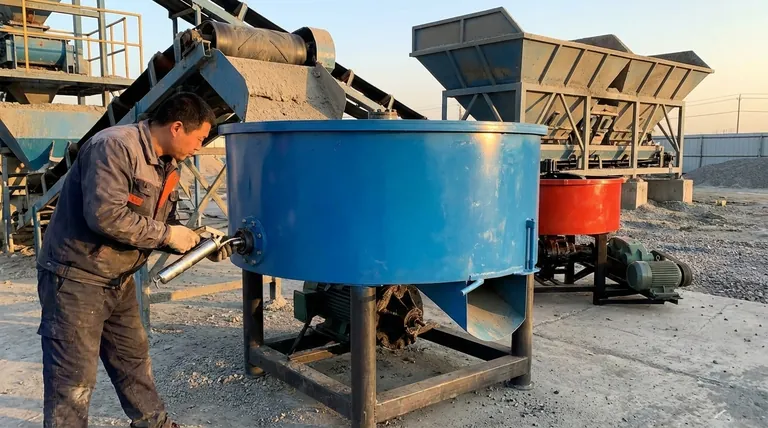
At a concrete mixing station, the most critical components requiring regular lubrication are those involved in material transport, such as the feed belt conveyor, transition storage hopper components, and the weighing belt conveyor. Proper lubrication is a foundational aspect of preventative maintenance that directly impacts the reliability and lifespan of the entire plant.
The core principle is that lubrication in a harsh concrete production environment is not merely about reducing friction. It is a multi-functional task essential for cooling moving parts, cleaning away abrasive contaminants, sealing components from dust and moisture, and preventing corrosion.
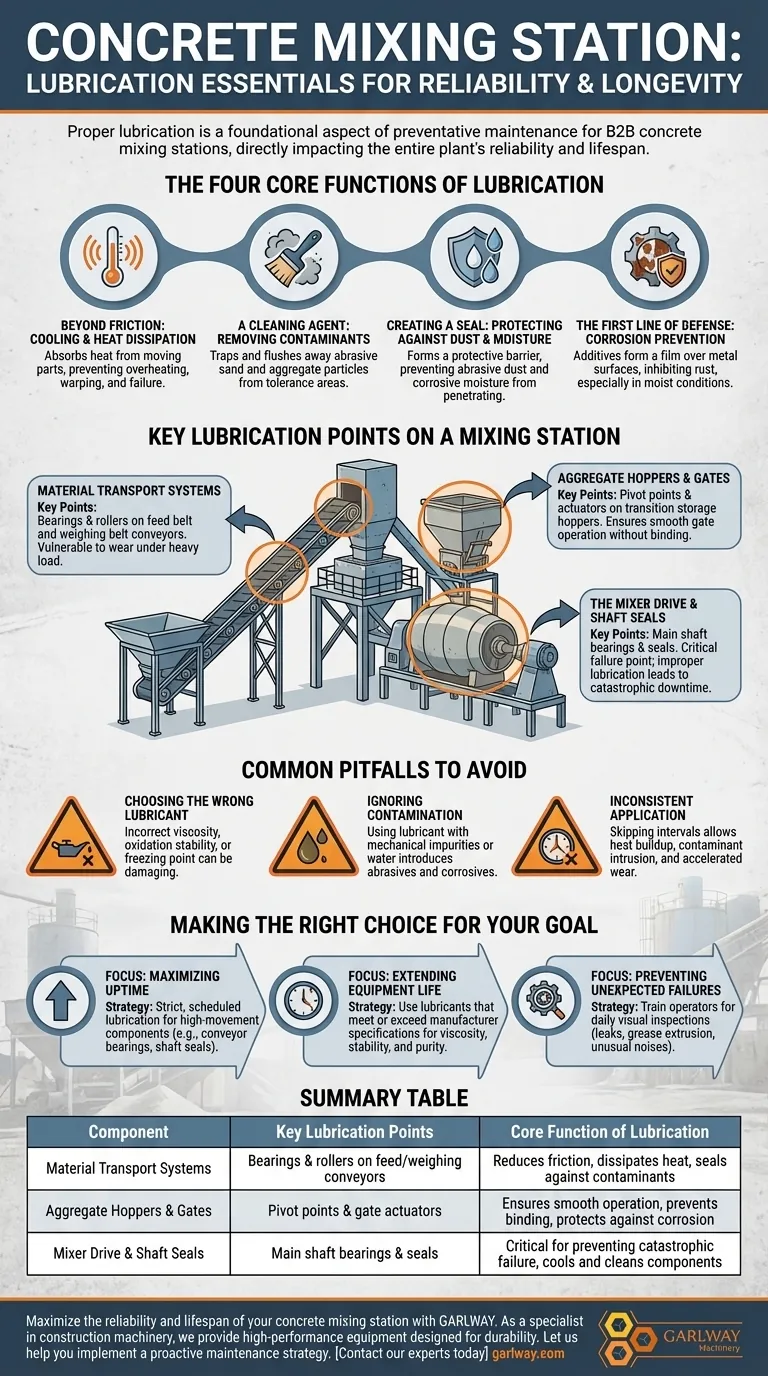
The Four Core Functions of Lubrication
Effective lubrication is a critical system that performs several vital roles simultaneously. Understanding these functions clarifies why a simple "squirt of oil" is insufficient for proper maintenance.
Beyond Friction: Cooling and Heat Dissipation
All moving mechanical parts, from conveyor rollers to mixer bearings, generate significant heat from friction. A constant supply of the correct lubricant absorbs this heat and carries it away, preventing components from overheating, warping, or failing prematurely.
A Cleaning Agent: Removing Contaminants
In the dusty, gritty environment of a concrete plant, small particles of sand and aggregate can act like sandpaper on metal surfaces. Lubricants are designed to trap these abrasive particles and flush them out of critical tolerance areas, preventing accelerated wear.
Creating a Seal: Protecting Against Dust and Moisture
A well-lubricated joint or bearing maintains a protective barrier. This "seal" of grease or oil is often the first line of defense, preventing abrasive concrete dust and corrosive moisture from penetrating sensitive mechanical components.
The First Line of Defense: Corrosion Prevention
Many components in a mixing station are made of steel and are highly susceptible to rust and corrosion, especially when exposed to moisture. Lubricants contain additives that form a protective film over metal surfaces, directly inhibiting the corrosion process.
Key Lubrication Points on a Mixing Station
While a manufacturer's maintenance schedule is the ultimate guide, certain areas universally demand consistent attention.
Material Transport Systems
The conveyors that move aggregates are the arteries of the plant. Key points include the bearings and rollers on the feed belt conveyor and the weighing belt conveyor. These parts are in constant motion under heavy load and are highly vulnerable to wear.
Aggregate Hoppers and Gates
Components on storage systems like the transition storage hopper also require lubrication. This often applies to the pivot points and actuators for the gates that control the flow of sand and stone, ensuring they open and close smoothly without binding.
The Mixer Drive and Shaft Seals
The heart of the plant is the mixer itself. The main shaft bearings and seals are arguably the most critical lubrication points. A failure here due to improper lubrication is catastrophic, leading to major downtime and expensive repairs.
Common Pitfalls to Avoid
Simply applying a lubricant is not enough; using the wrong type or method can be as damaging as using none at all.
Choosing the Wrong Lubricant
A lubricant for a concrete mixer must possess specific properties. It needs the correct viscosity (thickness) to handle heavy loads, good oxidation stability to resist breaking down under heat, and a low freezing point for cold-weather operation.
Ignoring Contamination
Using a lubricant that is contaminated with mechanical impurities or water introduces abrasive or corrosive elements directly into your machinery. Always use clean application tools and ensure lubricant containers are sealed and stored properly.
Inconsistent Application
Lubrication is not a "set it and forget it" task. It must be performed on a regular, documented schedule. Skipping intervals allows for heat buildup, contaminant intrusion, and accelerated wear that can quickly lead to component failure.
Making the Right Choice for Your Goal
Your lubrication strategy should align directly with your operational priorities.
- If your primary focus is maximizing uptime: Implement a strict, scheduled lubrication plan for all high-movement components, especially conveyor bearings and mixer shaft seals.
- If your primary focus is extending equipment life: Never compromise on quality; always use lubricants that meet or exceed the manufacturer's specifications for viscosity, temperature stability, and purity.
- If your primary focus is preventing unexpected failures: Train all operators to perform daily visual inspections for leaks, grease extrusion from seals, or unusual noises that indicate a lubrication issue.
Ultimately, a disciplined approach to lubrication is one of the most cost-effective investments you can make in the long-term health of your equipment.
Summary Table:
| Component | Key Lubrication Points | Core Function of Lubrication |
|---|---|---|
| Material Transport Systems | Bearings & rollers on feed/weighing belt conveyors | Reduces friction, dissipates heat, seals against contaminants |
| Aggregate Hoppers & Gates | Pivot points & gate actuators | Ensures smooth operation, prevents binding, protects against corrosion |
| Mixer Drive & Shaft Seals | Main shaft bearings & seals | Critical for preventing catastrophic failure, cools and cleans components |
Maximize the reliability and lifespan of your concrete mixing station with GARLWAY.
As a specialist in construction machinery, we provide high-performance winches, concrete mixers, and batching plants designed for durability in harsh environments. Our expertise ensures your equipment operates at peak efficiency with minimal downtime.
Let us help you implement a proactive maintenance strategy.
Contact our experts today to discuss your specific lubrication needs and discover how our solutions can benefit your operation.
Visual Guide
Related Products
- HZS90 Large Multiquip Concrete Mixers for Construction
- HZS75 Concrete Batching Plant Cement Mixer Price Concrete Mixer Bunnings Mixing Plant
- Portable Concrete Mixer Machine Equipment for Mixing Concrete
- Commercial Electric Concrete Mixer Machine HZS 50 Small Batch Plant for Sale
- HZS35 Small Cement Concrete Mixing Batch Plant
People Also Ask
- What are the types of concrete mixers used in batching plants? Choose the Right Mixer for Your Project
- What is the core component of a concrete batching plant? The Mixer Unit Defines Your Concrete Quality
- What are the different power sources for concrete mixers? Choose the Right Power for Your Project
- What are the main types of concrete mixers? A Guide to Batch, Continuous & More
- What are the main types of concrete mixers mentioned? Find the Perfect Mixer for Your Project





