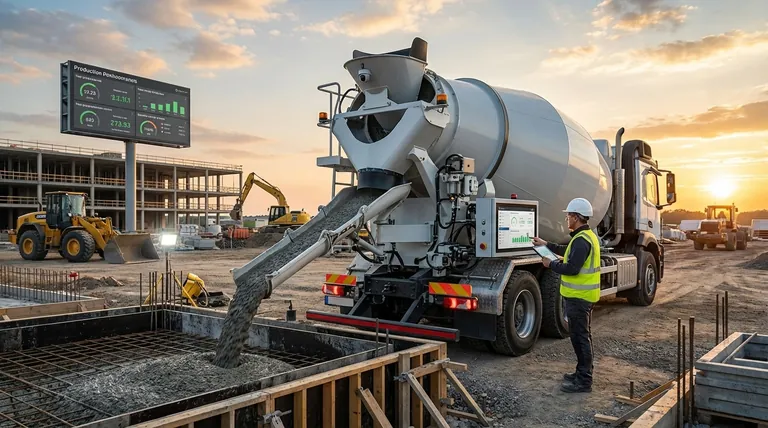
Innovations in volumetric concrete mixers have transformed these machines from simple mobile units into sophisticated, data-driven mobile batch plants. Key advancements focus on expanding mix design capabilities, integrating advanced sensor technology for precision, and improving overall production efficiency and material handling.
The most significant evolution is the shift from a machine that simply mixes on-site to a fully integrated system that offers precise, on-demand production of highly specialized concrete, drastically reducing waste and increasing logistical flexibility.
The Core Innovation: On-Demand Production
The foundational advantage of a volumetric mixer is its function as a mobile batch plant. It carries unmixed materials to the job site and produces fresh concrete exactly when and where it is needed.
Eliminating Waste and Delays
Traditional ready-mix trucks require you to order a specific amount in advance. This often leads to over-ordering to create a buffer, resulting in wasted material and cost.
On-demand production completely eliminates this problem. You mix the exact amount required for the job, down to the cubic foot, ensuring no waste.
Freshness and Quality Control
Concrete begins to hydrate the moment water is added. With a volumetric mixer, the mix is always fresh, produced just seconds before it is poured.
This allows for real-time adjustments to the mix design on-site, a level of control impossible with a pre-mixed delivery from a distant plant.
Key Technological Advancements
Modern volumetric mixers have integrated new technologies that expand their capabilities far beyond their original design, addressing historical concerns about precision and versatility.
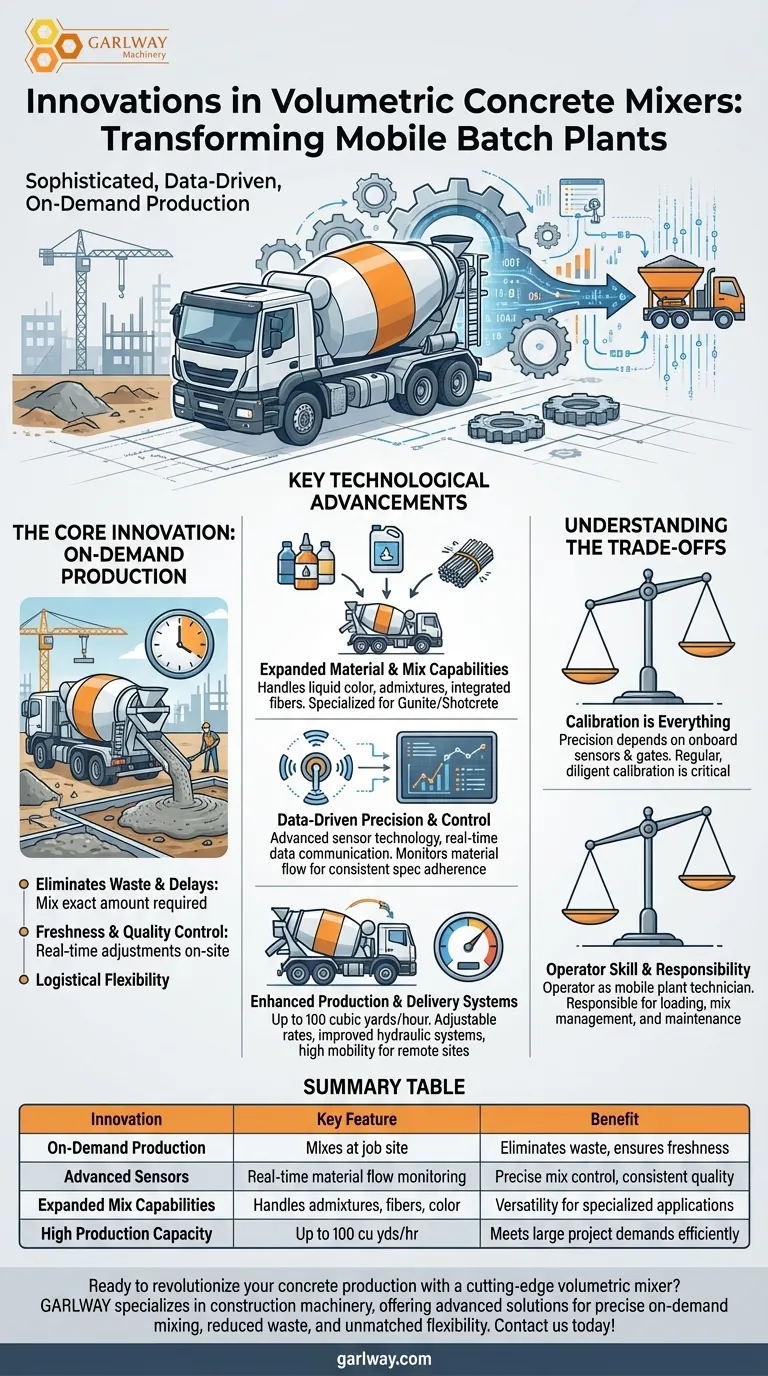
Expanded Material & Mix Capabilities
The latest mixers can handle a wide array of inputs beyond the basic components. They feature systems for adding liquid color, multiple admixtures for specific performance characteristics, and integrated fiber systems for reinforcement.
This versatility also extends to specialized applications, with many modern units equipped to produce materials for gunite or shotcrete on-demand.
Data-Driven Precision and Control
Early concerns about the accuracy of volumetric proportioning (measuring by volume, not weight) have been addressed by technology.
Advanced sensor technology and real-time data communication monitor the flow of all materials. These systems ensure the mix consistently meets the required specifications, providing a level of precision that rivals traditional methods.
Enhanced Production & Delivery Systems
Innovation has also focused on raw power and efficiency. Top-tier mixers can now produce up to 100 cubic yards of concrete per hour, with adjustable rates to match project needs.
Improved hydraulic systems and material handling designs ensure reliability, while the inherent mobility allows these trucks to reach remote or difficult-to-access job sites that are inaccessible to traditional mixers.
Understanding the Trade-offs
While modern technology has greatly improved accuracy, the primary trade-off of a volumetric system remains rooted in its core methodology.
Calibration is Everything
Unlike a central batch plant that relies on certified scales to weigh materials, a volumetric mixer's precision depends entirely on the calibration and accuracy of its onboard sensors and gates.
Regular, diligent calibration is not just recommended; it is critical to ensuring the concrete consistently meets engineering specifications. Any drift in the system can lead to an incorrect mix.
Operator Skill and Responsibility
The operator of a volumetric mixer is not just a driver; they are a mobile plant technician. They are responsible for loading materials correctly, managing the mix on-site, and ensuring the equipment is properly maintained and calibrated.
This places a greater burden of quality control on the individual operator compared to a centralized batch plant operation.
Making the Right Choice for Your Project
Choosing between volumetric and traditional ready-mix concrete depends entirely on the specific demands of your project.
- If your primary focus is remote access or logistical challenges: The self-contained, mobile nature of a volumetric mixer is an unparalleled advantage.
- If your primary focus is minimizing waste and controlling costs: The ability to produce the exact amount of concrete needed makes a volumetric mixer highly efficient.
- If your primary focus is projects with multiple, varied pours: The flexibility to change mix designs on-site without returning to a plant is a major time-saver.
These innovations have secured the volumetric mixer's role as a critical tool for efficient, flexible, and modern construction.
Summary Table:
| Innovation | Key Feature | Benefit |
|---|---|---|
| On-Demand Production | Mixes concrete at the job site | Eliminates waste, ensures freshness |
| Advanced Sensors | Real-time material flow monitoring | Precise mix control, consistent quality |
| Expanded Mix Capabilities | Handles admixtures, fibers, and color | Versatility for specialized applications |
| High Production Capacity | Up to 100 cubic yards per hour | Meets large project demands efficiently |
Ready to revolutionize your concrete production with a cutting-edge volumetric mixer? GARLWAY specializes in construction machinery, offering advanced volumetric mixers for construction companies and contractors globally. Our solutions deliver precise on-demand mixing, reduced material waste, and unmatched logistical flexibility for your projects. Contact us today to discuss how our mixers can enhance your efficiency and profitability!
Visual Guide
Related Products
- Belle Cement Mixer JS2000 Volumetric Concrete Mixer for Harbor Freight
- JS1000 Volumetric Concrete Mortar Mixer for Sale Skid Steer Cement Mixer
- Harbor Freight JS1500 On Site Concrete Mixing Volumetric Cement Mixer
- Portable Concrete Mixer Machine Equipment for Mixing Concrete
- HZS90 Large Multiquip Concrete Mixers for Construction
People Also Ask
- What is a volumetric concrete mixer? A Mobile Concrete Batch Plant for On-Demand Mixing
- What is the predicted future for volumetric concrete mixers? Growth Driven by On-Demand Efficiency
- How does a volumetric concrete mixer contribute to sustainability? Reduce Waste, Water, and Emissions On-Site
- How does volumetric concrete compare to ready-mix concrete? Choose the Right Method for Your Project
- What types of concrete can be produced with volumetric mixers? Achieve On-Demand Mixing for Any Project