
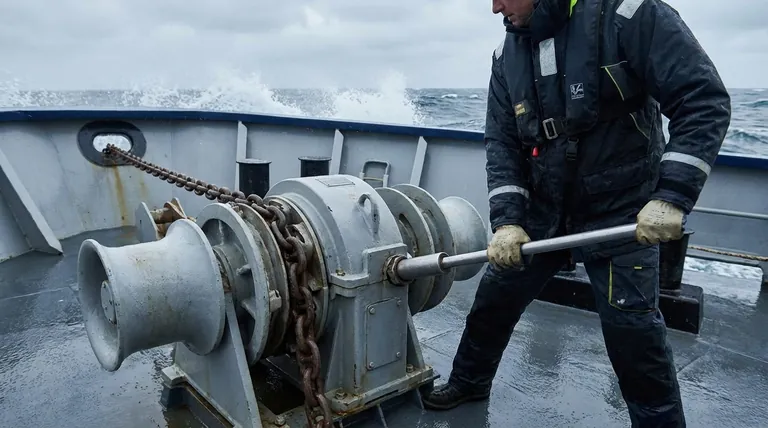
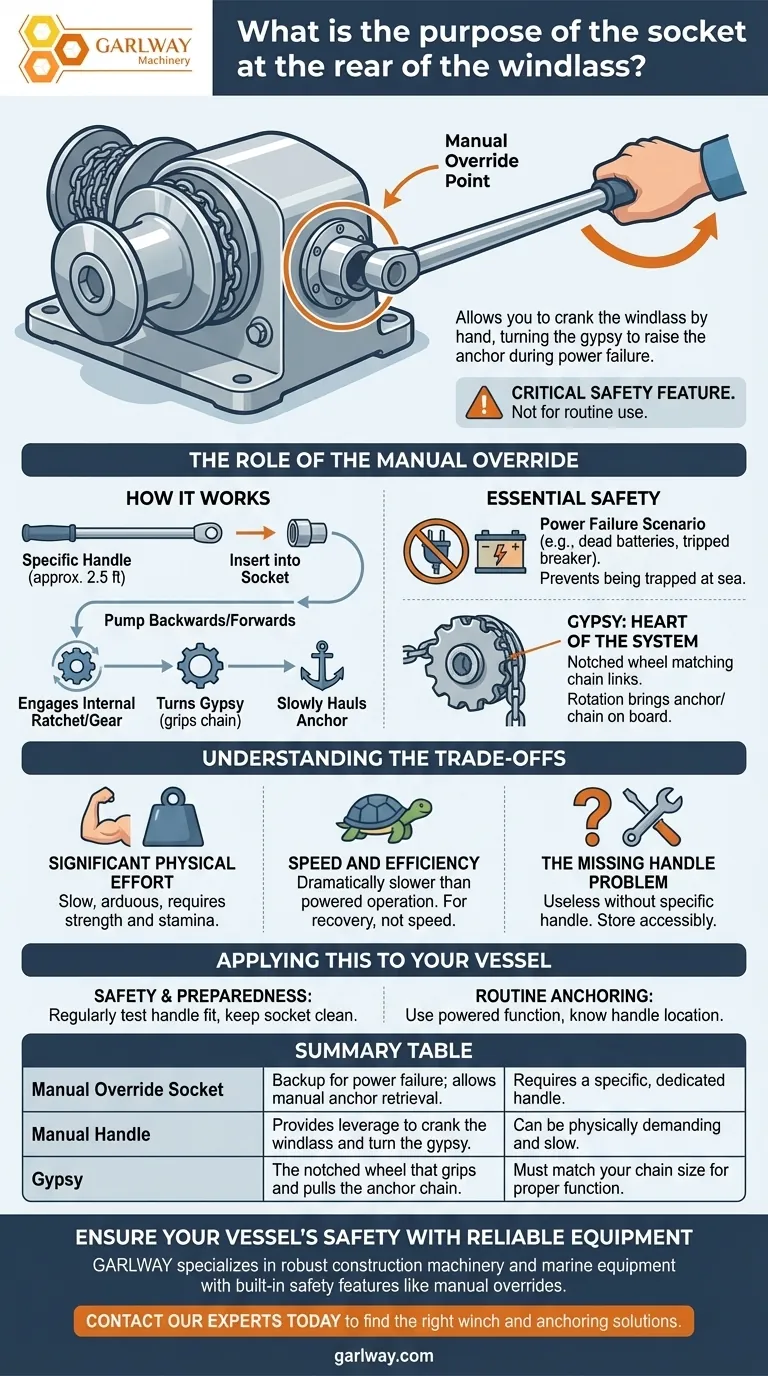
The socket at the rear of a windlass is a manual override point designed for a long handle. This handle allows you to crank the windlass by hand, turning the gypsy to raise the anchor if the primary power source fails.
The socket is not for routine use; it is a critical safety feature. It provides a reliable, non-powered method to retrieve your anchor during a power failure, ensuring you are never left unable to secure your vessel.
The Role of the Manual Override
An anchor windlass is a powerful machine, but its reliance on electrical or hydraulic power makes it vulnerable. The manual override socket is the fundamental backup system that guarantees functionality in any situation.
How Manual Operation Works
The process is purely mechanical. A specific handle, often around two and a half feet long for leverage, is inserted into the socket. Pumping this handle backwards and forwards engages an internal ratchet or gear mechanism. This action directly turns the gypsy, the notched wheel that grips the anchor chain, and slowly hauls the anchor upwards.
Why It's an Essential Safety Feature
A power failure at sea is a common scenario. Dead batteries, a tripped breaker, or a burned-out windlass motor can leave you in a difficult, and potentially dangerous, position. Without a manual override, you would be unable to retrieve your anchor, effectively trapping the vessel until power is restored or the anchor is cut loose.
The Gypsy: The Heart of the System
Understanding the manual override requires knowing the gypsy's role. The gypsy is specifically designed with notches that match the links of your anchor chain, providing the grip needed to pull it. Whether turned by a motor or by the manual handle, the gypsy's rotation is what brings the anchor and chain back on board.
Understanding the Trade-offs
While the manual override is a critical feature, it is important to recognize its limitations. It is an emergency system, not a primary method of operation.
Significant Physical Effort
Raising an anchor manually, especially with hundreds of feet of chain and a heavy anchor, is physically demanding. The long handle provides necessary leverage, but the work is slow, arduous, and requires considerable strength and stamina.
Speed and Efficiency
Manual cranking is dramatically slower than powered operation. What might take minutes with an electric motor could take a significant amount of time and effort by hand. It is designed for recovery, not for speed.
The Missing Handle Problem
The entire manual system is rendered useless without its specific handle. Many boat owners misplace this crucial piece of equipment or store it in an inaccessible location. The socket alone provides no benefit if the tool designed for it is not readily available in an emergency.
Applying This to Your Vessel
Your approach to the windlass should always account for both powered and manual operation.
- If your primary focus is safety and preparedness: Regularly test the manual handle in the socket to ensure it fits correctly and the mechanism engages. Keep the socket clean and free of corrosion or debris.
- If your primary focus is routine anchoring: Always use the powered function for normal operation, but know exactly where your manual handle is stored and be familiar with how to use it before you ever need it.
Ultimately, knowing how to operate your windlass manually is a core skill for any prepared mariner.
Summary Table:
| Feature | Purpose | Key Consideration |
|---|---|---|
| Manual Override Socket | Backup for power failure; allows manual anchor retrieval. | Requires a specific, dedicated handle. |
| Manual Handle | Provides leverage to crank the windlass and turn the gypsy. | Can be physically demanding and slow. |
| Gypsy | The notched wheel that grips and pulls the anchor chain. | Must match your chain size for proper function. |
Ensure Your Vessel's Safety with Reliable Equipment
A dependable windlass is non-negotiable for safe and efficient anchoring. GARLWAY specializes in robust construction machinery, including winches and marine equipment designed for demanding environments. Our solutions offer the reliability and built-in safety features, like manual overrides, that construction companies, contractors, and mariners need to operate with confidence.
Don't leave safety to chance. Contact our experts today to find the right winch and anchoring solutions for your operational needs.
Visual Guide
Related Products
- Quick Windlass Portable Winch for Truck and Boat Best Boat Winch
- 12000 lb Electric Boat Trailer Winch with Windlass Anchor Warn
People Also Ask
- What features were incorporated into the upgraded portable winch system? Boost Your Recovery Power & Safety
- What are some uses mentioned for portable winches beyond vehicle recovery? Essential Versatility for Property & Work
- How could the twisting issue with a portable winch be mitigated? Achieve Safe, Centered Pulls with Proper Rigging
- What are the primary uses of a portable winch for a truck? Boost Your Truck's Capability and Self-Reliance
- What is the single rope traction force of the quick winch without a pulley block? 0.5 to 40 Tons Explained

