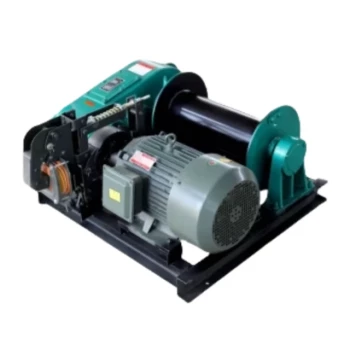
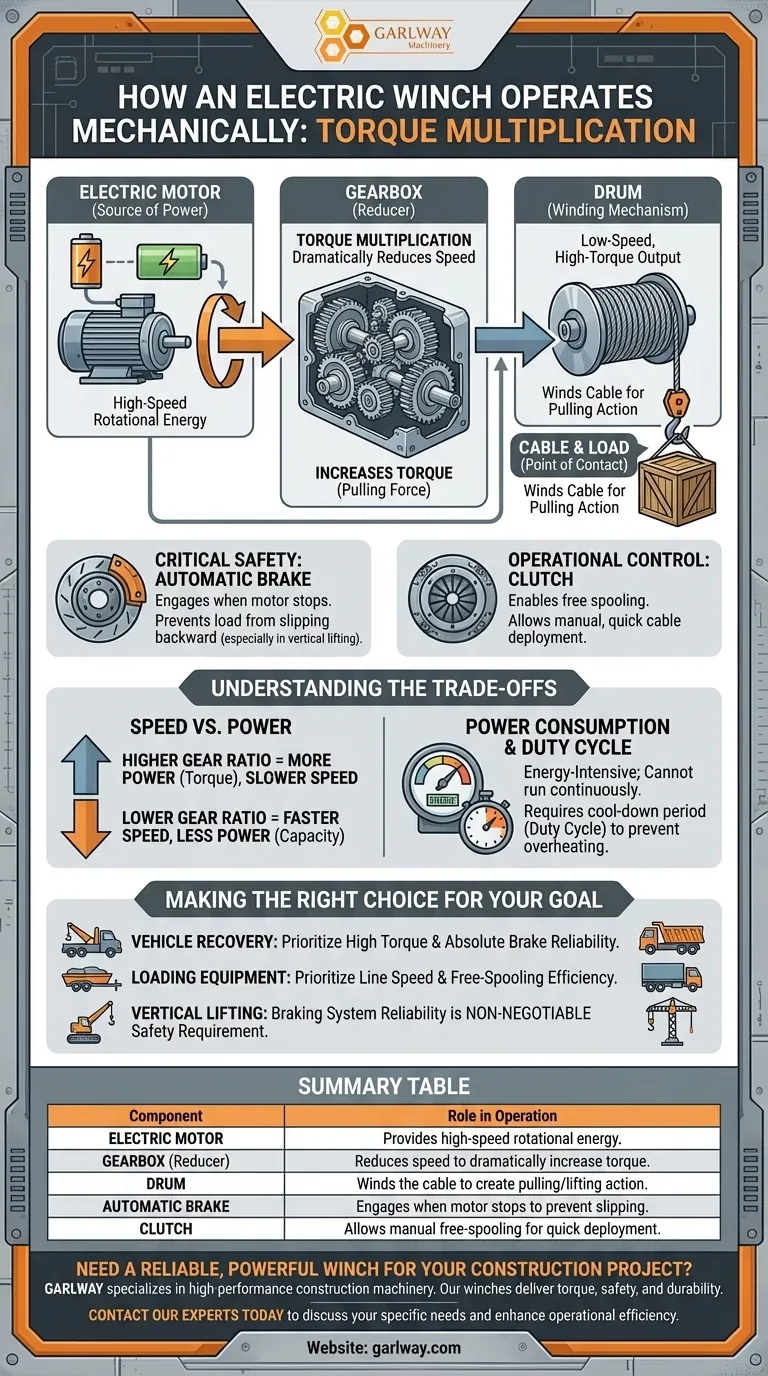
At its core, an electric winch operates by converting high-speed rotational energy from an electric motor into low-speed, high-torque pulling power. This conversion is achieved through a gearbox, which drives a drum to wind a wire rope or synthetic cable, effectively multiplying the motor's force to move heavy loads.
An electric winch is not simply a motor attached to a spool. It is a system of torque multiplication, where a specialized gearbox takes the rapid but weak rotation of a motor and transforms it into the slow, immensely powerful force required for pulling or lifting.
The Core Components and Their Roles
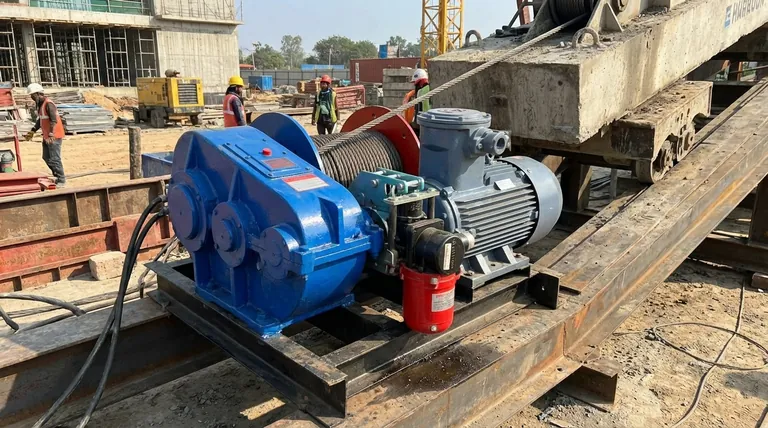
To understand the operation, we must look at how each key part contributes to the final output. The components are mounted together on a frame, working in a precise sequence.
The Motor: The Source of Power
The process begins with the electric motor. Powered by a vehicle's battery or a dedicated power source, its sole job is to generate high-speed rotational motion.
The Gearbox: The Heart of the Machine
This is the most critical component for generating force. The motor's high-speed rotation is fed into a gearbox, also known as a reducer.
Inside, a series of gears reduces the rotational speed dramatically. This reduction in speed results in a proportional increase in torque, or turning force. This is the principle that allows a small motor to pull thousands of pounds.
The Drum: The Winding Mechanism
The low-speed, high-torque output from the gearbox turns the drum. This cylindrical component is what the steel wire rope or synthetic cable is wound around.
As the drum rotates, it pulls the cable in, creating the winching action. The drum's speed directly determines how fast the load is moved.
The Cable: The Point of Contact
The wire rope or synthetic cable is the final link in the chain, attaching to the object being pulled or lifted. Its direction can be altered by using pulleys to navigate around obstacles or change the angle of the pull.
The Critical Safety and Control Mechanisms
Beyond raw power, a winch's mechanical design incorporates features for safety and usability.
The Automatic Brake: Preventing Catastrophe
A crucial safety feature is the automatic brake. When the motor is not active, this braking system automatically engages.
It prevents the drum from unwinding under load, ensuring the heavy object doesn't slip backward. The reliability of this brake is paramount, especially when lifting loads vertically.
The Clutch: Enabling Free Spooling
The clutch allows the operator to manually disengage the drum from the gearbox.
When disengaged, the drum can spin freely, a state known as "free spooling." This lets you pull the cable out by hand quickly, which is far more efficient than slowly unwinding it with the motor.
Understanding the Trade-offs
The mechanical design of a winch necessitates a balance between competing factors.
Speed vs. Power
The gear ratio inside the gearbox dictates the winch's primary characteristics. A higher gear ratio will result in more pulling power (torque) but a slower line speed.
Conversely, a winch with a lower gear ratio will pull faster but will have a lower maximum load capacity. There is always a direct trade-off between how much you can pull and how fast you can pull it.
Power Consumption and Duty Cycle
Generating immense torque is energy-intensive. Electric winches draw a significant amount of current from their power source.
Because of the heat generated by the motor and gearbox under load, they cannot be operated continuously. They have a specific duty cycle—a set amount of time they can run before needing a cool-down period to prevent mechanical damage.
Making the Right Choice for Your Goal
Understanding the mechanical principles helps you evaluate a winch based on its intended task.
- If your primary focus is vehicle recovery: The high torque from the gear reduction and the absolute reliability of the automatic brake are the most critical features.
- If your primary focus is loading equipment: The line speed and the convenience of the free-spooling clutch become more important for day-to-day efficiency.
- If your primary focus is lifting loads vertically: The braking system's design and reliability are non-negotiable safety requirements that outweigh all other factors.
By appreciating this interplay of motor, gears, and brakes, you can use this powerful tool not just effectively, but safely.
Summary Table:
| Component | Role in Operation |
|---|---|
| Electric Motor | Provides high-speed rotational energy from a power source. |
| Gearbox (Reducer) | Reduces speed to dramatically increase torque (pulling force). |
| Drum | Winds the cable to create the pulling/lifting action. |
| Automatic Brake | Engages when motor stops to prevent load from slipping. |
| Clutch | Allows manual free-spooling for quick cable deployment. |
Need a reliable, powerful winch for your construction or contracting project?
GARLWAY specializes in high-performance construction machinery, including robust electric winches designed for demanding applications. Our winches deliver the torque, safety features, and durability that professionals like you depend on.
Contact our experts today to discuss your specific needs and discover how a GARLWAY winch can enhance your operational efficiency and safety.
Visual Guide
Related Products
- Electric 120V Boat Winch by Badlands
- Electric and Hydraulic Winch for Heavy Duty Applications
- Small Electric Winch 120V and 240V for Compact Applications
- 12000 lb Electric Boat Trailer Winch with Windlass Anchor Warn
- Electric Hoist Winch Boat Anchor Windlass for Marine Applications
People Also Ask
- How do electric boat winches work? Unlock Effortless Launching & Retrieval
- How much current does an electric boat winch draw? Plan Your Electrical System for Peak Performance
- Can I run a winch straight from a battery? Essential Power Setup for Safe Operation
- What are the types of electric winches available? Choose the Right Winch for Your Job
- What are the uses of electric winches in mining and tunneling? Enhance Safety and Efficiency Underground