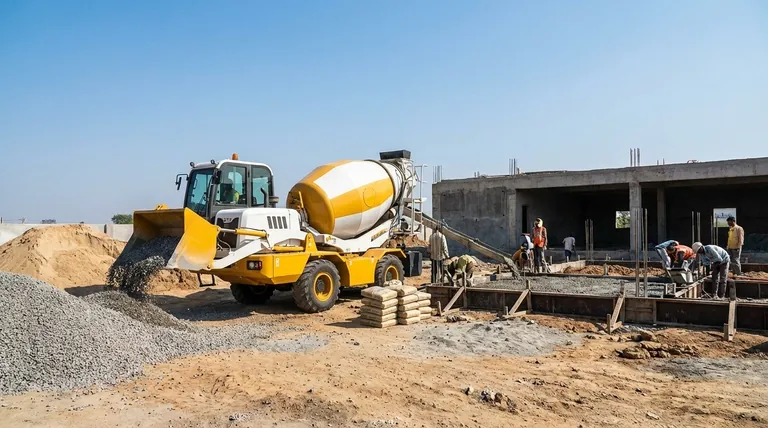
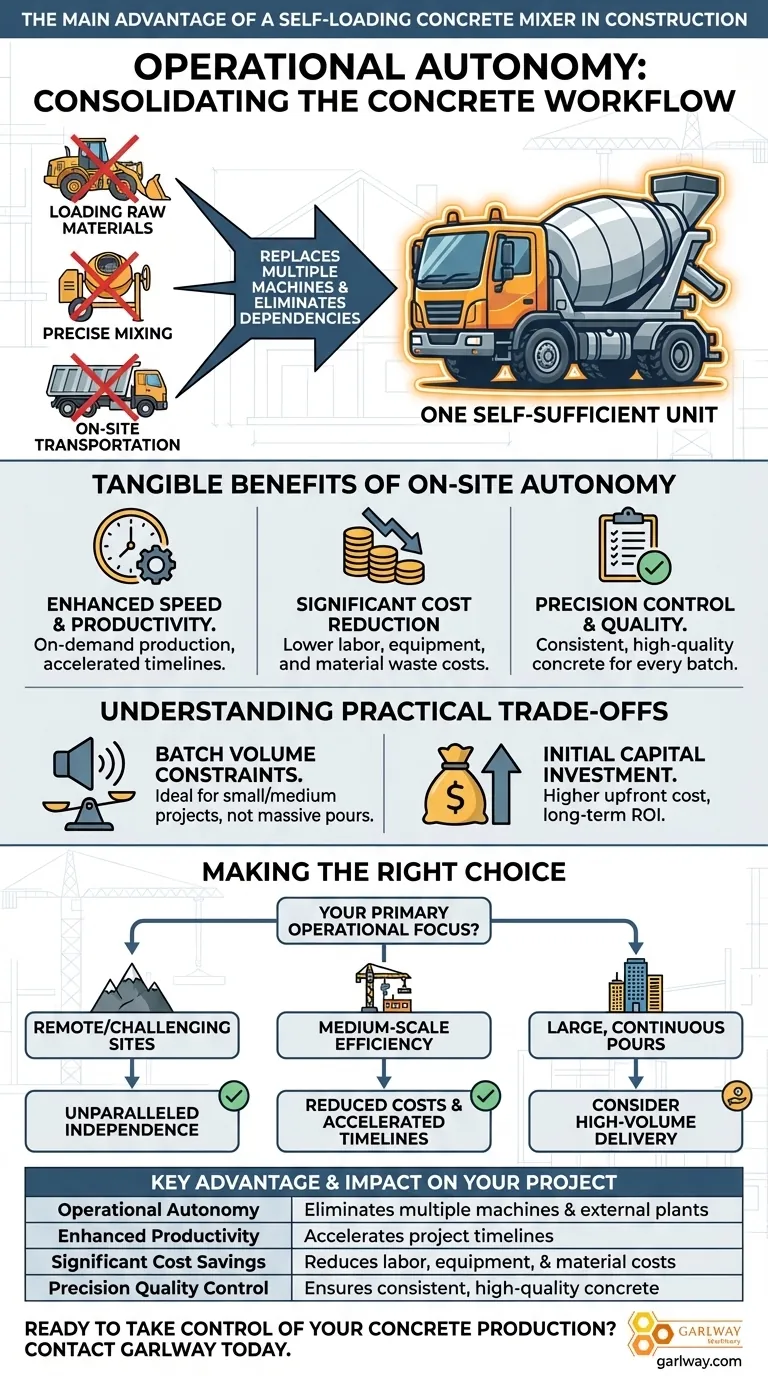
The main advantage of a self-loading concrete mixer is its profound operational autonomy. This single piece of equipment consolidates the entire concrete production process—loading raw materials, precise mixing, and on-site transportation—eliminating the need for separate machinery and reducing reliance on external batching plants and manual labor.
A self-loading mixer fundamentally changes your workflow from managing multiple pieces of equipment and supply chain dependencies to operating a single, self-sufficient unit. It transforms a logistical challenge into a streamlined, on-demand process you control entirely.
The Core Principle: Consolidating the Concrete Workflow
The true value of a self-loading mixer is its ability to integrate several distinct jobs into one efficient cycle, performed by a single machine and operator.
From Multiple Machines to One Unit
Traditionally, producing concrete on-site requires a wheel loader to handle aggregates, a mixer to combine materials, and often another vehicle to transport the final product. A self-loading mixer replaces all of these, creating a leaner operation.
Eliminating External Dependencies
By functioning as a mobile batching plant, this mixer removes the delays and coordination challenges associated with ordering and waiting for ready-mix concrete deliveries. You produce exactly what you need, precisely when you need it.
Reducing Labor Requirements
The integrated nature of the machine means fewer personnel are required to manage the concrete production process. One skilled operator can manage loading, mixing, and pouring, significantly lowering labor costs.
The Tangible Benefits of On-Site Autonomy
This newfound control over the concrete supply chain directly translates into measurable improvements in efficiency, cost, and quality.
Enhanced Speed and Productivity
With no waiting time for material loading or concrete delivery, project timelines are accelerated. The ability to produce fresh concrete on demand allows for a continuous and more efficient workflow, completing projects faster.
Significant Cost Reduction
The financial benefits are multi-faceted. You save on the capital and operational costs of multiple machines, reduce your labor budget, and minimize material waste by mixing only the required amount for each task.
Precision Control and Quality
On-site mixing gives you complete authority over the mix design and water-to-cement ratio. This ensures consistent, high-quality concrete for every batch, tailored perfectly to the specific requirements of the job.
Understanding the Practical Trade-offs
While highly effective, self-loading mixers are not a universal solution. Objectivity requires acknowledging their limitations.
Batch Volume Constraints
Self-loading mixers are ideal for small to medium-sized projects or remote sites. For massive, continuous pours requiring very large volumes of concrete, a dedicated high-capacity batching plant and a fleet of transit mixers may still be more efficient.
Initial Capital Investment
The upfront cost of a self-loading mixer is substantial. It represents a significant capital investment compared to simpler, portable concrete mixers. The return on investment is realized through long-term operational savings.
Site and Operator Requirements
Effective use requires a skilled operator who can manage the entire process. The machine also needs adequate space to maneuver and access to stockpiles of raw materials (cement, sand, and aggregate) on-site.
Making the Right Choice for Your Goal
To determine if this equipment fits your needs, evaluate your primary operational drivers.
- If your primary focus is remote or logistically challenging sites: A self-loader offers unparalleled independence where access to a batching plant is difficult or impossible.
- If your primary focus is maximizing efficiency on medium-scale projects: The consolidation of equipment and labor provides a powerful way to reduce costs and accelerate timelines.
- If your primary focus is large, continuous foundation pours: The batch size may be a limiting factor, and relying on high-volume delivery from a commercial plant might be more suitable.
Ultimately, investing in a self-loading concrete mixer is a strategic decision to take direct control of your on-site concrete production.
Summary Table:
| Key Advantage | Impact on Your Project |
|---|---|
| Operational Autonomy | Eliminates need for multiple machines and external batching plants. |
| Enhanced Productivity | Produces concrete on-demand, accelerating project timelines. |
| Significant Cost Savings | Reduces labor, equipment, and material waste costs. |
| Precision Quality Control | Ensures consistent, high-quality concrete for every batch. |
Ready to take control of your concrete production and boost your project's efficiency?
GARLWAY specializes in providing robust construction machinery, including self-loading concrete mixers, for construction companies and contractors globally. Our machines are engineered to deliver the autonomy and reliability you need to complete projects faster and more profitably.
Contact our experts today to discuss how a GARLWAY self-loading mixer can be the strategic advantage for your next project.
Visual Guide
Related Products
- Skid Steer Self Loading Concrete Mixers for Construction
- Belle Mixer Drum Self Loading Mortar Mixers JS3000
- Portable Cement Mixer with Lift Concrete Machine
- Portable Concrete Mixer Machine Equipment for Mixing Concrete
- Portable Ready Mix Concrete Mixer Equipment
People Also Ask
- How does the control system improve production efficiency in a self loading concrete mixer? Automate Mixing for Speed & Quality
- What is the purpose of keeping the drum rotating during transportation in a self loading concrete mixer? Ensure Quality & Consistency
- How does the weighing process work in a self loading concrete mixer? Achieve Precise, On-Site Concrete Batching
- What components are involved in the loading process of a self loading concrete mixer? A Guide to the Key Systems
- How should materials be loaded into a self-loading concrete mixer? Master the Step-by-Step Process