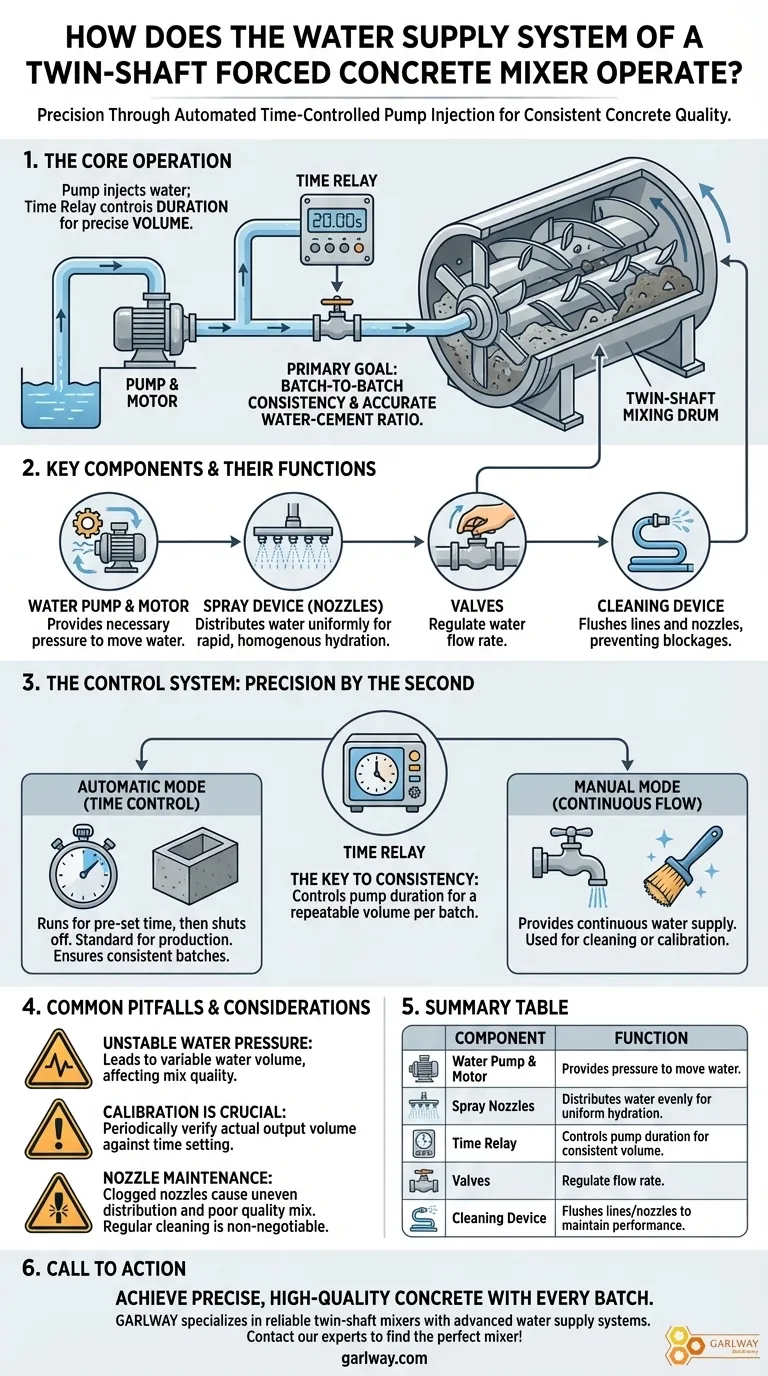
At its core, the water supply system in a twin-shaft forced concrete mixer operates using a pump to inject water into the mixing drum, with the total volume controlled precisely by a time relay. This automated system is designed to ensure a consistent and accurate water-cement ratio for every batch of concrete produced.
The primary goal of this system is not just to add water, but to guarantee batch-to-batch consistency. By controlling the duration of the water flow, the mixer achieves a repeatable and precise volume, which is critical for high-quality concrete production.
The Core Components and Their Function
The system is a straightforward but effective assembly of parts, each with a specific role in achieving a homogenous mix. Understanding these components is key to understanding the entire operation.
The Pumping and Delivery Mechanism
The water pump and motor are the heart of the system. They provide the necessary pressure to move water from the source into the mixing drum.
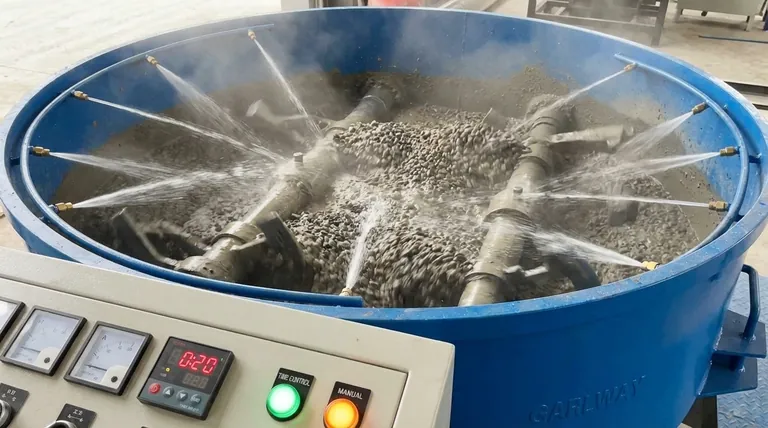
This pressurized water is delivered through a spray device. This isn't just a simple pipe; it's typically a nozzle or series of nozzles designed to distribute the water evenly over the aggregates and cement, preventing clumping and ensuring rapid, uniform hydration.
The Control and Regulation System
Two valves are used to regulate the flow of water. These components manage the rate at which water enters the drum, working in concert with the pump.
A cleaning device is also integrated into the system. This allows for flushing the lines and nozzles, which is essential for preventing blockages and maintaining performance over time.
The Control System: Precision by the Second
The intelligence of the system lies in its control method. For a batch mixer, where ingredients for one complete batch are mixed and then discharged, consistency is everything.
The Time Relay: The Key to Consistency
The most critical component for precision is the time relay. This device controls how long the water pump operates for each batch.
By setting a specific duration (e.g., 20 seconds), the operator ensures that the same volume of water is added every single time, assuming constant water pressure. This is the foundation of reliable batch production.
Automatic vs. Manual Modes
The system features two distinct operating modes to handle different tasks.
When the control is set to 'time control' (automatic), the pump runs for the pre-set time and then shuts off. This is the standard mode for producing concrete.
When set to 'manual,' the pump provides a continuous water supply. This mode is used for non-production tasks like cleaning the mixing drum or for initial system calibration.
Common Pitfalls and Considerations
While effective, this time-based system relies on certain assumptions and requires proper maintenance to remain accurate.
Dependence on Stable Water Pressure
The system's accuracy is directly tied to consistent water pressure. If the inlet pressure fluctuates, a fixed time duration will result in a variable volume of water being delivered, potentially affecting the mix quality.
The Importance of Calibration
The time setting is a proxy for volume. It is crucial to periodically calibrate the system by running the pump for its set time and measuring the actual water output to ensure it matches the mix design requirements.
Nozzle Maintenance is Non-Negotiable
Clogged or partially blocked spray nozzles are a common source of problems. This leads to uneven water distribution, resulting in a poor-quality, non-homogenous mix. Regular inspection and cleaning are essential.
Making the Right Choice for Your Goal
Your operational mode should always match your immediate objective.
- If your primary focus is consistent, high-quality concrete production: Always use the 'time control' mode and ensure the system is properly calibrated.
- If your primary focus is end-of-day cleanup or system maintenance: Use the 'manual' mode for a continuous flow to thoroughly wash out the drum and spray nozzles.
- If you suspect batch inconsistency: The first step is to verify the water supply by measuring the output volume during a timed cycle.
Ultimately, mastering the water supply system is fundamental to controlling the quality and consistency of your final concrete product.
Summary Table:
| Component | Function |
|---|---|
| Water Pump & Motor | Provides pressure to move water into the mixing drum. |
| Spray Nozzles | Distributes water evenly over materials for uniform hydration. |
| Time Relay | Controls pump duration to ensure a consistent, repeatable water volume per batch. |
| Valves | Regulate the flow rate of water entering the system. |
| Cleaning Device | Flushes lines and nozzles to prevent blockages and maintain performance. |
Achieve precise, high-quality concrete with every batch. GARLWAY specializes in construction machinery, offering reliable twin-shaft mixers with advanced water supply systems for construction companies and contractors globally. Our equipment ensures the batch-to-batch consistency you need for your projects. Contact our experts today to find the perfect mixer for your operation!
Visual Guide
Related Products
- JS500 Electric Cement Concrete Mixer for Sale
- Shaft Mixer Machine for Cement and Regular Concrete Mixing
- Portable Cement Mixer with Lift Concrete Machine
- HZS90 Large Multiquip Concrete Mixers for Construction
- HZS25 Best Cement Mixer for Quick Mix Concrete at Bunnings
People Also Ask
- What are the benefits of electric concrete mixers? Quiet, Clean, and Low-Maintenance Mixing
- What are the four factors to consider when selecting a concrete mixer? Optimize Your Construction Project
- What are the two main types of concrete mixers and their uses? Choose the Right Mixer for Your Project
- What is a concrete mixer used for? Achieve Consistent, High-Quality Concrete
- How can a concrete mixer be used to remove rust from metal parts? A Powerful, Large-Scale Cleaning Method