
At its core, a batch mixer operates on a simple principle: it produces a product in discrete, defined quantities, or "batches." All necessary ingredients are loaded into a drum or pan, mixed together for a set duration, and then the entire completed batch is discharged before the cycle begins again.
The defining characteristic of a batch mixer is its stop-and-start process, which allows for extremely precise control over the ingredients and consistency of each individual batch produced.
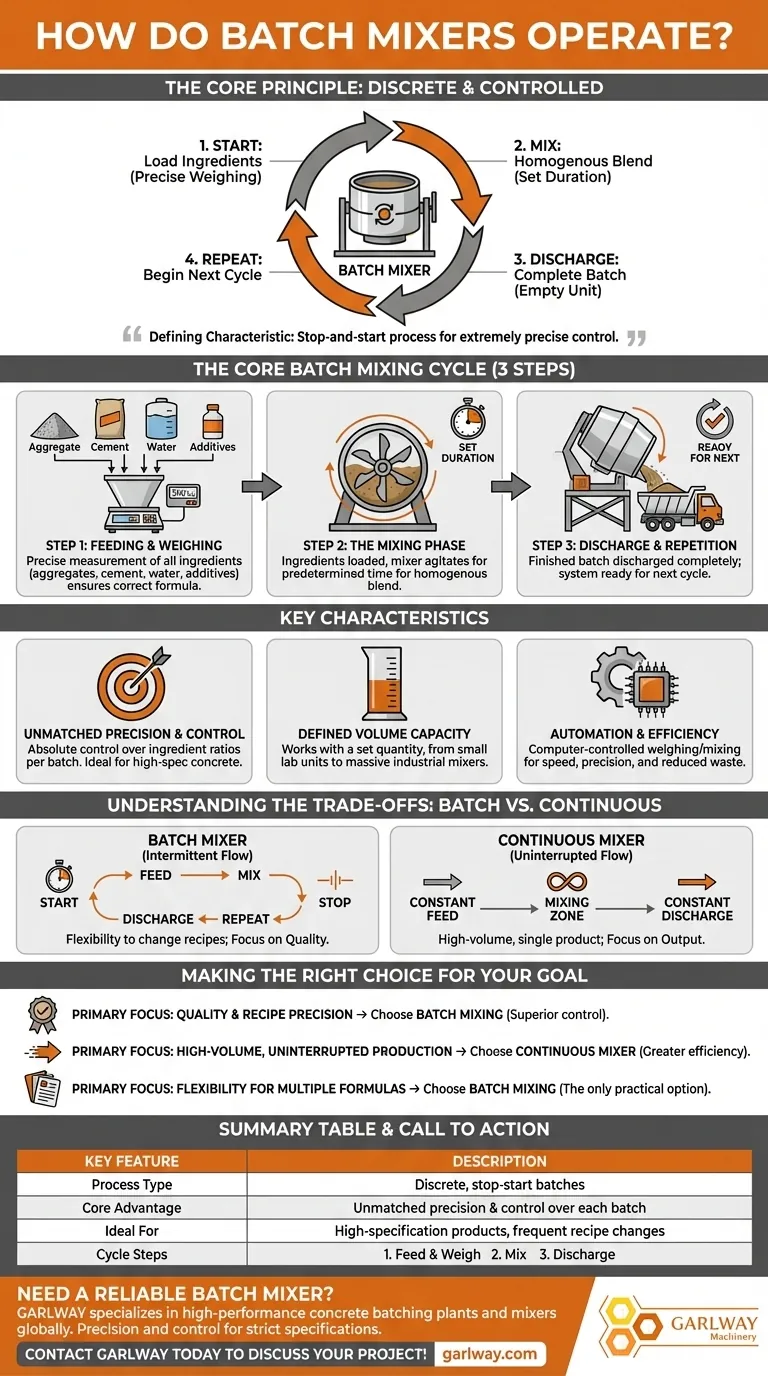
The Core Batch Mixing Cycle
The operation follows a clear, repeatable sequence of events for every single batch that is created. This methodical process is the key to its reliability and quality control.
Step 1: Feeding and Weighing
First, all raw materials are fed into the system. This includes primary components like aggregates and cement, as well as liquids like water and any special additives.
Crucially, each ingredient is weighed or measured precisely before being added. This step ensures that the formula is correct and that the final product meets exact specifications.
Step 2: The Mixing Phase
Once all ingredients are loaded into the mixing unit—typically a cylindrical drum or pan—the mixing process begins. The mixer agitates the materials for a predetermined amount of time to ensure a homogenous and consistent blend.
Step 3: Discharge and Repetition
After the mixing is complete, the entire finished batch is discharged from one end of the mixer. The system is then ready to receive the ingredients for the next batch, and the entire cycle repeats.
Key Characteristics of Batch Mixers
Understanding the operational cycle reveals the fundamental traits that define batch mixers and their ideal use cases.
Unmatched Precision and Control
Because each batch is an independent event, you have absolute control over the ingredient ratios. This makes batch mixers the standard for applications like high-specification concrete where quality and consistency are non-negotiable.
Defined Volume Capacity
Batch mixers are designed to handle a specific volume, which can range from small laboratory-scale units to massive industrial mixers capable of handling thousands of gallons. The key is that they work with a set quantity at a time.
Automation and Efficiency
While manual batch mixers exist, most modern systems are highly automated. Computers control the weighing and mixing processes, which increases speed, guarantees precision, and significantly reduces material waste.
Understanding the Trade-offs: Batch vs. Continuous
The primary distinction of a batch mixer becomes clear when you compare it to a continuous mixer. This comparison highlights its fundamental strengths and limitations.
The Interruption Principle
The batch process is inherently intermittent. It starts, mixes, stops, and discharges. This is fundamentally different from a continuous mixer, which constantly feeds materials in one end and discharges a finished product from the other without interruption.
Production Volume and Speed
For producing enormous quantities of a single, unchanging product, a continuous mixer is often more efficient. However, a batch mixer offers the flexibility to easily change the recipe from one batch to the next, which is impossible in a continuous flow.
Making the Right Choice for Your Goal
Selecting the correct mixing technology depends entirely on your production requirements and quality standards.
- If your primary focus is quality and recipe precision: The meticulous, controlled nature of batch mixing is the superior choice.
- If your primary focus is high-volume, uninterrupted production of one product: A continuous mixer will likely offer greater efficiency.
- If your primary focus is flexibility to produce multiple different formulas: Batch mixing is the only practical option, as each batch can be completely different.
Ultimately, choosing a batch mixer is a commitment to control and quality over sheer, uninterrupted output.
Summary Table:
| Key Feature | Description |
|---|---|
| Process Type | Discrete, stop-start batches |
| Core Advantage | Unmatched precision and control over each batch |
| Ideal For | High-specification products, frequent recipe changes |
| Cycle Steps | 1. Feed & Weigh 2. Mix 3. Discharge |
Need a reliable batch mixer for your construction projects?
GARLWAY specializes in construction machinery, offering high-performance concrete batching plants and mixers for construction companies and contractors globally. Our batch mixers deliver the precision and control you need to meet strict quality specifications.
Contact GARLWAY today to discuss your project requirements and find the perfect mixing solution!
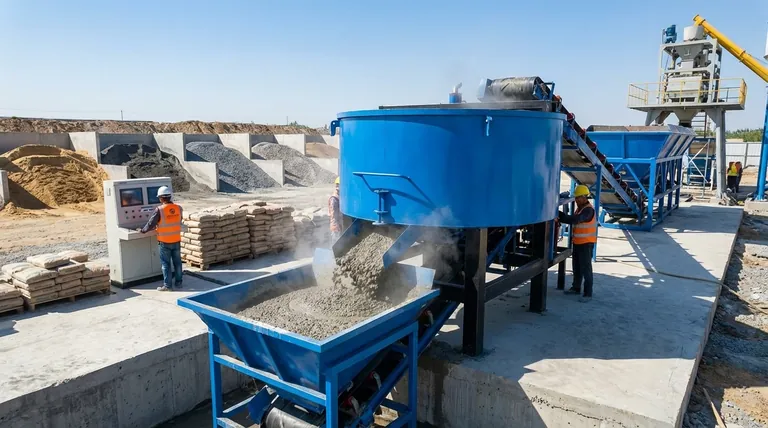
Visual Guide
Related Products
- Commercial Electric Concrete Mixer Machine HZS 50 Small Batch Plant for Sale
- HZS25 Best Cement Mixer for Quick Mix Concrete at Bunnings
- Portable Concrete Mixer Machine Equipment for Mixing Concrete
- HZS120 Ready Mix Concrete Batching Plant Commercial Mud Cement Mixer
- HZS75 Concrete Batching Plant Cement Mixer Price Concrete Mixer Bunnings Mixing Plant
People Also Ask
- What are the types of concrete mixers used in batching plants? Choose the Right Mixer for Your Project
- What is the core component of a concrete batching plant? The Mixer Unit Defines Your Concrete Quality
- Why is proper maintenance important for a concrete batch mix plant? Maximize Uptime & Profitability
- Why buy concrete batch plant parts only from the manufacturer? Protect Your Investment and Maximize Uptime
- What are the two main types of concrete batch mixers? Choose the Right Mixer for Your Project





