
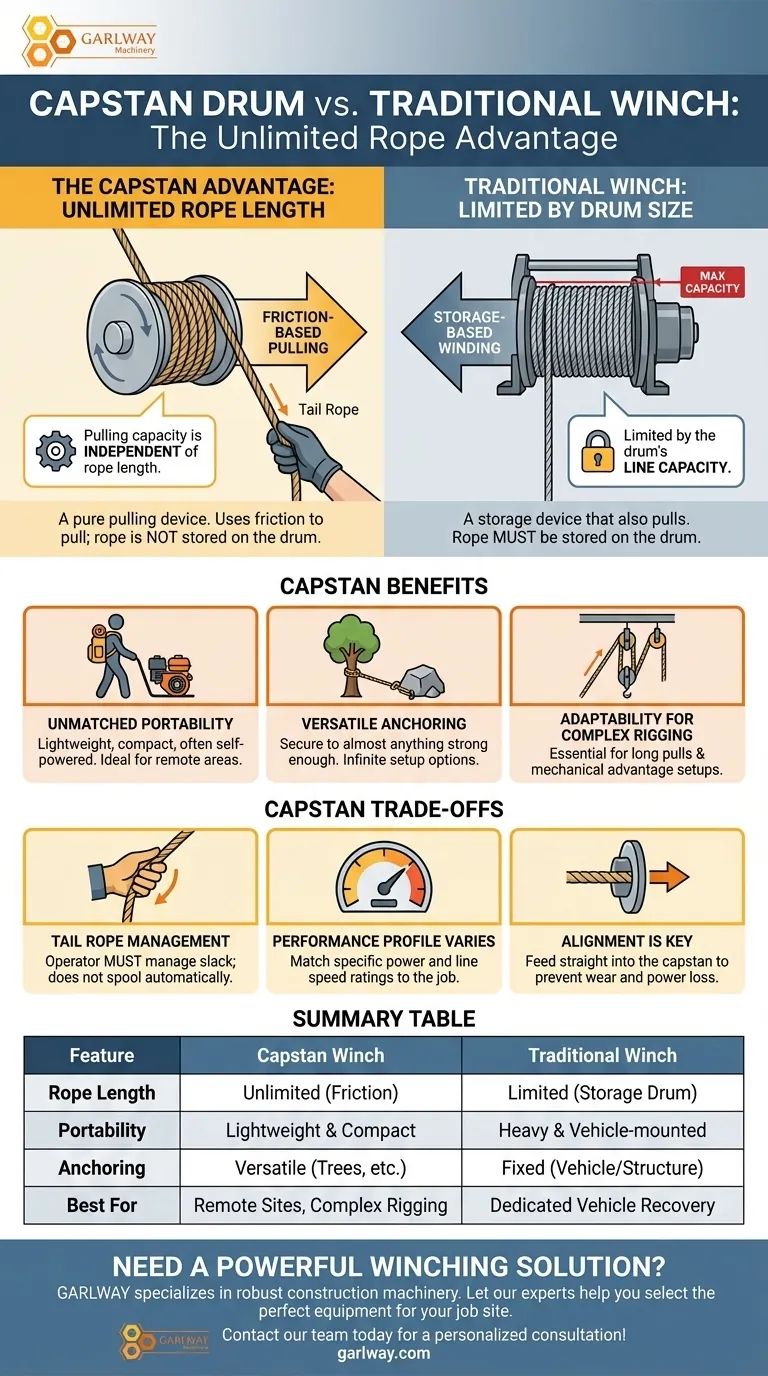
The single greatest advantage of a capstan drum is its ability to use an unlimited length of rope. Unlike a traditional winch that must store its entire line on a fixed-size drum, a capstan simply uses friction to pull the rope through its mechanism, meaning its pulling capacity is completely independent of the rope's length.
A traditional winch is a storage device that also pulls, limiting you to the length of line on its drum. A capstan is a pure pulling device, giving you the freedom to use any length of rope required for the task.
How a Capstan Fundamentally Differs from a Winch
To understand the benefits, it's important to grasp the core mechanical difference between these two tools. This distinction is the source of all their respective strengths and weaknesses.
The Winch: A Storage-Based System
A traditional winch works by winding a cable or rope onto its own integrated drum. The length of your pull is therefore permanently limited by how much line that drum can hold.
This design is simple and self-contained, making it ideal for fixed applications like vehicle-mounted recovery systems.
The Capstan: A Friction-Based System
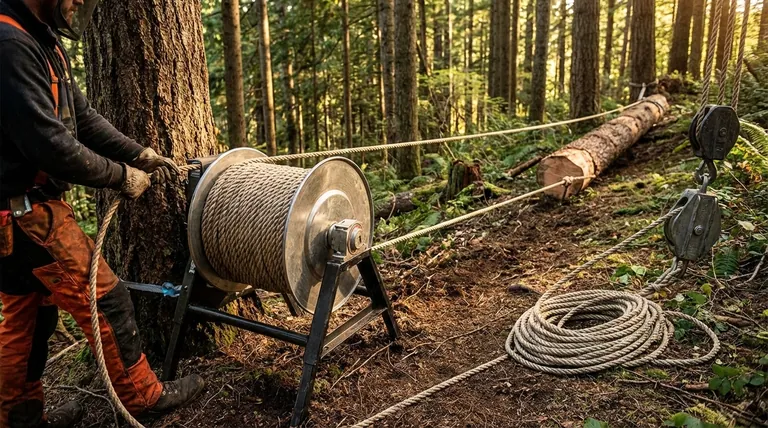
A capstan drum does not store the rope. Instead, the rope is wrapped around the rotating drum (the capstan) a few times.
As the capstan turns, friction between it and the rope grips the line and pulls it through. The operator simply manages the light tension on the "tail" end of the rope, while the machine does all the heavy pulling on the load end.
The Practical Benefits of This Design
The capstan's simple friction mechanism unlocks a level of flexibility and portability that traditional winches cannot match.
Unmatched Portability
Because they don't need a heavy, oversized drum to store cable, portable capstan winches are often lightweight and compact.
Many are self-powered with small gas engines, allowing a single person to carry the winch into remote areas and operate it without needing a vehicle or external power source.
Versatility in Anchoring
A traditional winch is usually bolted permanently to a vehicle or structure. A portable capstan winch, however, can be anchored to almost anything strong enough to handle the load.
This allows you to use a tree, a rock, or another vehicle as your anchor point, providing infinite options for setting up your pull, which is invaluable on remote job sites or in dense forests.
Adaptability for Complex Rigging
The unlimited rope length is essential for complex rigging situations, such as using a block-and-tackle system.
These setups multiply pulling force but require significantly longer lengths of rope to achieve the same pulling distance. A capstan handles this easily, whereas a traditional winch would run out of line.
Understanding the Trade-offs
The capstan's flexibility comes with unique operational demands that differ from a standard winch.
You Must Manage the Tail Rope
The most significant operational difference is that the user is responsible for managing the slack rope as it comes off the capstan.
Unlike a winch that spools the line automatically, you must either pull the tail end by hand or ensure it doesn't become tangled.
Performance Profile May Vary
Capstan winches are rated for specific line speeds and loads, such as 200 lbs at 31 feet per minute. It is critical to match the tool's power and speed to the specific demands of your job.
Alignment is Key
For smooth, efficient operation and to prevent premature rope wear, the line must be fed straight into the capstan. Poor alignment can reduce pulling power and damage your equipment.
Making the Right Choice for Your Goal
Your specific application dictates which tool is superior.
- If your primary focus is dedicated vehicle recovery: The speed and integrated nature of a permanently mounted traditional winch is often the most efficient choice.
- If your primary focus is portability and versatility: A portable capstan winch offers unparalleled freedom for use in forestry, hunting, or any remote job site.
- If your primary focus is complex rigging or long-distance pulls: The capstan's unlimited rope capability is the only practical solution.
Ultimately, choosing the right tool requires you to understand that one offers self-contained convenience while the other provides limitless operational freedom.
Summary Table:
| Feature | Capstan Winch | Traditional Winch |
|---|---|---|
| Rope Length | Unlimited | Limited by drum size |
| Portability | Lightweight & compact | Heavy & vehicle-mounted |
| Anchoring | Versatile (trees, rocks, etc.) | Fixed (vehicle/structure) |
| Best For | Remote sites, complex rigging | Dedicated vehicle recovery |
Need a powerful and versatile winching solution for your construction or contracting projects?
At GARLWAY, we specialize in robust construction machinery, including winches designed for demanding applications. Whether you require the unlimited rope capability of a capstan or the integrated power of a traditional winch, our experts can help you select the perfect equipment for your job site.
Let us provide you with a reliable solution that enhances your operational efficiency and safety.
Contact our team today for a personalized consultation!
Visual Guide
Related Products
- Portable Small Trailer Winch
- Small Electric Winch 120V and 240V for Compact Applications
- Electric and Hydraulic Winch for Heavy Duty Applications
- 12000 lb Heavy Duty Electric Boat Winch
- Hydraulic Winding Engine Harbor Freight Winch
People Also Ask
- What features were incorporated into the upgraded portable winch system? Boost Your Recovery Power & Safety
- What are some uses mentioned for portable winches beyond vehicle recovery? Essential Versatility for Property & Work
- How could the twisting issue with a portable winch be mitigated? Achieve Safe, Centered Pulls with Proper Rigging
- What is the significance of trailer winches in the boating industry? Ensure Safe and Efficient Boat Recovery
- What should be considered when mounting a winch on a trailer? Ensure a Safe, Aligned Installation





