
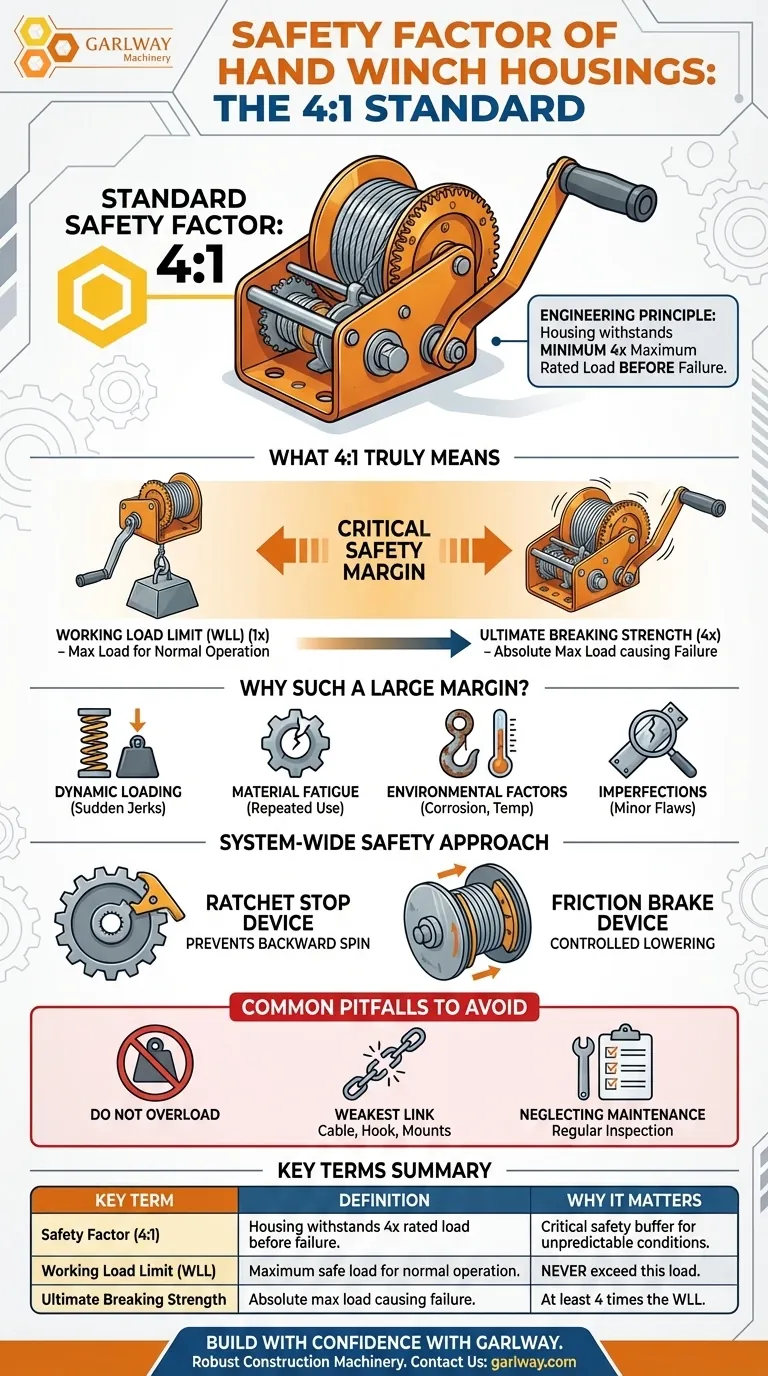
The standard safety factor applied to hand winch housings is 4:1. This engineering principle dictates that the housing must be built to withstand a minimum of four times its maximum rated load before any structural failure occurs.
A winch's safety factor is not merely a number; it is a critical buffer designed for unforeseen stresses. It works in concert with mechanical safety features like brakes and ratchets to create a comprehensive safety system.
What a 4:1 Safety Factor Truly Means
A safety factor provides a crucial margin of safety to account for real-world conditions that are often unpredictable. It ensures the equipment can handle dynamic forces that go beyond the static weight of the load.
The Working Load Limit (WLL)
The rated load, or Working Load Limit (WLL), is the maximum force a winch is designed to handle during normal, everyday operation. This is the number you should never exceed.
The Ultimate Breaking Strength
The ultimate strength is the absolute maximum load a component can bear before it physically breaks or deforms permanently. The 4:1 safety factor means this breaking point is at least four times higher than the WLL.
Why Such a Large Margin?
This substantial buffer isn't for overloading the winch. It exists to account for:
- Dynamic Loading: Sudden jerks or stops can momentarily multiply the force on the winch.
- Material Fatigue: Repeated use over many years can introduce micro-fractures and weaken the material.
- Environmental Factors: Corrosion or extreme temperatures can affect the integrity of the housing.
- Imperfections: Minor, undetectable flaws in materials or manufacturing.
Beyond the Housing: A System-Wide Approach to Safety
The structural integrity of the housing is just one piece of the puzzle. True operational safety relies on mechanical components that control the load.
The Ratchet Stop Device
A ratchet stop, or pawl, is a mechanical lock. It engages with the gear to prevent the winch drum from spinning backward under load, effectively holding the load securely in place if you let go of the handle.
The Friction Brake Device
A friction brake is essential for safely lowering a load. It provides resistance, allowing you to release the load in a smooth, controlled manner and preventing a dangerous free-fall scenario.
Common Pitfalls to Avoid
Understanding the safety factor is key to avoiding misuse. The most common and dangerous mistake is misinterpreting what this safety margin is for.
Never Intentionally Overload
A 4:1 safety factor is not an invitation to exceed the rated WLL. It is a non-negotiable safety margin for unexpected events, not a hidden reserve of capacity. Consistently operating above the WLL will cause premature wear and can lead to catastrophic failure.
The System is Only as Strong as its Weakest Link
The housing's 4:1 safety factor is irrelevant if the cable, hook, or mounting bolts are not rated for the same load. Always ensure that every component in your winching setup—from the anchor point to the hook—can handle the intended force.
Maintenance is Non-Negotiable
A high safety factor assumes the winch is in good condition. Regular inspection for cracks, corrosion, or deformation is critical. A compromised housing no longer has its original 4:1 safety factor.
How to Apply This to Your Project
Use this knowledge to ensure every operation is performed safely and correctly. Your approach should depend on your primary objective.
- If your primary focus is safe load handling: Always operate within the winch's stated rated load and confirm the ratchet and brake systems are functioning correctly before every use.
- If your primary focus is long-term reliability: Implement a regular inspection schedule to check the housing, frame, and mechanical parts for any signs of wear or damage that could compromise the safety factor.
- If your primary focus is total system integrity: Verify that all associated components, including the winch line, hooks, and anchor points, are properly rated for the task at hand.
By respecting the engineering principles of the entire system, you ensure the winch remains a safe and reliable tool.
Summary Table:
| Key Term | Definition | Why It Matters |
|---|---|---|
| Safety Factor (4:1) | Housing must withstand 4x the rated load before failure. | Provides a critical safety buffer for unpredictable real-world conditions. |
| Working Load Limit (WLL) | The maximum safe load for normal operation. | The load you should NEVER exceed during use. |
| Ultimate Breaking Strength | The absolute maximum load causing failure. | This value is at least 4 times the WLL. |
Ensure your projects are built on a foundation of safety and reliability.
At GARLWAY, we specialize in engineering robust construction machinery, including hand winches, concrete mixers, and batching plants. Our equipment is designed with rigorous safety standards to protect your team and your assets.
Let us help you build with confidence. Contact our experts today to find the perfect winch for your specific needs and learn more about our commitment to quality and safety for construction companies and contractors worldwide.
Visual Guide
Related Products
People Also Ask
- What features were incorporated into the upgraded portable winch system? Boost Your Recovery Power & Safety
- What are some uses mentioned for portable winches beyond vehicle recovery? Essential Versatility for Property & Work
- How could the twisting issue with a portable winch be mitigated? Achieve Safe, Centered Pulls with Proper Rigging
- What is the significance of trailer winches in the boating industry? Ensure Safe and Efficient Boat Recovery
- What should be considered when mounting a winch on a trailer? Ensure a Safe, Aligned Installation

