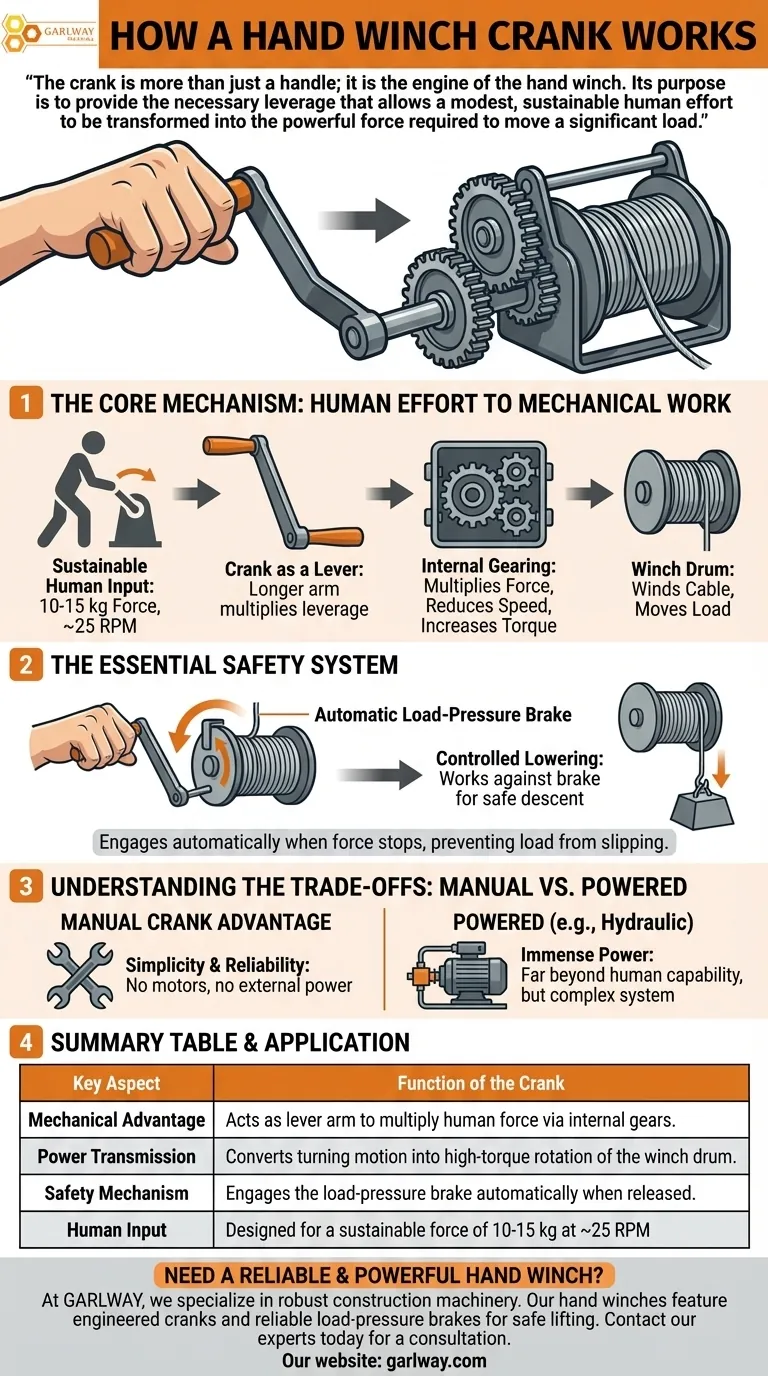
In a hand winch, the crank functions as the primary lever for converting human muscle power into mechanical work. The operator turns the crank handle, which rotates an internal gear system. This system provides a mechanical advantage, multiplying the user's force to turn the winch drum, which then winds or unwinds the cable to lift or pull a heavy load.
The crank is more than just a handle; it is the engine of the hand winch. Its purpose is to provide the necessary leverage that allows a modest, sustainable human effort to be transformed into the powerful force required to move a significant load.
The Core Mechanism: From Human Effort to Mechanical Work
Understanding how a hand winch functions begins with the crank. It's the starting point for the entire operation, translating your physical input into a powerful output.
The Crank as a Lever
The crank's length is not arbitrary; it's a lever arm. The longer the handle, the more leverage you have, making it easier to turn the internal gears against the resistance of the load. This is the first step in creating a mechanical advantage.
Driving the Winch Drum
As you turn the crank, it drives a series of gears. These gears reduce speed but increase torque. This means that many turns of the crank result in a slow but powerful rotation of the central drum. It is this drum rotation that winds the cable and moves the load.
The Critical Role of Gearing
The internal gearing is what truly multiplies your force. Without it, you would be trying to turn the drum directly, which would be impossible for any significant weight. The gear ratio determines how much your force is amplified.
Sustainable Human Input
The entire system is designed around the average force a person can sustain, which is typically between 10-15 kg of force. A comfortable operating speed is around 25 revolutions per minute of the crank.
The Essential Safety System
The crank's function is directly tied to the winch's safety mechanism. What happens when you let go is just as important as what happens when you turn it.
The Load-Pressure Brake
Most hand winches include a load-pressure brake. This brake automatically engages the moment you stop applying force and release the crank. The weight of the load itself applies pressure to the braking mechanism, preventing the drum from unwinding and the load from slipping.
Controlled Lowering
This brake system also allows for controlled lowering. To lower the load, you must turn the crank in the opposite direction. This action works against the brake, allowing for a deliberate and safe descent rather than an uncontrolled drop.
Understanding the Trade-offs: Manual vs. Powered
The function of a manual crank is best understood when contrasted with powered alternatives.
The Manual Advantage: Simplicity and Reliability
The primary benefit of a hand winch is its simplicity. There are no motors, fluids, or external power sources required. The crank-driven mechanism is reliable and can be used in any location.
The Power of Hydraulics: A Point of Contrast
A hydraulic winch, by contrast, replaces the crank and manual effort entirely. It uses pressurized fluid, typically oil, to drive a hydraulic motor that turns the drum. This generates immense power far beyond human capability but requires a complex system of pumps and generators.
The Limits of Human Power
The trade-off for the hand winch's simplicity is its reliance on physical strength. The design is limited by the amount of force an operator can comfortably and safely exert over time.
How to Apply This to Your Task
Understanding the crank's function helps you choose the right tool and operate it safely.
- If your primary focus is portability and field reliability: A hand winch is the superior choice, as its crank-driven mechanism is self-contained and requires no external power.
- If your primary focus is lifting heavy loads with minimal effort: A powered system like a hydraulic or electric winch is necessary to overcome the physical limits of a manual crank.
- If your primary focus is safety during operation: Always select a hand winch with an automatic load-pressure brake, ensuring the load is secure the moment you release the crank.
Ultimately, recognizing the crank as the core interface for both power and control is key to using a hand winch effectively and safely.
Summary Table:
| Key Aspect | Function of the Crank |
|---|---|
| Mechanical Advantage | Acts as a lever arm to multiply human force via internal gears. |
| Power Transmission | Converts turning motion into high-torque rotation of the winch drum. |
| Safety Mechanism | Engages the load-pressure brake automatically when released. |
| Human Input | Designed for a sustainable force of 10-15 kg at ~25 RPM. |
Need a reliable and powerful hand winch for your project?
At GARLWAY, we specialize in robust construction machinery designed for professionals like you. Our hand winches feature precisely engineered cranks and reliable load-pressure brakes to ensure safe, efficient lifting and pulling on any job site.
Let us provide the durable equipment your work demands.
Contact our experts today for a consultation and discover the right winch solution for your construction company or contracting business.
Visual Guide
Related Products
- Portable Small Trailer Winch
- Quick Windlass Portable Winch for Truck and Boat Best Boat Winch
- Electric Hoist Winch Boat Anchor Windlass for Marine Applications
- Electric and Hydraulic Winch for Heavy Duty Applications
- Hydraulic Winding Engine Harbor Freight Winch
People Also Ask
- What features were incorporated into the upgraded portable winch system? Boost Your Recovery Power & Safety
- What are some uses mentioned for portable winches beyond vehicle recovery? Essential Versatility for Property & Work
- How could the twisting issue with a portable winch be mitigated? Achieve Safe, Centered Pulls with Proper Rigging
- What is the significance of trailer winches in the boating industry? Ensure Safe and Efficient Boat Recovery
- What should be considered when mounting a winch on a trailer? Ensure a Safe, Aligned Installation