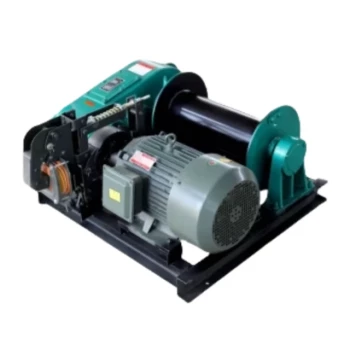
In simple terms, the lever effect in a hand winch refers to how the crank handle multiplies your physical effort into a powerful twisting force, known as torque. A longer handle allows you to generate the same amount of torque with significantly less effort, making it easier to begin the process of moving a heavy load.
The lever effect created by the winch handle is the critical first step in a system of force multiplication. It's not the sole source of the winch's power, but it's what initiates the entire mechanical advantage chain.
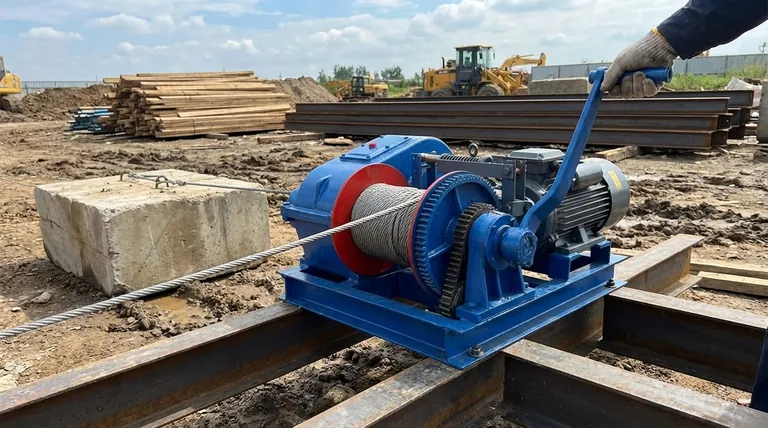
How a Winch Amplifies Your Effort
A hand winch is a system designed to multiply force. The lever effect is just the beginning of this process. It works in conjunction with gears and the winch drum to turn your manageable effort into a powerful pull.
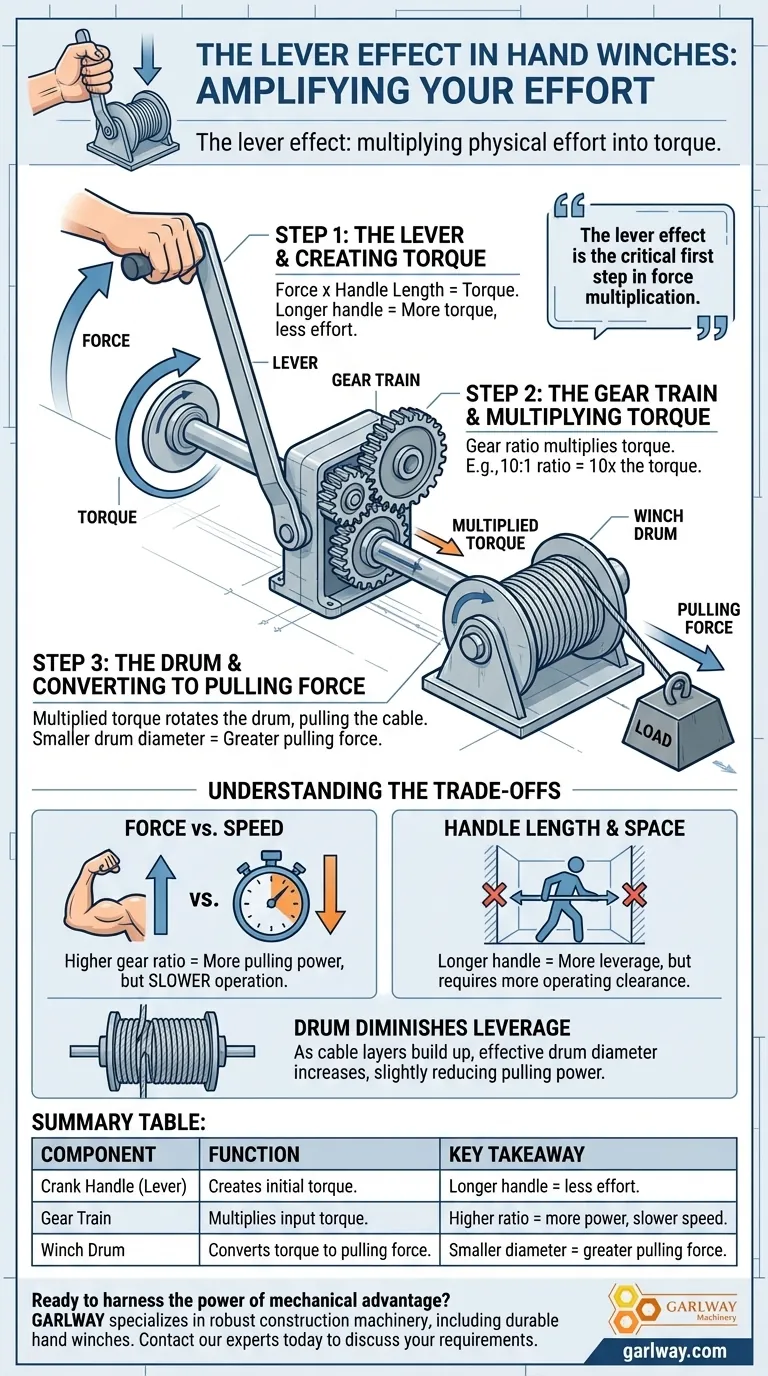
Step 1: The Lever and Creating Torque
The winch handle acts as a lever. When you apply force to the handle, you create torque on the input shaft of the winch's gearbox.
The amount of torque is calculated by a simple principle: Force x Handle Length = Torque.
This means that doubling the length of the handle allows you to create the same amount of torque with only half the effort. Think of using a long wrench to loosen a stubborn bolt versus trying to do it with a short one.
Step 2: The Gear Train and Multiplying Torque
The torque you create with the handle is then fed into a set of internal gears. This is where the most significant force multiplication happens.
A winch's gear ratio, such as 5:1 or 10:1, indicates how many times the gears multiply the torque.
A 10:1 gear ratio means the torque from the handle is multiplied by ten before it reaches the drum. This makes the system incredibly powerful.
Step 3: The Drum and Converting to Pulling Force
Finally, the multiplied torque is used to rotate the winch drum, which winds the cable and pulls the load.
The diameter of the drum plays a final role. A smaller drum diameter converts the same amount of torque into a greater linear pulling force on the cable.
Understanding the Trade-offs
The mechanical advantage gained through the lever and gears doesn't come for free. It requires a trade-off, primarily with speed and distance.
The Cost of Power: Speed
The fundamental trade-off is force vs. speed. A high gear ratio that multiplies your force by ten also means you have to turn the handle ten times for the drum to make one full rotation.
High-power winches can pull immense loads, but they do so very slowly.
The Practicality of Handle Length
While a longer handle provides more leverage, it also requires more clearance to operate. A handle that is too long can be cumbersome or impossible to use in tight spaces where you can't make a full rotation.
How the Drum Diminishes Leverage
As the cable wraps around the drum, it forms layers. Each new layer increases the effective diameter of the drum.
This slightly reduces the winch's pulling power because the same amount of torque is acting on a larger "lever arm" (the radius of the wound cable). The winch's maximum rated pull is typically calculated on the first layer of cable.
Making the Right Choice for Your Goal
Understanding the components of mechanical advantage helps you select the right tool for the job.
- If your primary focus is maximum pulling power: Look for a winch with a high gear ratio and a longer handle, and be prepared for slow operation.
- If your primary focus is speed on lighter loads: A winch with a lower gear ratio will pull the cable in much faster with each crank.
- If you have limited operating space: Carefully check the handle's swing radius to ensure you have enough clearance to work effectively.
By understanding these principles, you can see the winch not as a simple tool, but as an elegant system designed to amplify your own strength.
Summary Table:
| Component | Function | Key Takeaway |
|---|---|---|
| Crank Handle (Lever) | Creates initial torque. | A longer handle = more leverage, requiring less effort. |
| Gear Train | Multiplies the input torque. | A higher gear ratio (e.g., 10:1) = more power but slower speed. |
| Winch Drum | Converts torque into linear pulling force. | A smaller drum diameter = greater pulling force on the cable. |
Ready to harness the power of mechanical advantage for your projects?
GARLWAY specializes in robust construction machinery, including durable hand winches, concrete mixers, and batching plants designed for construction companies and contractors worldwide. Our equipment is engineered to maximize efficiency and safety on your job site.
Let us help you select the perfect winch for your specific needs. Contact our experts today to discuss your requirements and discover the GARLWAY advantage.
Visual Guide
Related Products
- Portable Small Trailer Winch
- Quick Windlass Portable Winch for Truck and Boat Best Boat Winch
- Electric and Hydraulic Winch for Heavy Duty Applications
- Warn Winch Windlass Boat Trailer Winch
- Electric Hoist Winch Boat Anchor Windlass for Marine Applications
People Also Ask
- What features were incorporated into the upgraded portable winch system? Boost Your Recovery Power & Safety
- What are some uses mentioned for portable winches beyond vehicle recovery? Essential Versatility for Property & Work
- How could the twisting issue with a portable winch be mitigated? Achieve Safe, Centered Pulls with Proper Rigging
- What is the significance of trailer winches in the boating industry? Ensure Safe and Efficient Boat Recovery
- What should be considered when mounting a winch on a trailer? Ensure a Safe, Aligned Installation