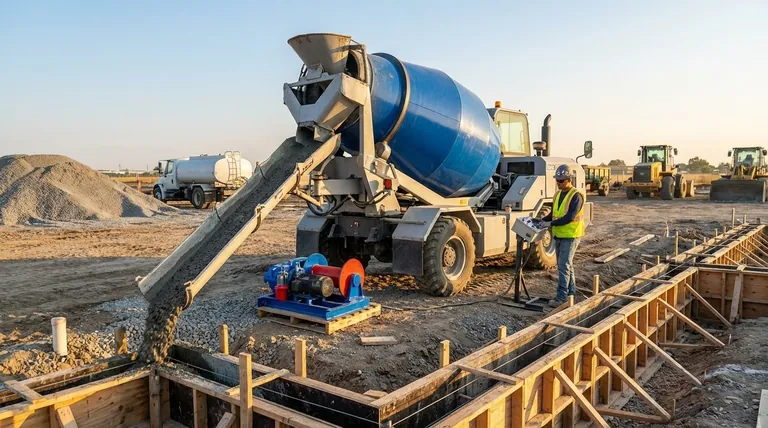
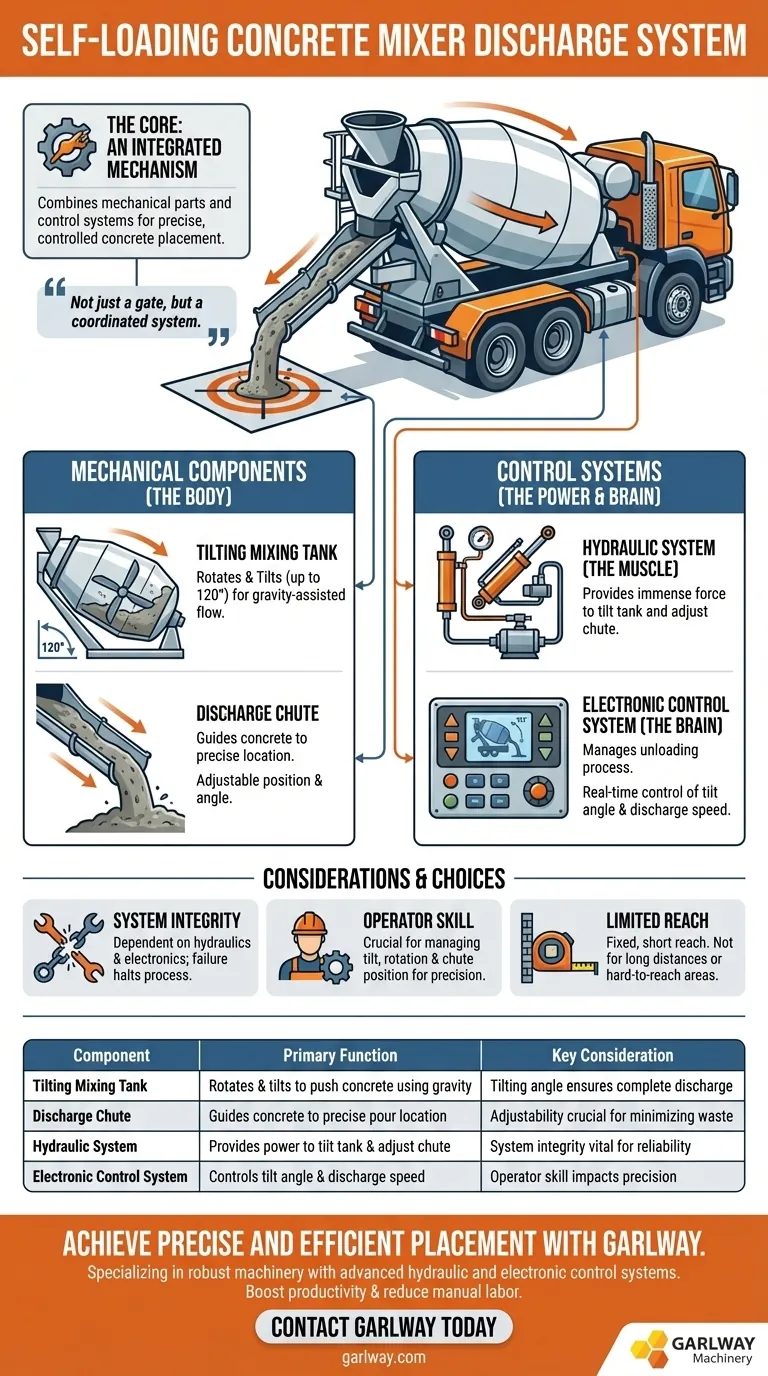
At its core, the discharge system of a self-loading concrete mixer is an integrated mechanism combining mechanical and control components. It primarily consists of a tilting mixing tank, a discharge chute, and the hydraulic and electronic systems that govern their movement to ensure precise and controlled concrete placement.
The key is to see the discharge function not as a simple gate, but as a coordinated system. The power of hydraulics, the precision of electronic controls, and the design of the tank and chute all work together to deliver concrete exactly where it's needed.
The Core Mechanical Components
The physical act of unloading concrete relies on two main mechanical parts that are designed to work in concert.
The Tilting Mixing Tank
The entire discharge process begins with the main mixing tank. By rotating, the tank uses its internal blades to push the well-mixed concrete toward its opening.
The tank itself is designed to tilt, often up to 120 degrees, using the force of the hydraulic system. This tilting action uses gravity to ensure the concrete flows out smoothly.
The Discharge Chute
The discharge chute is the final pathway for the concrete. It is a simple but critical component that guides the material from the tank's outlet to the exact pour location on the construction site.
The operator can typically adjust the position and angle of the chute to direct the flow, minimizing waste and reducing the need for manual labor to spread the concrete.
The Control Systems: Precision and Power
The mechanical components are useless without the systems that control them. These systems provide both the force for movement and the intelligence for precision.
The Hydraulic System
The hydraulic system is the muscle of the operation. It provides the immense force required to tilt the heavy, concrete-filled mixing tank.
It also powers the actuators that control the discharge chute, allowing the operator to make adjustments easily from the cab.
The Electronic Control System
This system is the brain of the machine. The operator uses the electronic control system to manage the entire unloading process.
From the control panel, the operator can adjust the tank's tilt angle and rotation direction. This allows for real-time control over the discharge speed, ensuring a smooth and predictable pour.
Understanding the Trade-offs
While highly efficient, this system is not without its operational considerations. Understanding these limitations is key to using the machine effectively.
Dependency on System Integrity
The entire discharge operation is dependent on the hydraulic and electronic systems. A failure in a hydraulic line or an electronic sensor can halt the unloading process completely.
Operator Skill is Crucial
The precision of the pour is ultimately determined by the operator's skill. Effectively managing the tilt angle, tank rotation, and chute position in real-time requires experience to achieve optimal results.
Limited Reach
The reach of the discharge chute is fixed and relatively short. This can be a limitation on job sites that require placing concrete over long distances or in hard-to-reach areas, where a dedicated concrete pump might be necessary.
Making the Right Choice for Your Goal
Understanding how these components function together helps you evaluate the machine based on your project's specific needs.
- If your primary focus is precision placement: The responsiveness of the electronic controls and the maneuverability of the discharge chute are the most important features for you.
- If your primary focus is speed and efficiency: The power of the hydraulic system, which dictates how quickly the tank can tilt and discharge, is your key metric.
- If your primary focus is reliability and uptime: The quality and maintenance of the hydraulic and electronic systems are paramount to prevent costly on-site delays.
By recognizing how these parts form a single, functional system, you can better leverage the full potential of a self-loading mixer on your job site.
Summary Table:
| Component | Primary Function | Key Consideration |
|---|---|---|
| Tilting Mixing Tank | Rotates and tilts to push concrete out using gravity. | Tilting angle (up to 120°) ensures complete discharge. |
| Discharge Chute | Guides concrete from the tank outlet to the precise pour location. | Adjustability is crucial for minimizing waste and labor. |
| Hydraulic System | Provides the power to tilt the tank and adjust the chute. | System integrity is vital for reliability and uptime. |
| Electronic Control System | Allows the operator to precisely control tilt angle and discharge speed. | Operator skill impacts the precision of the final pour. |
Ready to achieve precise and efficient concrete placement on your job site?
At GARLWAY, we specialize in engineering robust and reliable construction machinery for contractors and construction companies worldwide. Our self-loading concrete mixers are designed with advanced hydraulic and electronic control systems to give you unparalleled control over the discharge process, ensuring every pour is accurate and efficient.
Let us help you boost your project's productivity and reduce manual labor.
Contact GARLWAY today to discuss your specific needs and discover how our mixers, winches, and batching plants can deliver superior value for your business.
Visual Guide
Related Products
- Skid Steer Self Loading Concrete Mixers for Construction
- Belle Mixer Drum Self Loading Mortar Mixers JS3000
- Portable Cement Mixer with Lift Concrete Machine
- Portable Concrete Mixer Machine Equipment for Mixing Concrete
- Portable Ready Mix Concrete Mixer Equipment
People Also Ask
- How does the control system improve production efficiency in a self loading concrete mixer? Automate Mixing for Speed & Quality
- What is the purpose of keeping the drum rotating during transportation in a self loading concrete mixer? Ensure Quality & Consistency
- How does the weighing process work in a self loading concrete mixer? Achieve Precise, On-Site Concrete Batching
- What components are involved in the loading process of a self loading concrete mixer? A Guide to the Key Systems
- How should materials be loaded into a self-loading concrete mixer? Master the Step-by-Step Process