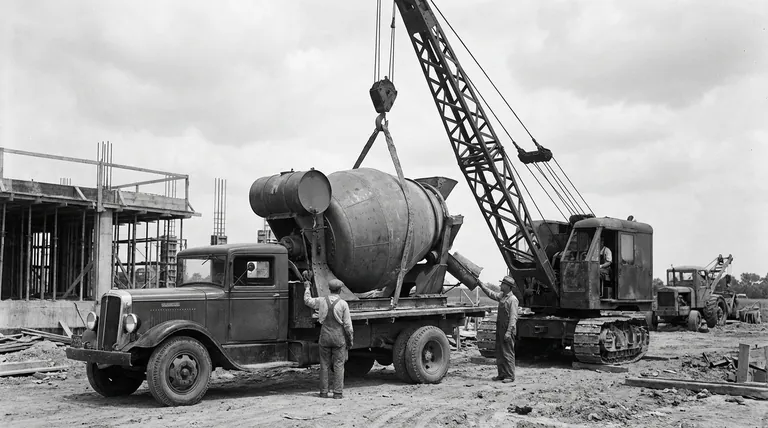
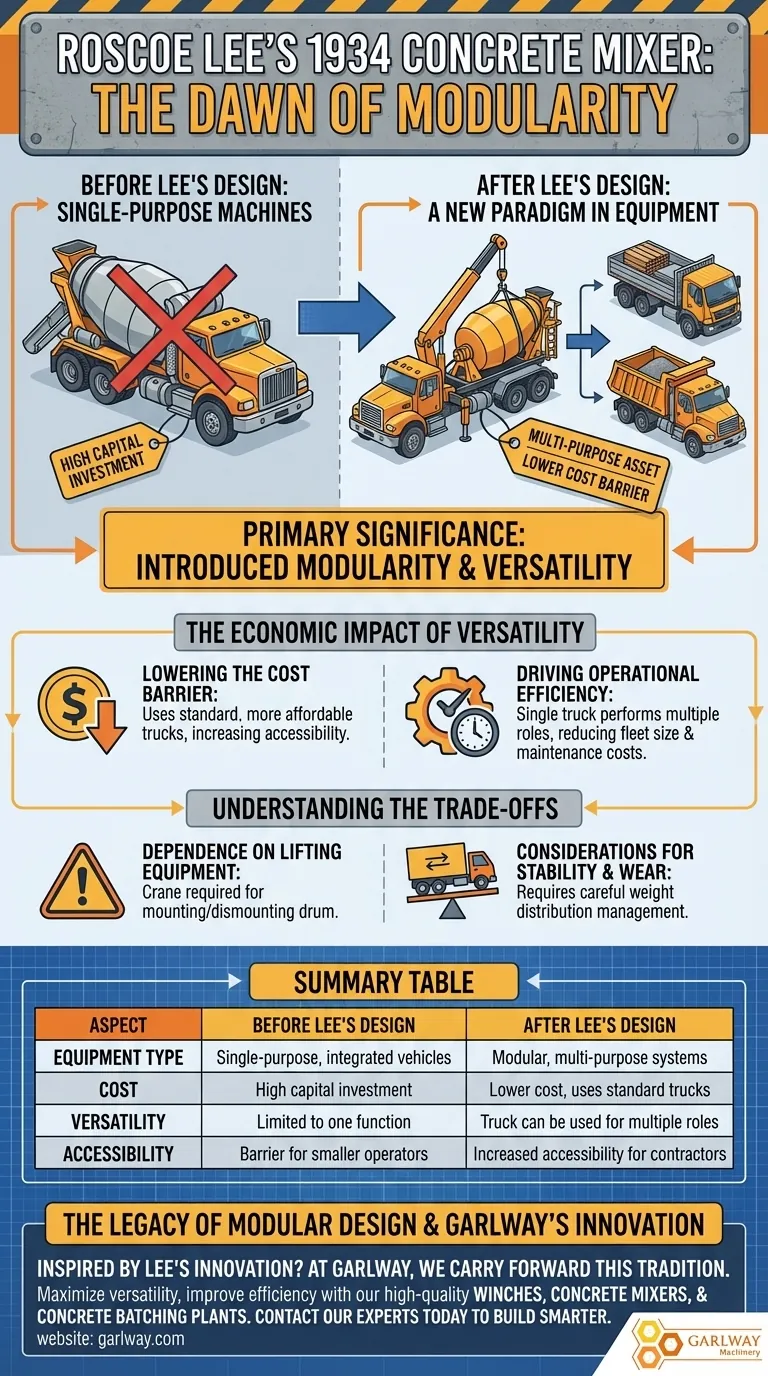
The primary significance of Roscoe Lee's 1934 concrete mixer design was its introduction of modularity and versatility to construction equipment. By designing a mixer drum that could be placed onto a standard truck with a crane, he created a system that was less expensive and allowed the truck to be used for other purposes, such as a flatbed or dump truck.
This innovation fundamentally shifted the economic model for construction vehicles. It moved away from expensive, single-purpose machines toward more flexible, cost-effective assets that could serve multiple roles on a job site.
A New Paradigm in Equipment Design
Before Lee's design, concrete mixers were typically integrated, purpose-built vehicles. This represented a significant capital investment that could only serve one function. Lee's approach challenged this established model directly.
Decoupling the Mixer from the Truck
The core concept was simple but powerful: separate the mixing function from the transport vehicle.
Lee's design enabled a standard mixer drum to be lifted by a crane and secured onto the back of a generic truck chassis. This broke the permanent bond between the two components.
The Power of a Multi-Purpose Asset
This separation meant the truck was no longer just a concrete mixer.
Once the mixing job was complete, the drum could be removed. The very same truck could then be converted into a flatbed for hauling materials or a dump truck for moving earth, dramatically increasing its value and utilization.
The Economic Impact of Versatility
The true significance of this design lies in the economic advantages it created, particularly for smaller operators and businesses looking to maximize efficiency.
Lowering the Cost Barrier
A dedicated, single-purpose mixer truck is a major expense. Lee's design allowed contractors to use a standard, more affordable truck they likely already owned.
This lowered the barrier to entry, making ready-mix concrete transport more accessible and reducing the initial capital required to take on certain jobs.
Driving Operational Efficiency
With a versatile vehicle, a single truck could perform the work of several specialized ones.
This reduced the need for a larger fleet, lowered maintenance and insurance costs, and simplified logistics on the construction site. A company could do more with less equipment.
Understanding the Trade-offs
While innovative, this modular approach presented practical considerations that differ from a fully integrated, purpose-built mixer.
Dependence on Lifting Equipment
The primary operational requirement of Lee's system was the need for a crane.
To mount or dismount the mixer drum, a crane had to be available on-site. This could add a logistical step and potential cost that isn't a factor with a dedicated mixer truck.
Considerations for Stability and Wear
Placing a heavy, rotating drum on a standard truck chassis raises different engineering questions than a purpose-built vehicle.
Factors like weight distribution, center of gravity, and the stress on the truck's frame during transport and mixing would need careful management to ensure safe and reliable operation.
The Legacy of Modular Design
Roscoe Lee's 1934 concept was more than just a new type of mixer; it was a new way of thinking about industrial equipment.
- If your primary focus is historical innovation: Lee's design is significant for introducing modularity, which fundamentally increased the versatility and affordability of essential construction machinery.
- If your primary focus is business efficiency: The key lesson is how decoupling a specialized function from a core asset (the truck) can dramatically lower costs and increase its overall utilization.
Ultimately, this innovation proved that designing for flexibility can be just as powerful as designing for a single, dedicated purpose.
Summary Table:
| Aspect | Before Lee's Design | After Lee's Design |
|---|---|---|
| Equipment Type | Single-purpose, integrated vehicles | Modular, multi-purpose systems |
| Cost | High capital investment | Lower cost, uses standard trucks |
| Versatility | Limited to one function | Truck can be used for multiple roles |
| Accessibility | Barrier for smaller operators | Increased accessibility for contractors |
Inspired by Roscoe Lee's Legacy of Innovation?
At GARLWAY, we carry forward this tradition of designing intelligent, efficient construction machinery. We specialize in providing high-quality winches, concrete mixers, and concrete batching plants to construction companies and contractors worldwide.
Let us help you build smarter:
- Maximize your equipment's versatility with our durable and reliable machinery.
- Improve your operational efficiency and reduce costs with our tailored solutions.
Ready to enhance your construction capabilities? Contact our experts today to discuss how GARLWAY's equipment can be a valuable asset for your projects!
Visual Guide
Related Products
- Portable Concrete Mixer Machine Equipment for Mixing Concrete
- Construction Products Concrete Plant Machine Mixing Concrete Mixer
- Portable Electric Concrete Mixer Machine for Cement Mixing
- JZC400 Mobile Small Concrete Mixer Cement Mixer Machine
- Hydraulic Concrete Mixer Machine Cement Mixing Equipment for Mixture Concrete
People Also Ask
- Why is it necessary to use a portable concrete mixer? Gain Total Control & Efficiency
- How much concrete can you pour with a portable mixer? Find the Perfect Fit for Your Project
- What types of projects are portable concrete mixers suitable for? Ideal for DIY & Small-Scale Construction
- How much does a portable concrete mixer hold? A Guide to Choosing the Right Capacity
- What types of portable concrete mixers exist? Find the Perfect Mixer for Your Project