
At their core, planetary mixers are designed for materials that demand absolute precision and uniformity. They are most commonly used for challenging applications like high-performance concrete and advanced refractory materials, where inconsistent mixing can lead to critical structural failures.
A planetary mixer is not a general-purpose tool; it is a specialized instrument. Its value lies in its ability to produce a perfectly homogeneous mix from materials that would otherwise resist uniform blending.
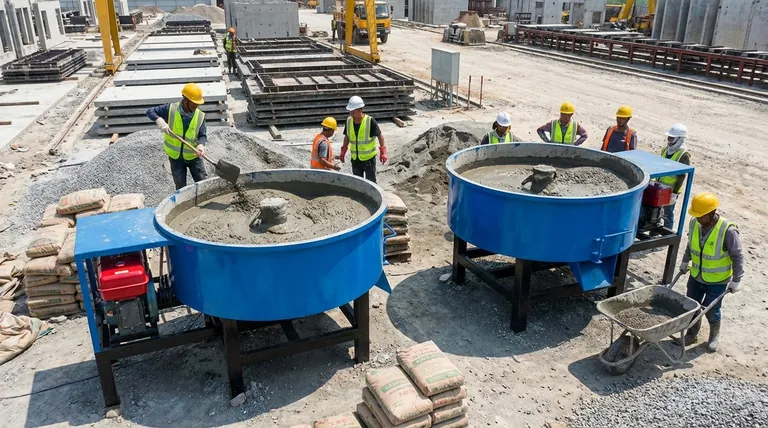
The Principle: Why Planetary Motion Excels
The effectiveness of a planetary mixer stems directly from its unique mixing action, which is fundamentally different from simpler drum or pan mixers.
Complete Vessel Coverage
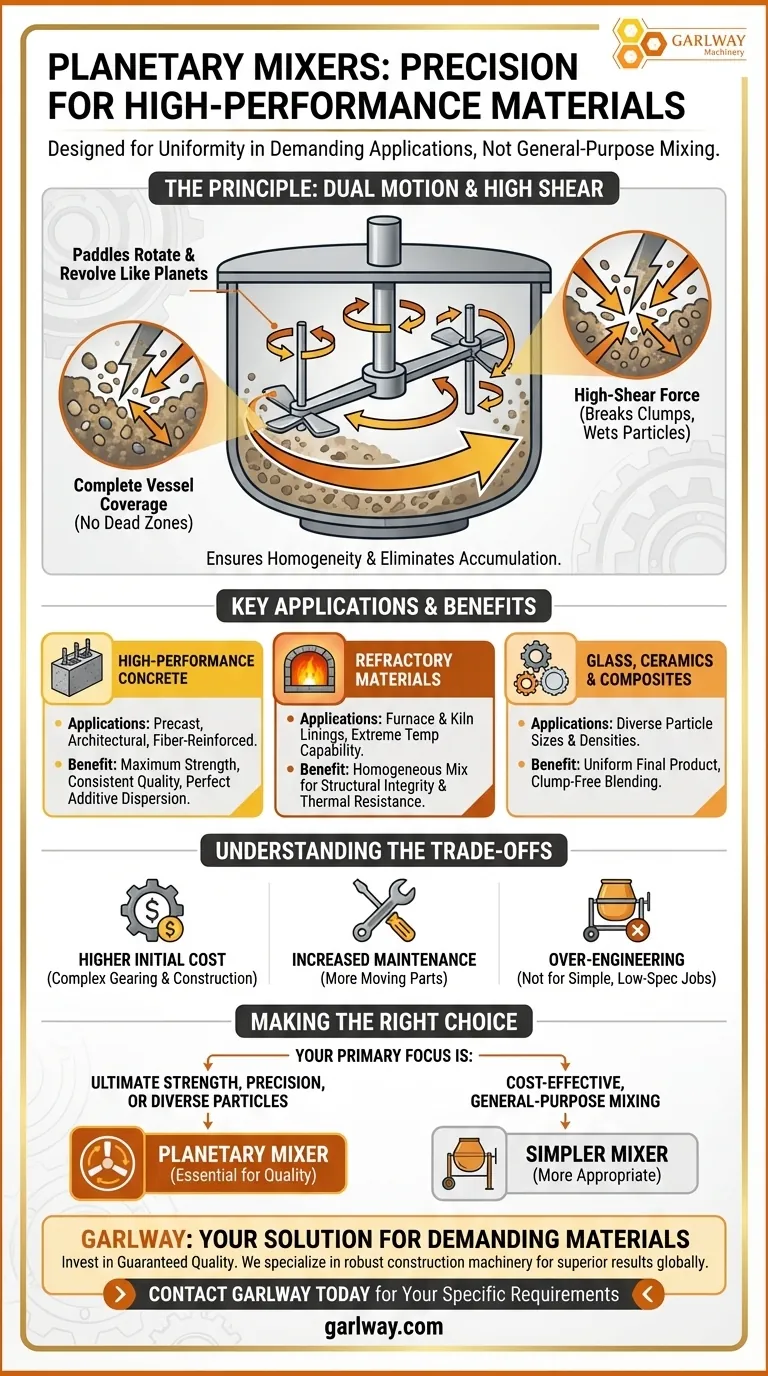
The term "planetary" describes how the mixing paddles operate. One or more paddles rotate on their own axes while also revolving around a central point in the mixing vessel, much like planets orbiting the sun.
This dual motion ensures the paddles sweep across the entire floor and walls of the vessel, eliminating the dead zones where unmixed material can accumulate.
High-Shear Force for Homogeneity
The counter-rotating movement of the paddles against the flow of material creates a powerful high-shear action.
This force is critical for breaking down clumps, thoroughly wetting every particle, and evenly distributing additives, pigments, or fibers throughout the mix.
Key Materials and Applications
The demanding nature of the planetary mixing process makes it ideal for specific, high-stakes industrial materials.
High-Performance Concrete
For applications like precast concrete elements, architectural panels, or fiber-reinforced concrete, simple mixing is insufficient.
A planetary mixer ensures every grain of sand and piece of aggregate is coated in cement paste and that any additives are perfectly dispersed, resulting in maximum strength and consistent quality.
Refractory Materials
Refractories are materials engineered to withstand extreme temperatures, used in applications like lining furnaces and kilns.
Their performance is critically dependent on a precise and homogeneous mixture of different particle sizes. A planetary mixer guarantees this consistency, which is essential for the material's structural integrity and thermal resistance.
Other Demanding Mixes
The principles of complete coverage and high shear make these mixers versatile for other industrial needs. This includes mixing glass, ceramics, and other materials with varying particle sizes and densities that require a perfectly uniform final product.
Understanding the Trade-offs
While powerful, a planetary mixer is not the right choice for every situation. Its specialized design comes with specific considerations.
Higher Initial Cost
The complex gearing and robust construction required for the planetary motion make these mixers significantly more expensive than standard drum or pan mixers.
Increased Maintenance Complexity
The sophisticated drive system involves more moving parts, which can lead to higher maintenance requirements and costs over the life of the equipment compared to simpler designs.
Over-Engineering for Simple Jobs
For standard, low-specification concrete pours where absolute uniformity is not the primary concern, the precision of a planetary mixer is unnecessary. A more basic mixer is often a more cost-effective solution.
Making the Right Choice for Your Material
Your decision should be based on the required quality and performance of the final product, not just the material itself.
- If your primary focus is ultimate strength and precision: A planetary mixer is essential for high-performance concrete, refractories, or any composite where consistency is paramount.
- If your primary focus is handling diverse particle sizes: The high-shear action is ideal for ensuring materials with different densities and shapes are blended into a truly homogeneous mixture.
- If your primary focus is cost-effective, general-purpose mixing: A simpler and more economical drum or pan mixer is likely the more appropriate tool for the job.
Ultimately, choosing a planetary mixer is an investment in guaranteed quality for your most demanding applications.
Summary Table:
| Material Type | Key Challenge | How Planetary Mixer Helps |
|---|---|---|
| High-Performance Concrete | Achieving maximum strength and consistency | Ensures every particle is coated for uniform quality |
| Refractory Materials | Withstanding extreme temperatures | Creates a perfectly homogeneous mix for structural integrity |
| Glass, Ceramics & Composites | Blending diverse particle sizes and densities | High-shear action breaks down clumps for a uniform final product |
Need a Mixer for Your Most Demanding Materials?
If your projects involve high-performance concrete, refractories, or other composites where inconsistent mixing is not an option, a GARLWAY planetary mixer is your solution. We specialize in providing robust construction machinery, including concrete mixers and batching plants, to help construction companies and contractors globally achieve superior results and guaranteed quality.
Contact GARLWAY today to discuss your specific mixing requirements and find the perfect equipment for your needs.
Visual Guide
Related Products
- JS1000 Volumetric Concrete Mortar Mixer for Sale Skid Steer Cement Mixer
- Portable Ready Mix Concrete Mixer Equipment
- Portable Cement Mixer with Lift Concrete Machine
- Portable Concrete Mixer Machine Equipment for Mixing Concrete
- Harbor Freight JS1500 On Site Concrete Mixing Volumetric Cement Mixer
People Also Ask
- What is the basic working principle of volumetric concrete mixers? On-Demand Mixing for Zero Waste
- What are the advantages of using volumetric mixers for small concrete jobs? Save Costs and Gain On-Site Control
- What are the advantages of volumetric concrete mixers compared to drum mixers? Achieve On-Demand Mixing & Zero Waste
- What are some innovations in volumetric concrete mixers? Boost Efficiency with On-Demand Production
- Why do volumetric mixers provide better ROI? Maximize Profit with On-Demand Concrete Production


