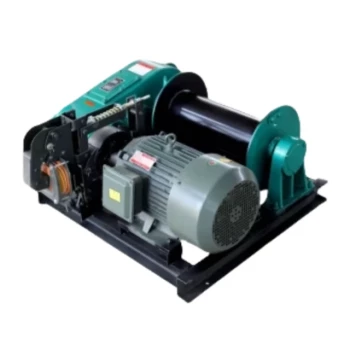
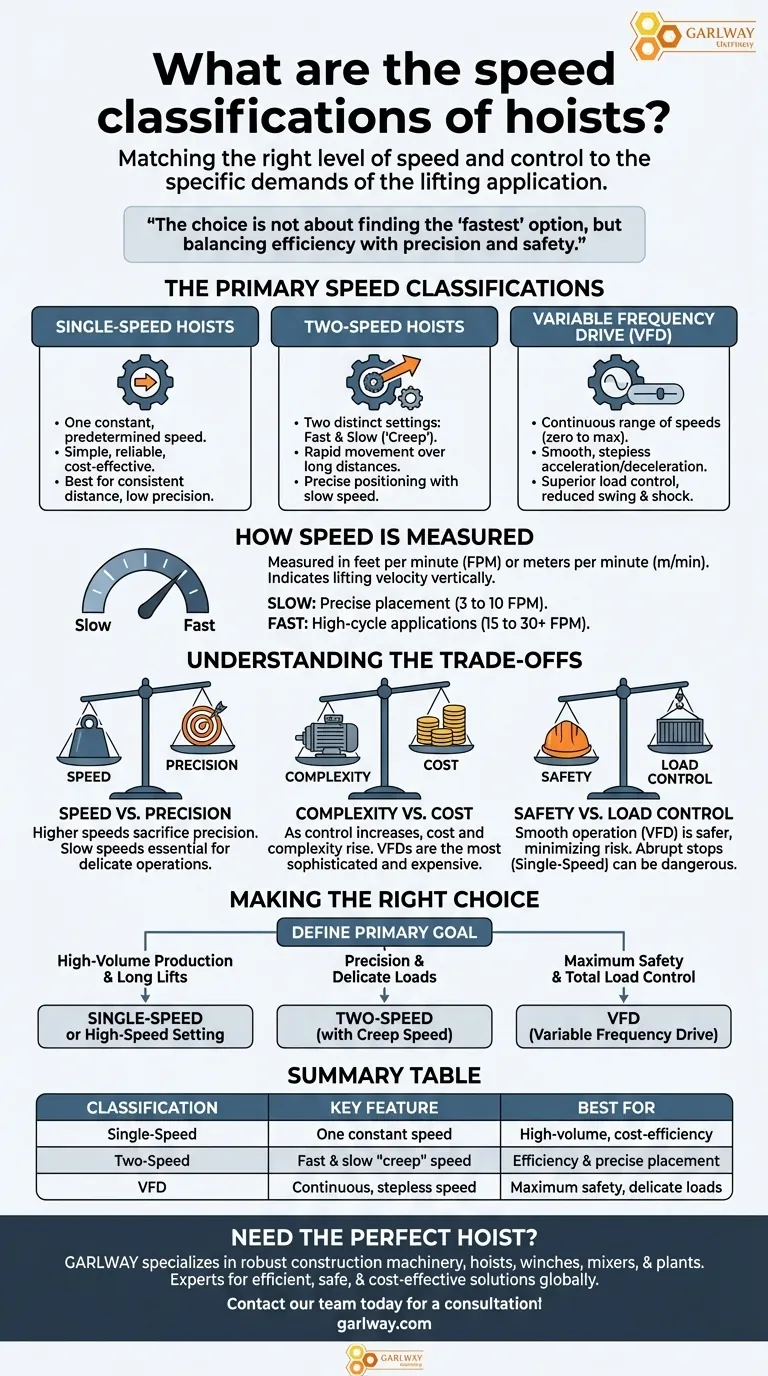
At its most basic level, hoists are classified by speed into two general categories: fast and slow. However, in practice, the industry uses more precise classifications that define how that speed is controlled: single-speed, two-speed, and variable frequency drive (VFD).
The choice between hoist speeds is not about finding the "fastest" option, but about matching the right level of speed and control to the specific demands of the lifting application, balancing efficiency with precision and safety.
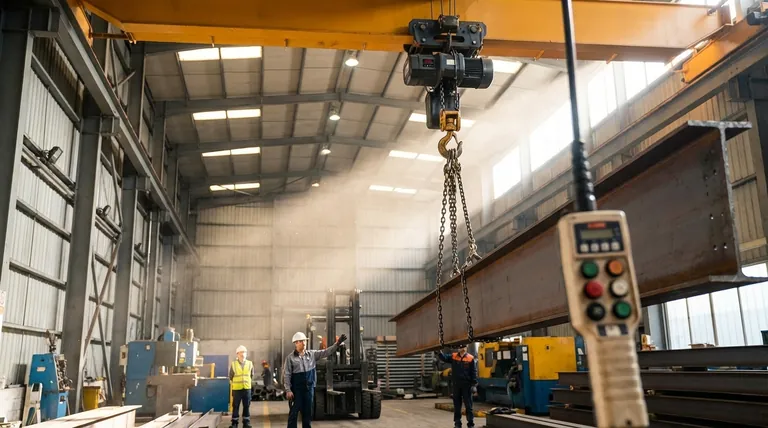
The Primary Speed Classifications Explained
Understanding the functional differences between speed control systems is the key to selecting the right equipment. Each type offers a distinct level of control over the load.
Single-Speed Hoists
A single-speed hoist operates at one constant, predetermined speed for both lifting and lowering. There is no option to adjust the velocity during operation.
These hoists are simple, reliable, and cost-effective. They are best suited for applications where the load is moved over a consistent distance and precision placement is not the primary concern.
Two-Speed Hoists
A two-speed hoist provides the operator with two distinct speed settings: one fast and one slow. The slow speed, often called the "creep speed," is typically a fraction of the fast speed (e.g., a 4:1 ratio).
This dual functionality allows for rapid movement over long vertical distances using the high speed, followed by a switch to the slow speed for careful, precise positioning of the load at the beginning or end of the lift.
Variable Frequency Drive (VFD) Hoists
Hoists equipped with a Variable Frequency Drive (VFD) offer the most advanced speed control. A VFD allows for a continuous range of speeds, from zero to the maximum rated speed.
This technology enables smooth, stepless acceleration and deceleration. The result is superior load control, reduced load swing, and minimized mechanical shock on the hoist and its supporting structure.
How Speed is Measured and Defined
The terms "fast" and "slow" are relative. Their meaning depends on the context of the hoist's capacity and intended use.
Understanding Lifting Speed (FPM/MPM)
Hoist speed is measured in feet per minute (FPM) or meters per minute (m/min). This value indicates how quickly the hoist can lift a load vertically.
For example, a hoist with a speed of 16 FPM will lift a load 16 feet in one minute.
What Determines "Fast" vs. "Slow"?
A "slow" speed is generally one that allows for very precise and careful load placement. This might be in the range of 3 to 10 FPM.
A "fast" speed is designed for efficiency and high-cycle applications, often ranging from 15 to 30 FPM or higher, depending on the hoist's capacity and design.
Understanding the Trade-offs
Choosing a hoist speed involves balancing performance goals with operational realities. Each system comes with its own set of advantages and limitations.
Speed vs. Precision
This is the most critical trade-off. Higher speeds sacrifice precision. A fast, single-speed hoist makes it very difficult to accurately position a load without jogging the controls, which can cause load swing and shock. Slow "creep" speeds are essential for delicate operations.
Complexity and Cost
As control increases, so do cost and complexity. Single-speed hoists are the simplest and most economical. Two-speed hoists add a more complex motor and controls, increasing the price. VFDs are the most expensive option due to the sophisticated electronic drive system.
Safety and Load Control
Smooth operation is safer operation. The abrupt starts and stops of a single-speed hoist can be dangerous when handling fragile or hazardous materials. The smooth acceleration of a VFD provides the highest level of load control and safety, minimizing the risk of accidents.
Making the Right Choice for Your Application
To select the correct hoist, first define the primary goal of your lifting task.
- If your primary focus is high-volume production and long lifts: A single-speed or the high-speed setting on a two-speed hoist provides the necessary efficiency.
- If your primary focus is precision and handling delicate loads: A two-speed hoist is the minimum requirement, as its "creep speed" is essential for careful placement.
- If your primary focus is maximum safety and total load control: A VFD-equipped hoist is the definitive choice for its smooth, stepless operation that protects the load and equipment.
Ultimately, matching the hoist's capabilities to the job's demands ensures an efficient, safe, and cost-effective lifting solution.
Summary Table:
| Classification | Key Feature | Best For |
|---|---|---|
| Single-Speed | One constant speed for lifting/lowering | High-volume production, long lifts, cost-efficiency |
| Two-Speed | Fast speed & slow "creep" speed | Applications requiring both efficiency and precise placement |
| VFD (Variable Frequency Drive) | Continuous, stepless speed control | Maximum safety, delicate loads, total control |
Need a hoist that perfectly matches your application's speed, precision, and safety requirements?
At GARLWAY, we specialize in providing robust construction machinery, including a wide range of hoists, winches, concrete mixers, and batching plants. Our experts can help you select the ideal equipment—whether you're a construction company or a contractor—to ensure an efficient, safe, and cost-effective lifting solution for your projects globally.
Contact our team today for a personalized consultation and quote!
Visual Guide
Related Products
- Hydraulic Winding Engine Harbor Freight Winch
- Electric and Hydraulic Winch for Heavy Duty Applications
- Electric Hoist Winch Boat Anchor Windlass for Marine Applications
People Also Ask
- What role does hydraulic fluid play in hydraulic winches? It's the Lifeblood of Your Heavy-Duty Pulling Power
- What vehicles commonly use hydraulic winches? For Industrial Trucks Needing Unmatched Power
- What are the features of hydraulic winches? Unmatched Power and Continuous Duty for Heavy Loads
- What preventive measures can be taken to avoid oil leakage in hydraulic winches? Ensure Long-Term Reliability
- What does 'power out' mean in a hydraulic winch? Achieve Absolute Control When Lowering Heavy Loads